
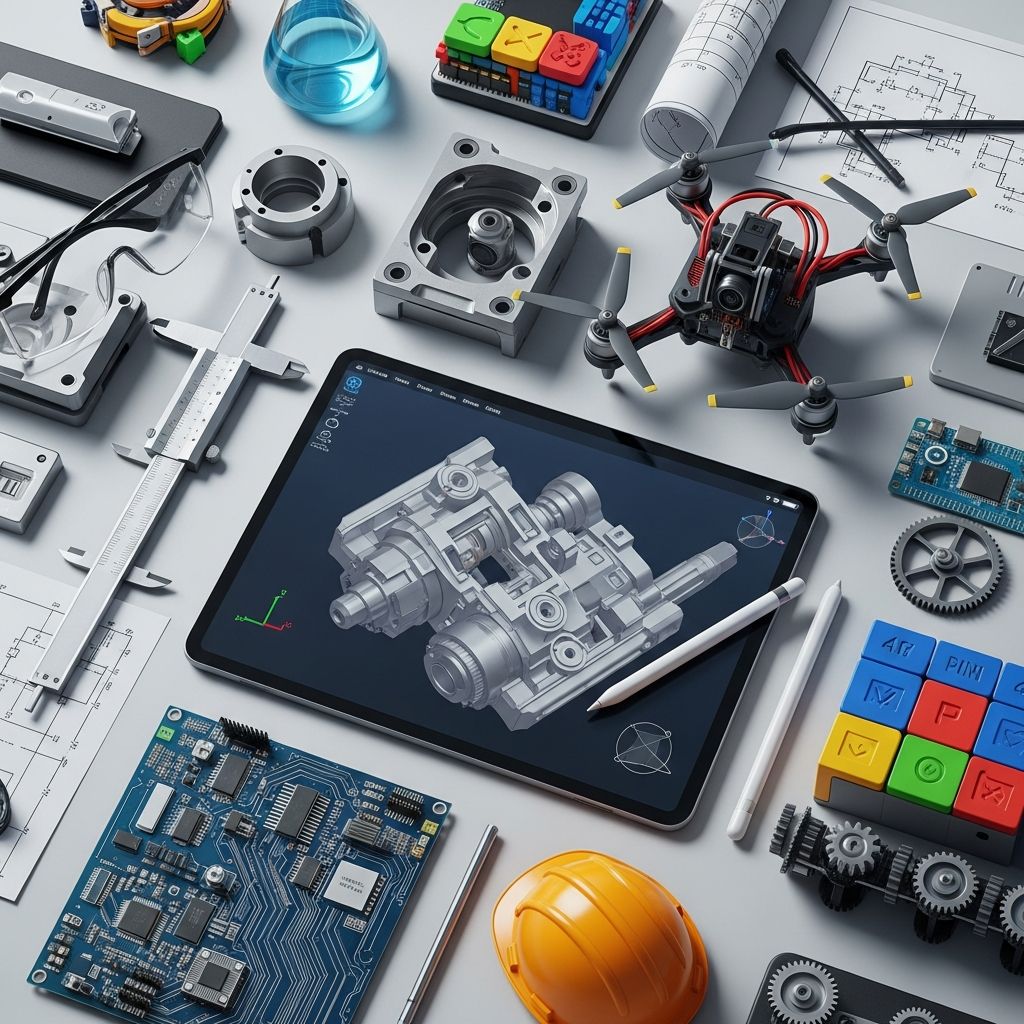
The engineering profession stands at a critical inflection point. As industries embrace digital transformation, sustainability demands, and increasingly complex infrastructure challenges, the technical skill set required of engineers has expanded dramatically. Beyond traditional mathematics and design capabilities, today’s engineers must navigate artificial intelligence applications, manage data uncertainty, and communicate across multidisciplinary teams. Understanding which competencies matter most—and how to develop them—has become essential for career advancement and meaningful contribution to real-world challenges.
Foundational Competencies That Define Engineering Excellence
Every engineering discipline rests upon a bedrock of core abilities that transcend specialization. These foundational skills form the platform upon which specialized technical knowledge builds, and their mastery distinguishes competent practitioners from exceptional ones.
Analytical and Problem-Solving Capabilities
At the heart of engineering practice lies the capacity to deconstruct complex problems into manageable components and synthesize solutions that account for multiple competing constraints. This encompasses far more than mathematical computation; it requires engineers to weigh trade-offs between cost, safety, sustainability, and performance while remaining adaptable as circumstances change.
Problem-solving in engineering contexts manifests differently across disciplines. Civil engineers designing infrastructure must balance structural integrity with budget constraints and environmental impact. Chemical engineers optimize production processes while minimizing waste and maintaining regulatory compliance. Electrical engineers troubleshoot grid failures while integrating renewable energy sources. Each domain requires engineers to think critically about how theory translates to implementation, where assumptions may fail, and how to validate solutions before deployment.
Employers consistently identify analytical thinking as the single most valuable professional skill, appearing across virtually every engineering role. The ability to assess situations from multiple perspectives, identify root causes of failures, and evaluate alternative approaches separates engineers who solve problems from those who truly innovate.
Mathematical Foundations and Computational Literacy
Mathematics remains the foundational language of engineering, enabling engineers to model systems, predict behavior, and verify designs before physical implementation. However, contemporary engineering extends mathematical competency beyond hand calculations to computational methods and simulation environments.
Modern engineers must understand not only mathematical principles but also how to leverage computational tools to explore design spaces, conduct sensitivity analyses, and validate assumptions. This bridges traditional mathematical rigor with practical engineering workflow, where simulation software often substitutes for expensive physical prototyping.
Software Proficiency and Digital Tools
The digital transformation of engineering practice has made software competency non-negotiable. The specific tools vary by discipline, but proficiency with current platforms directly impacts hiring decisions and career trajectory.
Computer-Aided Design and Visualization
CAD software has become ubiquitous across engineering disciplines, serving as the primary medium through which designs are conceptualized, communicated, and refined. Employers consistently rank CAD proficiency among the top technical skills, particularly for entry-level positions. However, CAD competency extends beyond button-clicking; it requires understanding how to model geometries accurately, organize complex assemblies, and produce documentation that manufacturing or construction teams can execute reliably.
Beyond traditional 2D drafting, modern engineers increasingly work with 3D parametric modeling, which enables rapid iteration, automatic updates across related components, and simulation integration. The ability to visualize designs spatially and communicate intent through visual media has become critical for interdisciplinary collaboration, where team members may lack specialized design training.
Visualization skills extend beyond CAD to encompassing broader data presentation capabilities. Engineers must convey complex technical concepts to stakeholders ranging from fellow engineers to regulatory bodies to general publics. This requires proficiency with tools for creating clear technical drawings, diagrams, charts, and presentations that distill complexity into comprehensible formats.
Specialized Analysis and Simulation Software
Most engineering disciplines rely on specialized software for analysis that would be impossible or impractical to perform manually. Civil engineers use structural analysis and GIS tools to model building behavior under loads and plan infrastructure efficiently. Chemical engineers employ process simulation software to optimize manufacturing conditions before implementation. Electrical engineers utilize circuit simulation and power flow analysis software to design reliable systems. Industrial engineers leverage workflow modeling and data analytics platforms to identify inefficiencies.
Competency with these tools requires understanding not only how to operate software interfaces but also the underlying principles governing the simulations. Engineers must recognize when results are valid, identify potential sources of error, and validate computational predictions against real-world behavior or laboratory testing.
Office and Productivity Software
Despite the specialized nature of engineering work, basic proficiency with office productivity tools remains essential. Engineers spend significant time preparing documentation, managing schedules, analyzing data, and communicating findings. Competency with spreadsheet applications, word processors, and presentation software enables engineers to work efficiently and present their analysis persuasively.
Contemporary Technical Challenges and Emerging Competencies
Beyond traditional skill sets, several emerging technical areas are reshaping how engineering work is performed and what capabilities employers prioritize.
Artificial Intelligence and Machine Learning Integration
Artificial intelligence represents perhaps the most significant technical shift in engineering practice, with applications spanning design optimization, predictive maintenance, autonomous systems, and complex problem-solving. Leading engineering organizations have identified AI integration as a critical capability gap requiring curriculum reform and professional development.
For engineers, AI competency encompasses multiple layers. At the foundational level, engineers must understand how machine learning algorithms function, recognize their applicability to engineering challenges, and critically evaluate their reliability. More advanced practitioners develop skills in training models, validating predictions, and ensuring AI systems meet safety and ethical requirements.
The challenge extends beyond technical implementation to encompassing ethical considerations. Engineers must understand potential biases in training data, verify that AI systems perform reliably across diverse conditions, and ensure that algorithmic decision-making aligns with human values and regulatory requirements.
Navigating Uncertainty and Risk Management
Engineering education traditionally emphasized design within well-defined parameters, but real-world practice increasingly requires managing uncertainty. Parameters vary, models have limitations, extreme events occur, and perfect information rarely exists. Contemporary engineers must develop frameworks for working with incomplete data, identifying critical uncertainties, and designing safety margins appropriately.
This competency requires understanding probability and statistics, recognizing when models break down, and communicating uncertainty honestly to decision-makers. Engineers must move beyond point estimates to characterizing the range of plausible outcomes and explaining the confidence warranted by available evidence.
Sensor Technology and Data Verification
As infrastructure becomes increasingly instrumented and monitoring systems proliferate, engineers must understand sensor technologies, data quality issues, and validation approaches. This encompasses recognizing sensor limitations, identifying spurious readings, evaluating measurement reliability, and integrating diverse data sources coherently.
Automation and Control Systems
Automation capabilities span from manufacturing facilities to smart cities, and engineers who can design and implement automated systems provide substantial value through labor cost reduction, efficiency improvements, and safety enhancement. This requires competency in control systems, telemetry, sensor design, systems integration, and increasingly, AI-driven automation platforms.
Design Philosophy and User-Centered Approaches
Modern engineering extends beyond purely technical optimization to encompassing broader considerations of accessibility, inclusivity, and user experience. These considerations require engineers to think beyond traditional performance specifications to understanding how designs impact diverse populations.
User-centered and universal design principles emphasize creating solutions that work effectively for the widest possible range of people, including those with disabilities or limitations. This requires expanding traditional design tools and training, encouraging cross-disciplinary collaboration beyond engineering, and embedding accessibility considerations throughout the design process rather than treating them as afterthoughts.
Structural Analysis and Design Verification
Across engineering disciplines, the ability to assess structural integrity and performance under expected and extreme conditions remains fundamental. This encompasses manual calculations for straightforward cases and sophisticated finite element analysis for complex geometries and loading conditions.
Structural analysis competency includes understanding failure modes, stress concentrations, material properties, and the difference between theoretical predictions and actual behavior. Engineers must perform quality verification to ensure designs meet safety requirements before implementation, recognizing where conservative assumptions are warranted and where more precise analysis may reduce unnecessary material consumption and cost.
Project Management and Coordinating Complex Work
As engineering projects grow in scope and complexity, project management capabilities distinguish individual contributors from leaders who multiply the effectiveness of entire teams. This encompasses timeline management, budget oversight, resource allocation, and risk mitigation across diverse projects.
Project management skills vary by context. Civil engineers manage construction timelines and contractor coordination. Chemical engineers oversee safety protocols and production schedules. Electrical engineers lead renewable energy system integration. Industrial engineers implement organization-wide process improvements. Mechanical engineers guide prototype development into manufacturing.
Beyond executing projects on schedule and budget, effective project managers identify risks early, escalate issues appropriately, and make trade-off decisions that balance competing objectives. Formal training through project management certifications and tools like Microsoft Project or Primavera can enhance these capabilities.
Professional Certification and Credential Pathways
Many engineering roles require or strongly prefer specific professional credentials that validate competency. The Professional Engineer (PE) certification establishes that engineers possess the knowledge, experience, and ethical standards to design, construct, and maintain structures in compliance with governmental regulations. Beyond the PE credential, specialized certifications in project management, emerging technologies, and specific software platforms can enhance career opportunities.
Communication and Collaborative Effectiveness
While technical mastery forms the foundation of engineering competency, the ability to communicate effectively and collaborate across disciplines increasingly determines career success. Engineers must articulate complex technical concepts clearly to diverse audiences, from specialized engineers to non-technical stakeholders to regulatory bodies.
Effective communication encompasses multiple modalities: written technical documentation, oral presentations, visual representations, and collaborative problem-solving conversations. Engineers must adapt complexity levels based on audience expertise, highlight relevant information, and justify design decisions convincingly.
Teamwork fundamentals include defining shared objectives, clarifying responsibilities, resolving conflicts constructively, and leveraging diverse perspectives to improve outcomes. Research indicates that strong team cohesion enables members to sustain focus and commitment significantly longer than individuals working independently, directly translating to improved project outcomes.
Developing and Maintaining Technical Competence
Engineering practice evolves continuously as new tools, methods, and challenges emerge. Professional growth requires ongoing learning throughout careers, whether through formal coursework, professional conferences, hands-on project experience, or self-directed study.
The most effective learning often occurs through applied challenges where engineers stretch beyond current competencies while receiving feedback and guidance. Early-career engineers benefit substantially from mentorship, exposure to diverse projects, and deliberate practice in areas targeted for growth.
Staying current requires engineers to periodically reassess their skill portfolios, identify gaps relevant to career aspirations, and invest in capabilities aligned with industry evolution and personal interests.
References
- The Top 5 Technical Skills Civil Engineers Need — American Society of Civil Engineers (ASCE). 2025-09-04. https://www.asce.org/publications-and-news/civil-engineering-source/article/2025/09/04/the-top-5-technical-skills-civil-engineers-need
- Top 5 Skills Engineering Students Need Before Graduation — New Mexico State University Global Campus. https://global.nmsu.edu/blog/engineering-and-it/skills-for-engineering-students/
- Your Ultimate Guide to Key Engineering Skills in 2026 — Randstad USA. https://www.randstadusa.com/job-seeker/skills/top-skills-engineering-2026/
- 12 Essential Engineering Skills for Your Resume — Indeed.com. https://www.indeed.com/career-advice/resumes-cover-letters/essential-engineering-skills
- 10 Essential Engineering Skills You Can Learn Before University — University of Brighton. https://www.brighton.ac.uk/studying-here/subject-areas/architecture-technology-engineering/engineering/10-essential-engineering-skills-you-can-learn-before-university.aspx
- So You Want to Be an Engineer? Learn the Skills That Matter — Interesting Engineering. https://interestingengineering.com/culture/engineer-technical-soft-skills

- Integrated M.A. in Applied Linguistics, University of Hyderabad
- 5+ years in editorial, instructional, SEO, and research-based writing
Sneha is a relationships and lifestyle writer with a strong foundation in applied linguistics and certified training in relationship coaching. She brings over five years of writing experience to theskillvault, crafting thoughtful, research-driven content that empowers readers to build healthier relationships, boost emotional well-being, and embrace holistic living. Her writing and insights reflect the belief that beauty, happiness, and wellness…