
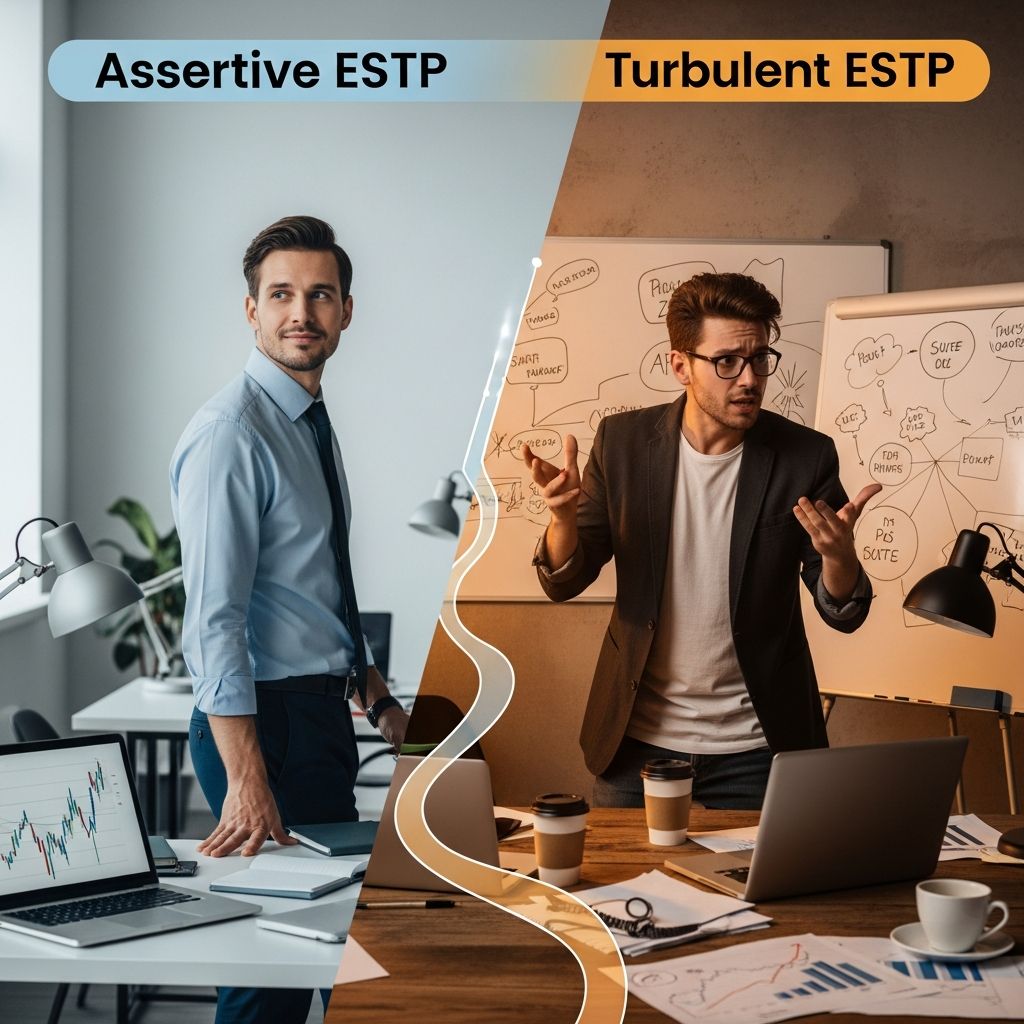
The ESTP Entrepreneur personality is known for energy, practicality, and a love of action. People with this type are Extraverted, Observant, Thinking, and Prospecting, and they typically thrive in fast-paced, hands-on environments where decisions must be made quickly and results are visible in real time. Within this type, however, there are two distinct identity variants: Assertive ESTP (ESTP-A) and Turbulent ESTP (ESTP-T). Both share core ESTP traits, but they differ in how they handle confidence, stress, criticism, and long-term direction.
This article explores those differences in depth and offers practical ideas for growth, whether you recognize yourself as more Assertive, more Turbulent, or somewhere in between.
What Makes Someone an ESTP Entrepreneur?
Before examining the Assertive and Turbulent identities, it helps to understand the foundation of the ESTP type itself.
- Extraverted (E): Energized by people and outer activity; often sociable and expressive.
- Observant (S): Focused on concrete reality and current details rather than abstract theories.
- Thinking (T): Tends to rely on logic and objectivity over personal feelings in decisions.
- Prospecting (P): Prefers flexibility, options, and spontaneity over strict plans.
Studies of personality suggest that ESTPs are especially drawn to action, quick problem-solving, and real-world effectiveness. Their typical strengths include:
- Fast, pragmatic decision-making in concrete situations.
- Comfort with risk and uncertainty, especially in competitive contexts.
- Social confidence and the ability to persuade and engage others.
- Hands-on problem solving and crisis management.
However, as with any personality type, there is significant variability inside the ESTP group. That is where the Assertive vs. Turbulent identity dimension comes in.
The Identity Dimension: Assertive vs. Turbulent
In many trait-based models, an additional layer describes how stable, self-assured, or sensitive to stress a person tends to be. This can be expressed as:
- Assertive (A): More self-confident, emotionally stable, and resistant to external pressure.
- Turbulent (T): More self-critical, sensitive to evaluation, and reactive to stress.
Psychological research related to neuroticism and emotional stability points out that people who score lower on negative emotionality often report greater day-to-day calm and higher life satisfaction, while those who score higher are more reactive, but can also be highly motivated to improve.
Translating this into ESTP language, both Assertive and Turbulent Entrepreneurs love action and real-world challenges, but they diverge in how they experience pressure and how they interpret successes and failures.
Core Differences Between ESTP-A and ESTP-T
| Aspect | Assertive ESTP (ESTP-A) | Turbulent ESTP (ESTP-T) |
|---|---|---|
| Baseline confidence | Typically high; assumes things will work out | More variable; confidence rises and falls with outcomes |
| Response to stress | Stress is brushed off or minimized | Stress is felt strongly and can dominate thinking |
| Attitude toward mistakes | Moves on quickly, sometimes without reflection | Replays errors, sometimes to the point of rumination |
| Motivation style | Driven by challenge, autonomy, and excitement | Driven by improvement, validation, and avoiding failure |
| Long-term planning | Prefers staying flexible; may under-plan | Thinks more about consequences; may over-worry |
Confidence, Self-Image, and Risk
Assertive ESTP: Confident and Unfazed
Assertive ESTPs typically project an aura of unshakable self-belief. They often assume they can handle whatever comes, and they rarely allow doubts to slow them down. Because the ESTP type as a whole favors direct experience over lengthy analysis, Assertive ESTPs may push this tendency even further: acting first, adjusting later.
Distinctive features of ESTP-A confidence include:
- High tolerance for risk: They may enter new ventures with minimal hesitation.
- Quick ego recovery: Embarrassment or failure is shaken off rapidly.
- Self-trust: They rely on their instincts and track record instead of constant self-evaluation.
This approach can lead to impressive breakthroughs, especially in crisis or entrepreneurial environments where hesitation is costly. At the same time, the very confidence that propels them forward can make them underestimate downside risks or skip important safeguards.
Turbulent ESTP: Confident, But Often Self-Questioning
Turbulent ESTPs usually still come across as bold and energetic, but internally they are more likely to second-guess themselves. Their confidence is real, yet it is more conditional: closely tied to how well things are currently going.
- Heightened sensitivity to evaluation: Praise and criticism carry more weight.
- Performance-based self-worth: A win boosts their self-image dramatically; a loss can be felt as personally significant.
- Risk with more calculation: They may still act quickly, but are more inclined to ask “What if this fails?” than Assertive ESTPs.
Because they notice potential pitfalls more, Turbulent ESTPs sometimes develop better contingency thinking than their Assertive counterparts. However, if worry becomes excessive, it can block the decisive action that is a natural ESTP strength.
Handling Pressure, Setbacks, and Criticism
Stress Response Patterns
Personality research suggests that more emotionally reactive individuals are quicker to notice threats and may experience stronger physiological stress responses. For ESTPs, who already live at a fast pace, this emotional layer can dramatically change how they experience their adventurous lifestyle.
- ESTP-A under stress: They are likely to minimize the problem, joke through it, or double down on action to regain control.
- ESTP-T under stress: They are more likely to feel pressure intensely, replay conversations, and search for what they “should have done differently.”
Reactions to Feedback
Feedback is a powerful driver of learning, but people receive it differently:
- Assertive ESTPs may treat criticism as background noise unless it clearly affects their goals. They often prefer blunt, practical feedback and can appear indifferent to softer emotional cues.
- Turbulent ESTPs may analyze feedback deeply, trying to understand every nuance. They can use criticism to improve rapidly, but also risk interpreting neutral comments as negative.
Used well, both patterns can be assets: Assertive ESTPs avoid getting stuck in self-doubt, while Turbulent ESTPs can refine their skills continuously. Problems arise when Assertive types ignore useful warnings or when Turbulent types spiral into unnecessary self-blame.
Work, Leadership, and Career Pathways
ESTPs are often drawn to roles that reward fast thinking, social agility, and visible results, such as sales, emergency services, negotiations, operations management, and entrepreneurship. Identity differences shape how Assertive and Turbulent ESTPs experience these roles.
At Work: Assertive ESTP (ESTP-A)
At work, Assertive ESTPs tend to:
- Take charge naturally in chaotic or unclear situations.
- Prioritize action over consensus, especially when deadlines are tight.
- Show resilience after losses, quickly shifting to the next opportunity.
- Dislike micromanagement and rigid procedures; they want freedom to experiment.
They can be highly effective in roles like crisis response, trading, tactical leadership, and fast-growing startups, where courage and speed are prized. However, they may under-invest in long-term planning, documentation, or relationship repair if they feel those tasks slow them down.
At Work: Turbulent ESTP (ESTP-T)
Turbulent ESTPs often bring a more vigilant, improvement-oriented flavor to their careers. They may:
- Monitor performance metrics more closely, seeking evidence they are doing well.
- Rehearse and prepare a bit more than Assertive ESTPs before high-stakes meetings.
- Notice subtle client or team reactions and adjust their approach accordingly.
- Use dissatisfaction as fuel to refine processes or skills.
This can make them especially effective in roles where both speed and accurate reading of others are critical, such as negotiations, client-facing leadership, and performance-based sales. They may just need to guard against burnout by setting realistic standards and recognizing progress.
Relationships, Communication, and Conflict
Shared ESTP Relationship Tendencies
Across both identities, many ESTPs share relationship characteristics:
- Preference for shared experiences over long, abstract talk about feelings.
- Direct communication style, often honest to the point of bluntness.
- Love of novelty and spontaneous plans with partners and friends.
Assertive ESTP in Relationships
Assertive Entrepreneurs often bring a light, confident energy to relationships. They tend to believe things will work out and are less inclined to dwell on conflicts once they feel an issue is “handled.” This can feel refreshing to some partners, but may frustrate others if important emotional concerns seem brushed aside.
Helpful relationship habits for ESTP-A include:
- Pausing long enough to ask, “Did I really hear their concern, or did I just solve the surface problem?”
- Recognizing that a partner may need reassurance, not just a solution.
- Admitting mistakes occasionally, to show humility and build trust.
Turbulent ESTP in Relationships
Turbulent Entrepreneurs may experience relationships as more emotionally intense. They are often quick to pick up subtle shifts in tone or mood and may worry more about being misunderstood or rejected.
Growth areas for ESTP-T include:
- Checking interpretations: asking, “Is this what you meant?” instead of assuming the worst.
- Practicing self-compassion when they make relational errors.
- Balancing sensitivity with the directness that makes them natural ESTPs.
Personal Growth for Each Identity
Growth Suggestions for Assertive ESTP (ESTP-A)
- Integrate reflection into action: Short, regular check-ins (weekly or after major decisions) can improve accuracy without slowing them excessively.
- Invite honest feedback: Actively asking trusted people what they see can uncover blind spots that confidence might conceal.
- Plan for downside risk: Simple contingency plans protect against impulsive miscalculations, especially with finances or health.
- Practice emotional noticing: Paying attention to their own and others’ emotional states can prevent conflicts from being minimized or ignored.
Growth Suggestions for Turbulent ESTP (ESTP-T)
- Set realistic performance standards: Aim for consistent improvement, not perfection, especially in new roles.
- Use structured debriefs: After a setback, ask “What did I learn?” instead of “What’s wrong with me?”
- Limit rumination time: Scheduling a specific time to review mistakes, then intentionally moving on, can protect their natural decisiveness.
- Notice strengths as carefully as weaknesses: Keeping a simple record of wins helps calibrate their self-image.
Which One Is Better: ESTP-A or ESTP-T?
Neither identity is inherently superior. Research on personality traits such as extraversion and emotional stability indicates that different configurations can be advantageous in different environments. For example:
- High stability (similar to Assertive): May predict better coping under chronic stress and more consistent well-being.
- Moderate emotional sensitivity (similar to Turbulent): Can support careful preparation, empathy, and responsiveness to change.
In a fast-moving sales environment, an Assertive ESTP’s thick skin and quick rebound might shine. In a negotiation-heavy leadership role, a Turbulent ESTP’s attunement to subtle shifts and hunger to improve may be a key advantage.
Ultimately, the most effective path is owning your identity while borrowing useful strategies from the other side. An Assertive ESTP who learns to reflect can become more precise; a Turbulent ESTP who builds self-acceptance can become more confident without losing their edge.
Frequently Asked Questions (FAQs)
Q1: Can an ESTP switch between Assertive and Turbulent over time?
Identity traits such as emotional stability and self-confidence tend to be relatively stable, but they can shift somewhat through life experiences, mental health, and deliberate personal development. People might also show more Assertive behavior in domains where they feel skilled and more Turbulent behavior in areas where they feel insecure.
Q2: Do Assertive and Turbulent ESTPs have different career options?
They usually gravitate toward similar fields that reward fast action and real-world impact—such as business, emergency response, operations, or sales. The difference lies more in how they operate: Assertive ESTPs may thrive in high-risk, high-autonomy roles, while Turbulent ESTPs might excel where performance feedback and detailed client interaction are central.
Q3: Which identity handles relationships better, ESTP-A or ESTP-T?
Neither is automatically better. Assertive ESTPs may avoid drama and recover from conflict fast, but could accidentally overlook deeper emotional needs. Turbulent ESTPs may be more emotionally responsive and attentive, but risk overinterpreting small signals. Healthy communication habits matter far more than the specific identity.
Q4: How can I tell if I am more Assertive or Turbulent as an ESTP?
Ask yourself how you typically react to setbacks and criticism: Do you usually shrug them off quickly (more Assertive), or do you replay them and feel driven to fix every flaw (more Turbulent)? Consider also how strongly your mood depends on external success and how often you find yourself worrying about what others think.
Q5: Can understanding my ESTP identity improve my mental health?
Self-knowledge can support better coping strategies. Assertive ESTPs may benefit from acknowledging stress instead of always brushing it off, while Turbulent ESTPs can work on self-compassion and balanced thinking. Combining personality insights with evidence-based approaches such as cognitive-behavioral strategies or professional support can be especially helpful for emotional well-being.
References
- ESTP Personality Type: The Entrepreneur — Simply Psychology. 2023-02-10. https://www.simplypsychology.org/estp-personality.html
- ESTP Personality (Entrepreneur) — 16Personalities. (n.d.). https://www.16personalities.com/estp-personality
- ESTP “The Entrepreneur” Personality Type: Complete Guide — EarlyYears.tv. 2022-06-15. https://www.earlyyears.tv/estp-entrepreneur-personality-type-complete-guide/
- All About the ESTP Personality Type — Indeed Career Guide. 2022-08-09. https://www.indeed.com/career-advice/finding-a-job/estp-personality
- What to Know About the Entrepreneur Personality — Robert F. Smith. 2023-03-20. https://robertsmith.com/blog/entrepreneur-personality/

- Integrated M.A. in Applied Linguistics, University of Hyderabad
- 5+ years in editorial, instructional, SEO, and research-based writing
Sneha is a relationships and lifestyle writer with a strong foundation in applied linguistics and certified training in relationship coaching. She brings over five years of writing experience to theskillvault, crafting thoughtful, research-driven content that empowers readers to build healthier relationships, boost emotional well-being, and embrace holistic living. Her writing and insights reflect the belief that beauty, happiness, and wellness…