
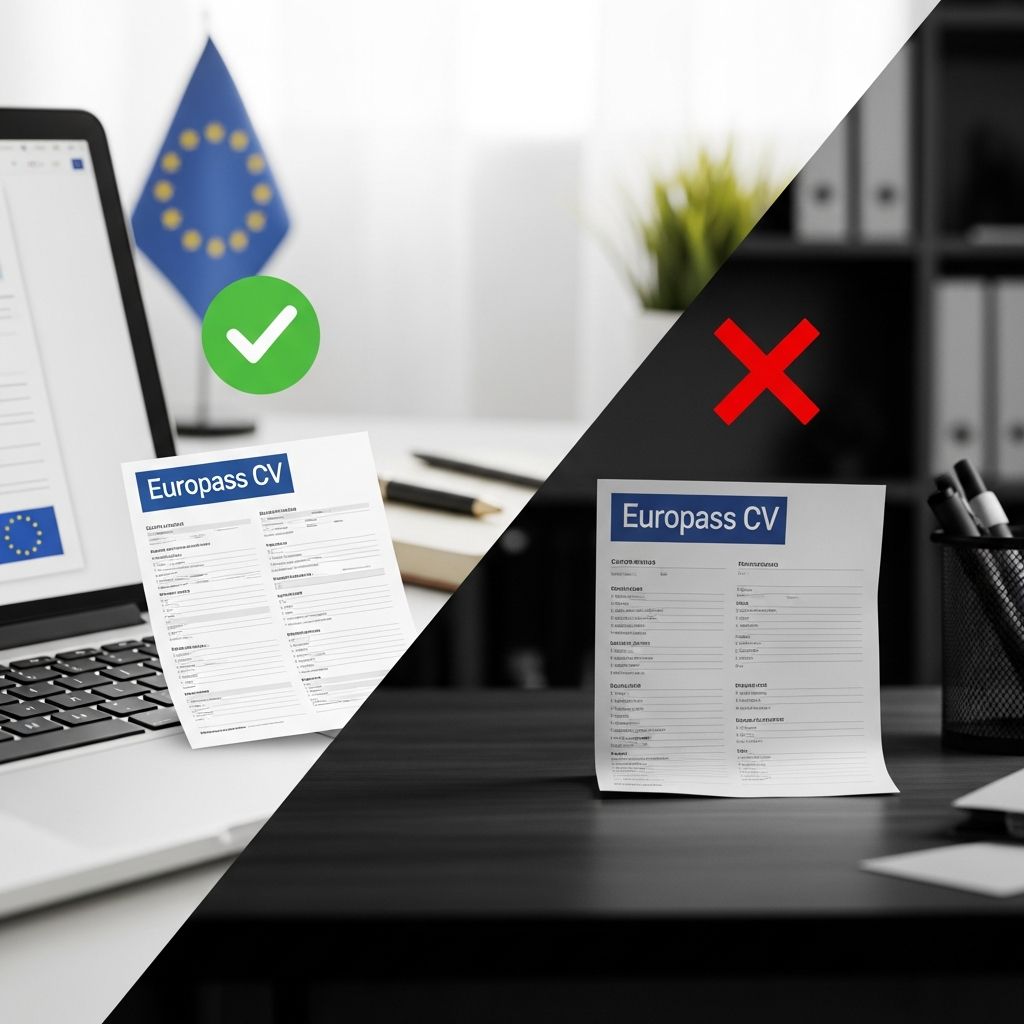
The Europass CV is one of the most widely recognised resume formats in Europe, but that does not mean it is always the best choice for your career goals. Understanding how it works, what recruiters think of it, and where it fits in modern hiring will help you choose the right format with confidence.
What Exactly Is a Europass CV?
The Europass CV is a standardised curriculum vitae format promoted by the European Union to support transparency of skills and easier mobility across European countries. It uses a fixed structure and common descriptors so employers, schools and institutions can compare candidates more easily across borders. The CV is created and stored through the official Europass online tools, where you can also maintain a profile and generate multiple CV versions.
| Feature | Europass CV | Typical Modern CV |
|---|---|---|
| Main purpose | Standardise skills presentation across Europe | Market your value to a specific employer |
| Structure | Highly fixed, predefined sections | Flexible, tailored to role and seniority |
| Design | Basic, uniform layout | Varied layouts, branding and hierarchy |
| Ideal use | EU programmes, academic/government roles | Most private-sector and competitive roles |
How the Europass Ecosystem Works
Europass is more than a simple template. It is a digital toolbox created and maintained by the European Union.
- Europass profile: A secure online profile where you record your skills, work history, education and achievements in one place.
- CV and cover letter builder: Tools that pull information from your profile to generate ready-to-download documents.
- Job and course suggestions: Recommendations of roles and learning opportunities based on your recorded skills and interests.
- Mobility support: Additional documents like Europass Mobility help describe skills gained during time abroad in a clear, comparable way.
This system was designed to make European labour markets more integrated and to value skills and qualifications consistently, regardless of where someone studied or worked.
Strengths of the Europass CV Format
Although its popularity with some recruiters has declined, the Europass CV still offers several meaningful advantages in specific contexts.
1. High Recognition Across Europe
Employers, universities and public institutions across the EU know the Europass template and understand how to navigate it quickly. This familiarity can reduce friction, especially when a recruiter is screening large numbers of international applicants.
- Many European public-sector organisations and EU-funded programmes explicitly reference Europass in their application guidelines.
- The standard structure means hiring teams can find key details without learning a new layout for every application.
2. Built-in Multilingual Support
The official Europass tools allow you to create CVs in multiple European languages while maintaining consistent structure and terminology. This helps when applying to roles in countries where you are not fully comfortable writing professional documents from scratch in the local language.
- Key descriptors for skills and qualifications are harmonised, reducing misunderstandings between education systems.
- Language sections encourage you to describe proficiency in a comparable way across candidates.
3. Standardisation for Cross-Border Mobility
The format supports comparability of qualifications, an important goal for EU mobility policies. For example, employers can more easily interpret education levels from other countries when they are mapped to shared frameworks like the European Qualifications Framework.
- Standardisation helps institutions assess applicants from diverse systems on similar criteria.
- It is especially helpful in study-abroad programmes, early-career mobility schemes and structured traineeships.
4. Free and Accessible Tools
The entire Europass suite, including the CV builder, is free to use and funded by the European Union. This lowers barriers for candidates who may not have access to paid templates, design software or professional writing services.
- All data in a Europass profile is under the user’s control and only shared when they choose to.
- Updates to skills or experience can be applied across future CV versions very quickly.
Where the Europass CV Falls Short
Despite its strengths, the Europass CV has notable limitations when measured against the expectations of modern talent acquisition, especially in the private sector.
1. Limited Personal Branding
Because the layout is tightly standardised, all Europass CVs tend to look very similar. This is intentional for fairness and comparability, but it also means your application can struggle to stand out in competitive fields like technology, consulting, marketing or design.
- Modern hiring often favours concise, results-focused narratives and clear visual hierarchy, which the rigid structure does not always support.
- There is little room to experiment with layout, employer-focused summaries or industry-specific sections.
2. Risk of Information Overload
The default Europass approach encourages candidates to enter very detailed histories of work, training and personal skills. Without careful editing, this can lead to long, dense documents that make it harder for hiring managers to find the information that matters most for a specific vacancy.
- Recruiters typically scan CVs in seconds; overly long entries can reduce clarity rather than increase it.
- Key achievements may be buried among less relevant details because every role is described in the same way.
3. Not Always Aligned with Employer Expectations
While some EU institutions welcome the format, many private companies now prefer short, tailored CVs or resumes that focus tightly on the role at hand. These employers may view a generic Europass CV as a sign that the applicant has not fully customised their application.
- In fast-moving industries, recruiters often look for one or two pages highlighting quantifiable impact, not a comprehensive career record.
- Applicant tracking systems (ATS) vary widely; although Europass is structured, it is not automatically better-optimised for every ATS used by employers.
4. Less Suitable for Design-Driven or Creative Roles
Fields like UX/UI design, marketing, media and some areas of tech increasingly use the CV or resume as a subtle indicator of aesthetic sense and communication style. The intentionally conservative Europass design rarely showcases these qualities.
- Creative professionals often build custom layouts, interactive portfolios or visual resumes, which offer more scope than a uniform template.
- Some design-centric employers may perceive a standardised CV as lacking individuality, even if the candidate’s experience is strong.
When Using a Europass CV Makes Sense
Despite its drawbacks, there are situations where Europass remains an appropriate and even recommended choice.
- Applications to EU institutions or national public bodies that explicitly mention or recommend Europass in their application instructions.
- Academic exchanges, scholarships and mobility programmes focused on promoting cross-border study or training, where standardisation is important.
- Early-career job seekers or recent graduates who need a structured way to think through their skills and experiences for the first time.
- International candidates who are unsure what local CV standards look like and prefer a neutral, widely understood baseline.
- Situations requiring multiple language versions of the same CV, where keeping structure and terminology consistent is essential.
When You Are Better Off Avoiding It
There are also clear cases when another format will serve you better.
- Applying to competitive private-sector roles (startups, tech, consulting, marketing, finance) where employers expect concise, highly tailored resumes.
- Targeting design-heavy or brand-conscious industries, where visual impact and distinctive presentation are valued.
- Senior or executive applications, which often require a focused, strategic narrative and may use executive summaries, key achievements tables or board experience sections.
- Countries with strong local CV traditions outside the EU, where Europass is not widely used or recognised.
Adapting Europass Content into a Modern CV
If you already have a Europass CV, you can use it as a raw material source for a more targeted, modern resume. The key is to edit ruthlessly and reframe information around employer needs.
Prioritise Achievements Over Duties
Instead of listing every responsibility, highlight outcomes:
- Replace “responsible for managing a team” with “led a team of 6, improving project on-time delivery from 70% to 92% in one year.”
- Use numbers, timeframes and concrete results wherever possible to show the scale and impact of your work.
Reduce Length and Focus on Relevance
For most applications:
- Aim for 1 page if you have under 5–7 years of experience.
- Aim for 2 pages if you are more experienced and the role requires a deeper track record.
- Remove or shorten details that do not directly support your target role.
Reorganise Sections for Impact
You do not have to keep the order used in Europass. For many roles, a more effective structure is:
- Headline and brief professional summary
- Key skills and technical competencies
- Relevant work experience with quantified achievements
- Education and professional training
- Selected projects, publications or certifications (if relevant)
- Languages and additional information
Checklist: Choosing Between Europass and a Custom CV
Use the following quick checklist when deciding which format to submit:
- Does the employer or programme ask for Europass? If yes, use it or provide it as an additional document.
- Is the role in an EU institution, public authority or mobility scheme? Europass is often a safe and expected choice.
- Is this a private-sector role in a competitive field? Favour a concise, tailored CV designed for that specific industry.
- Do you need multiple language versions quickly? Europass can be a helpful starting point, but you may still refine the wording manually.
- Are you early in your career and unsure what to include? Build a Europass profile to collect information, then adapt it into a more focused CV.
Frequently Asked Questions About Europass CVs
Is the Europass CV still accepted by employers?
Yes, the Europass CV is still recognised by many employers and institutions across Europe, especially in public and academic contexts. However, it is not universally preferred, and many private companies expect more tailored formats.
Is Europass only for EU citizens?
No. Anyone can create a Europass profile and CV; the tools are open and free to all users. The system is simply optimised for mobility within the European labour and education markets.
Does using a Europass CV improve my chances of getting a job?
Europass can make your skills clearer and more comparable across borders, which may help in international or institutional processes. For private-sector roles, your chances depend more on relevance, clarity and results than on the specific template.
Can I customise the design of a Europass CV?
The official format offers limited visual customisation because standardisation and comparability are core goals. If you need strong personal branding or a unique layout, a custom CV outside the Europass system is usually better.
Should I send both a Europass CV and a regular CV?
Only send extra documents when they add value and are welcome. If an organisation mentions Europass specifically, you can provide that version and, where appropriate, attach a shorter tailored CV or portfolio for extra context.
References
- What is Europass? — European Union, European Education and Culture Executive Agency. 2023-06-15. https://europass.europa.eu/en/what-europass
- What is a Europass profile? — European Union, European Education and Culture Executive Agency. 2023-06-15. https://europass.europa.eu/en/what-europass-profile
- Europass Mobility — European Union, European Education and Culture Executive Agency. 2022-11-10. https://europass.europa.eu/en/work-europe/mobility
- Europass Curriculum Vitae (CV) — TrackTest. 2021-05-05. https://tracktest.eu/europass-curriculum-vitae/
- What You Need to Know About the Europass CV Format — MyCVCreator Blog. 2022-09-01. https://www.mycvcreator.com/blog/what-you-need-to-know-about-the-europass-cv-format

Medha Deb is an editor with a master's degree in Applied Linguistics from the University of Hyderabad. She believes that her qualification has helped her develop a deep understanding of language and its application in various contexts. Medha specializes in the areas of beauty, health, sports, and wellness and is committed to ensuring that the content on the website is…