
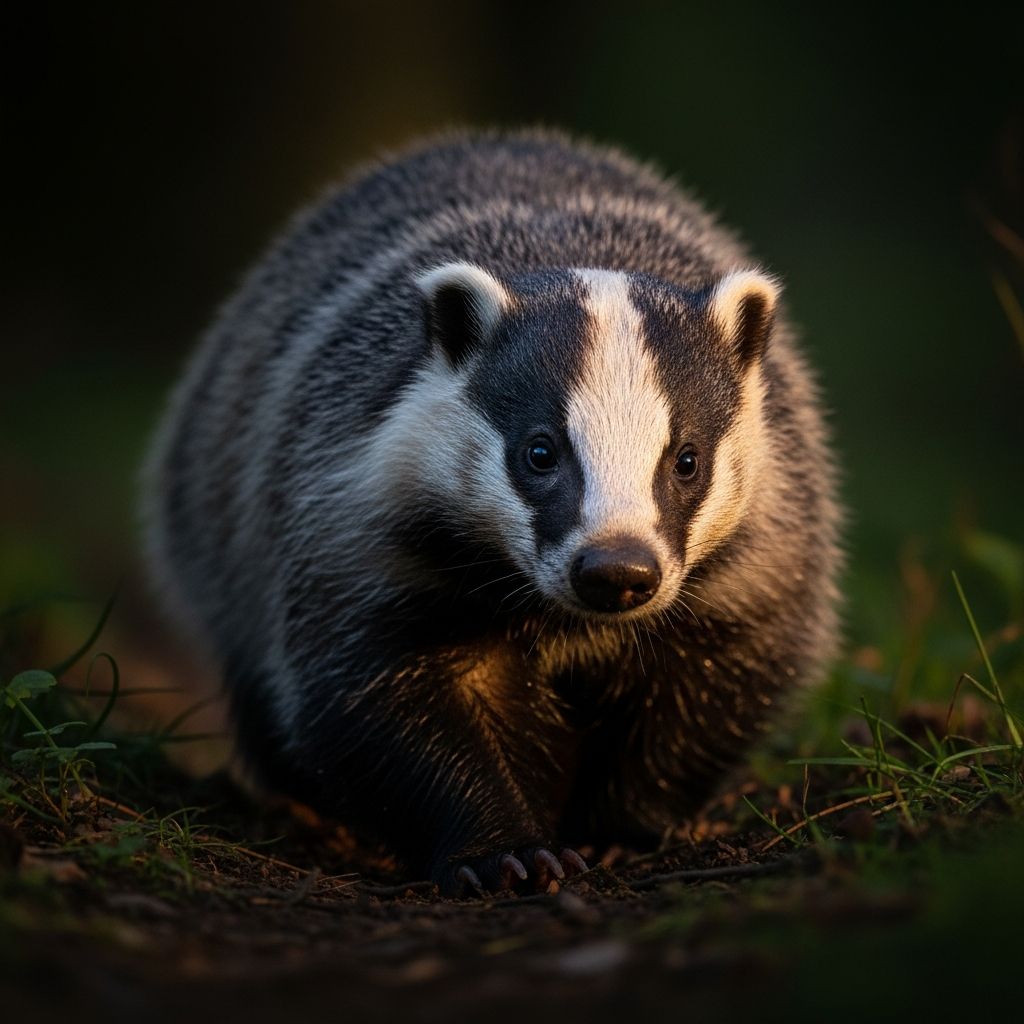
The **European badger** (*Meles meles*), a robust member of the Mustelidae family, thrives across vast Eurasian landscapes, embodying resilience and adaptability in wildlife. Known for its striking black-and-white facial stripes and exceptional digging abilities, this mammal plays key roles in ecosystems as a predator, forager, and soil aerator.
Physical Characteristics and Adaptations
European badgers possess a compact, powerful build suited for their subterranean lifestyle. Adults measure 70-100 cm in length, with short, sturdy legs ending in strong, non-retractable claws ideal for excavating soil. Their wedge-shaped bodies, covered in coarse fur blending grey, black, white, and brown, provide camouflage in varied terrains.
Weight fluctuates seasonally: spring averages 7-13 kg, peaking at 15-24 kg in autumn to sustain winter torpor. Males (boars) are typically larger than females (sows), with broader heads and thicker necks. The iconic facial pattern—white head with two bold black stripes extending from nose to ears—likely serves as a warning signal to predators. Small black eyes, a short tail, and naked foot pads complete their rugged form.
- Greyish back fur for woodland blending.
- Black legs and throat contrasting pale underbelly.
- Powerful forelimbs enabling deep burrowing.
Geographic Range and Habitat Preferences
Native to nearly all of Europe—from Ireland to the Caucasus—and western Asia, including parts of China and the Russian Arctic, the European badger boasts one of the widest mustelid distributions. Absent only in far northern Scandinavia, Mediterranean islands like Sicily, and some southern extremes, populations are densest in Britain, continental Europe, and Russia.
They inhabit diverse environments: deciduous and coniferous woodlands adjacent to open fields, grasslands, farmlands, scrublands, riverbanks, steppes, and even semi-deserts or mountains. Preferred sites offer short grasslands for worm-hunting near tree cover for setts. In Britain, over 560,000 individuals occupy setts, with densities doubling in recent decades. Urban adaptation is rising, with badgers foraging in parks and gardens.
| Region | Population Notes | Key Habitats |
|---|---|---|
| Britain | ~300,000-560,000; 77% growth 1980s-90s | Woodlands, pastures |
| Continental Europe | Increasing; abundant in Russia | Grasslands, farms |
| Asia | Extends to China, Caucasus | Steppes, mountains |
Social Structure and Sett Life
Unlike solitary mustelids, European badgers form complex clans of 2-24 adults plus cubs, larger in Britain than continental Europe. Setts—elaborate underground networks of tunnels, chambers, and levels—serve as homes, often reused for centuries and housing multiple generations. Main setts feature multiple entrances; outliers provide foraging satellites.
Social dynamics involve hierarchies, communal nursing, and scent-marking via latrines. Boars defend territories overlapping with neighbors, patrolled nocturnally. Cubs emerge in spring, play-fighting to hone skills. Lifespan averages 5 wild years, up to 15 in captivity.
Foraging Habits and Diet
Primarily nocturnal, badgers emerge post-dusk to forage using keen smell for earthworms (50-90% diet), supplemented by insects, small mammals (rabbits, rodents), birds, eggs, fruits, roots, cereals, and carrion. Omnivorous flexibility aids survival; they cache food minimally.
Digging prowess unearths prey, while broad diets prevent competition. In farmland, they consume pests but may raid crops. Daily intake supports fat reserves for winter, when activity dips but doesn’t fully hibernate.
- Worms and invertebrates: Primary protein source.
- Small vertebrates: Opportunistic hunting.
- Plant matter: Fruits, nuts in season.
Reproduction and Family Dynamics
Mating peaks in summer, with delayed implantation yielding cubs in February-April (1-5 per litter, average 2-3). Females breed after year one; males mature similarly. Communal care sees non-mothers lactating for cubs, boosting survival. Cubs stay in setts 8-12 weeks before surfacing, dispersing at 1 year.
High cub mortality from predators (foxes, wolves) and starvation underscores clan protection’s value.
Predators, Threats, and Human Interactions
Adults face few predators—lynxes, wolves, bears, eagles—but cubs are vulnerable. Human conflicts arise over bovine TB transmission (debated), crop damage, and roadkill. Culling occurs in parts of Britain, though populations remain stable.
Rabies once threatened Central Europe, now controlled. Legal protections since 1990s boosted UK numbers.
Conservation Status and Population Trends
IUCN lists as **Least Concern** due to vast range and growing numbers. UK estimates rose from 1980s, hitting 560,000 by 2018. Habitat loss and persecution persist, but adaptability ensures prosperity.
Frequently Asked Questions (FAQs)
Where do European badgers live?
Across Europe and western Asia, favoring woodlands near open fields for setts and foraging.
What do European badgers eat?
Mainly earthworms, plus insects, small mammals, fruits, and plants—an omnivorous diet.
Are European badgers social?
Yes, they live in clans up to 24 strong, sharing elaborate setts.
How large do European badgers get?
70-100 cm long, 7-24 kg depending on season and sex.
Are European badgers endangered?
No, classified Least Concern with stable, increasing populations.
Do badgers hibernate?
They enter torpor in winter, reducing activity but not true hibernation.
This article draws from credible wildlife sources to illuminate the European badger’s fascinating life, emphasizing its ecological importance and adaptability amid modern challenges.
References
- European badger – People’s Trust for Endangered Species — PTES. 2023. https://ptes.org/get-informed/facts-figures/european-badger/
- European badger – Wikipedia — Wikipedia contributors. 2023-10-01. https://en.wikipedia.org/wiki/European_badger
- European Badger – Facts, Diet, Habitat & Pictures — Animalia.bio. 2023. https://animalia.bio/european-badger
- Badger facts and information — Trees for Life. 2023. https://treesforlife.org.uk/into-the-forest/trees-plants-animals/mammals/european-badger/
- (European) Badger Facts: aka the Eurasian Badger — Animal Fact Files (YouTube). 2023. https://www.youtube.com/watch?v=lCHHBv4wN5U
- European badger – Wildlife Online — Wildlife Online. 2023. https://www.wildlifeonline.me.uk/animals/species/european-badger
- European badger — The Wildlife Trusts. 2023. https://www.wildlifetrusts.org/wildlife-explorer/mammals/european-badger

Medha Deb is an editor with a master's degree in Applied Linguistics from the University of Hyderabad. She believes that her qualification has helped her develop a deep understanding of language and its application in various contexts. Medha specializes in the areas of beauty, health, sports, and wellness and is committed to ensuring that the content on the website is…