
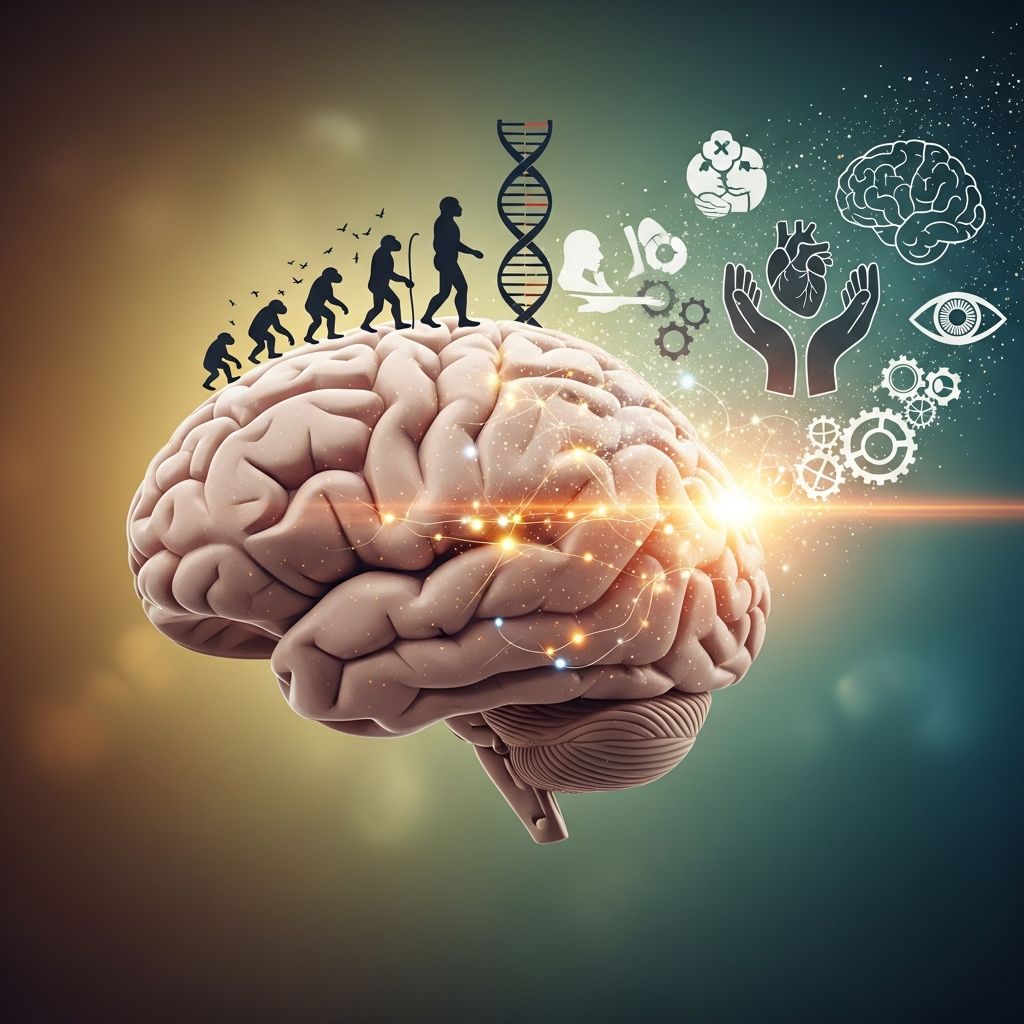
The human mind is a product of millions of years of evolution, shaped by the relentless pressures of survival and reproduction in ancient environments. Evolutionary psychology applies principles of natural selection to explain why we think, feel, and behave as we do today.
Foundations of the Evolutionary Approach to the Mind
Evolutionary psychology posits that the brain consists of specialized modules, each evolved to tackle specific problems faced by our hunter-gatherer ancestors. These mechanisms handle tasks like detecting predators, forming alliances, or choosing mates, much like the heart pumps blood or lungs process oxygen.
At its core, this field integrates Darwin’s theory of natural selection with cognitive science. Traits that enhanced survival and reproductive success were passed on, while others faded. The brain, therefore, is an information-processing device fine-tuned over eons for recurrent challenges in the ancestral environment, often called the Environment of Evolutionary Adaptedness (EEA).
Unlike traditional psychology, which might focus on learning or culture alone, evolutionary psychology views these as operating atop innate psychological foundations. For instance, fear of snakes isn’t just learned; it’s an adaptation because venomous reptiles posed lethal risks to early humans.
Core Principles Guiding Evolutionary Explanations
Several key tenets underpin this discipline:
- Adaptationism: Most psychological traits are adaptations—solutions sculpted by selection pressures.
- Domain-Specificity: The mind features dedicated circuits for different problems, not a general-purpose computer.
- EEA Relevance: Behaviors make sense when viewed through the lens of Pleistocene-era life, not modern cities.
- Gene-Environment Interaction: Genes provide predispositions, but environment triggers their expression.
These principles, articulated by pioneers like John Tooby and Leda Cosmides, aim to unify psychology with biology, treating the mind as a biological organ.
Universal Psychological Adaptations in Action
Humans exhibit remarkably consistent fears, desires, and social tendencies worldwide, pointing to evolved universals. Consider language acquisition: Children effortlessly learn complex grammar, an adaptation for communication that boosted group coordination and survival.
Cheater detection is another hallmark. Experiments show people excel at spotting rule-breakers in social exchanges, a skill vital for maintaining cooperation in small ancestral bands. Similarly, mate preferences—men favoring youth and beauty (fertility cues), women valuing resources and status—reflect sexual selection pressures.
| Adaptation | Ancestral Problem | Modern Manifestation |
|---|---|---|
| Fear Response | Predator Avoidance | Phobias of heights, spiders |
| Kin Altruism | Offspring Protection | Nepotism in families |
| Sexual Jealousy | Paternity/Maternity Certainty | Relationship conflicts |
This table illustrates how ancient solutions persist, often maladaptively in today’s world of fast food and smartphones.
Research Methods: Reverse-Engineering the Mind
Evolutionary psychologists employ diverse tools to test hypotheses. Cross-cultural studies reveal universals, like incest avoidance, transcending societies. Wason selection tasks demonstrate intuitive logic for social contracts but not abstract ones, evidencing specialized reasoning.
Behavioral ecology examines modern hunter-gatherers as proxies for ancestral life. Neuroimaging reveals brain activations tied to evolved functions, such as the amygdala lighting up for threats. Experimental designs manipulate variables to isolate adaptations, ensuring predictions are falsifiable.
Sex Differences: Insights from Sexual Selection
Dimorphisms in behavior stem from differing reproductive costs. Women, investing nine months in pregnancy, prioritize partner quality; men, with lower costs, emphasize quantity. This explains greater male variability in traits like promiscuity or risk-taking.
Such patterns hold across cultures, from Yanomamö tribes to urban West, underscoring biology’s role over pure socialization.
Emotions as Evolved Action Plans
Emotions aren’t random; they’re coordinated responses. Anger mobilizes for competition, disgust prevents toxin ingestion, happiness cements bonds. Each emotion packages physiology, cognition, and behavior for adaptive outcomes.
In ancestral settings, jealousy prevented cuckoldry (paternal uncertainty), a massive reproductive cost for men. Today, it fuels drama but served vital functions.
Parenting and Family Dynamics
Parental investment theory predicts stepparents invest less than biological ones, explaining higher abuse rates by stepfathers—a cross-cultural pattern. Infants’ cuteness elicits care, an adaptation manipulating adults’ nurturing instincts.
Cognitive Biases: Mismatches with Modernity
Our minds excel at ancestral tasks but falter elsewhere. The availability heuristic overestimates vivid risks like terrorism over diabetes. Sweet tooths evolved for scarce fruit but now drive obesity epidemics.
Status-seeking fueled competition for mates and resources; in equality-driven societies, it manifests as consumerism or social media validation.
Critiques and Ongoing Debates
Critics argue evolutionary psychology is unfalsifiable “just-so stories” or overly adaptationist, ignoring drift or pleiotropy. Others claim it neglects culture’s role or ethical issues like justifying inequality.
Proponents counter with empirical rigor: Predictions must be precise and tested. Massive cross-cultural databases, like those from the Human Relations Area Files, support universality claims. The field evolves, incorporating gene-culture coevolution.
Recent advances blend it with developmental psychology, showing how evolved mechanisms unfold across the lifespan.
Applications in Contemporary Life
Understanding evolved minds informs policy. Recognizing innate tribalism aids conflict resolution; sex differences guide relationship counseling. Marketing leverages status cues; education tailors to modular learning strengths.
In mental health, depression may signal withdrawal from poor strategies, an adaptation gone awry. Evolutionary insights demystify behaviors like addiction or violence.
Frequently Asked Questions (FAQs)
What distinguishes evolutionary psychology from other fields?
It focuses on ultimate causes (why traits evolved) alongside proximate ones (how they work), rooting explanations in Darwinian biology.
Is evolutionary psychology deterministic?
No—genes set potentials, but environment and choice shape outcomes. It’s probabilistic, not fatalistic.
Does it apply only to ancient behaviors?
Recent evolution continues; e.g., adaptations to agriculture or urbanization are emerging research areas.
How does it address morality?
Moral intuitions like fairness evolved for reciprocity; culture builds ethical systems atop them.
Can anyone study evolutionary psychology?
Yes—undergrad courses abound, with grad programs in psych, anthro, or biology. Key skills: evolutionary theory, stats, cross-cultural methods.
Future Directions and Emerging Frontiers
Genomics promises to link genes to adaptations; AI models simulate ancestral minds. Evo-devo psych explores child development’s evolved trajectory. Integrating with neuroscience maps psychological modules to brain regions.
As climate change alters environments, studying rapid adaptation could predict societal shifts. Evolutionary psychology bridges humanities and sciences, illuminating our shared heritage.
References
- Evolutionary psychology — Wikipedia. 2026-04-01. https://en.wikipedia.org/wiki/Evolutionary_psychology
- What Is An Evolutionary Psychologist And How Do They Study — BetterHelp. 2023-10-15. https://www.betterhelp.com/advice/psychologists/what-is-an-evolutionary-psychologist-what-do-they-do/
- Evolutionary psychology | Human Behavior & Adaptation — Britannica. 2024-02-20. https://www.britannica.com/science/evolutionary-psychology
- Evolutionary Psychology – Stanford Encyclopedia of Philosophy — Stanford University. 2023-08-12. https://plato.stanford.edu/entries/evolutionary-psychology/
- An Introduction to Evolutionary Developmental Psychology — PMC (NIH). 2023-08-01. https://pmc.ncbi.nlm.nih.gov/articles/PMC10426875/

Medha Deb is an editor with a master's degree in Applied Linguistics from the University of Hyderabad. She believes that her qualification has helped her develop a deep understanding of language and its application in various contexts. Medha specializes in the areas of beauty, health, sports, and wellness and is committed to ensuring that the content on the website is…