
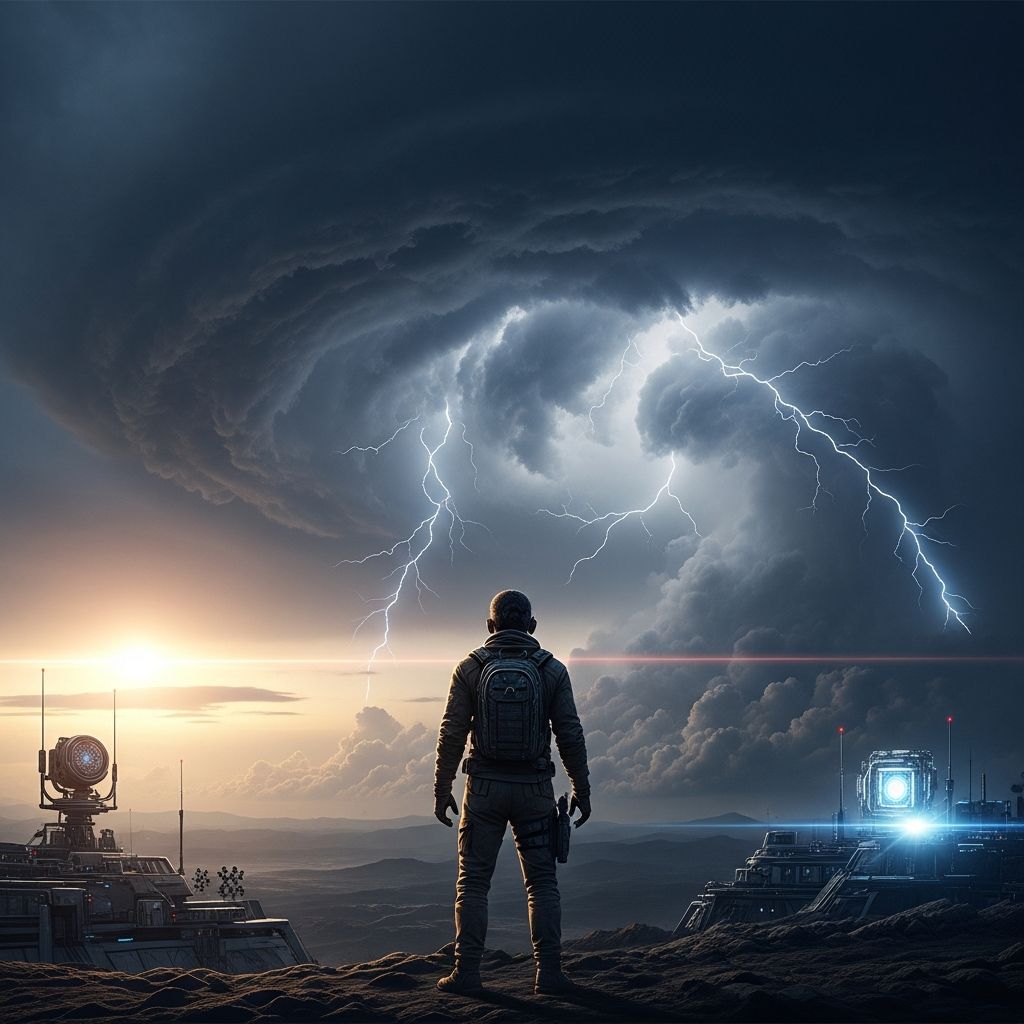
Humanity has reached an extraordinary moment. For the first time in our history, we possess technologies powerful enough to end our story, yet we have barely begun to explore our long-term potential. This tension between unprecedented power and incomplete wisdom lies at the heart of the modern discussion about existential risk and the long-run future of humanity.
1. What Are Existential Risks?
Existential risks are threats that could permanently destroy humanity’s long-term potential. They include events that either cause human extinction or irreversibly cripple our civilization so badly that recovery to a flourishing state is no longer possible.
Unlike ordinary disasters, which are tragic but bounded, existential catastrophes would represent a permanent loss of everything humanity could ever achieve.
1.1 How Existential Risks Differ from Other Dangers
- Scale: They affect all of humanity, not just a region or generation.
- Irreversibility: The damage cannot meaningfully be undone; there is no second attempt.
- Moral stakes: They jeopardize not only current lives, but all possible future lives.
Many familiar global challenges, such as financial crises or typical natural disasters, are severe yet ultimately survivable. Existential risks belong to a different category: they threaten the entire future trajectory of civilization.
1.2 Categories of Existential Threats
Though the details vary, most analyses of global catastrophic risks converge on a core set of candidate threats:
- Nuclear war: Large-scale nuclear conflict could cause mass deaths, long-term environmental harm, and possible societal collapse.
- Engineered pandemics: Advances in biotechnology increase both our ability to prevent disease and the possibility of deliberately or accidentally created pathogens with extreme lethality or transmissibility.
- Unaligned artificial intelligence: Future AI systems that surpass human capabilities could potentially act in ways misaligned with human values, with large-scale or irreversible consequences.
- Climate change and tipping points: Severe, poorly managed climate change could create cascading crises, potentially interacting with other risks such as conflict and migration on an unprecedented scale.
- Natural cosmic risks: Extremely large asteroid or comet impacts and supervolcanic eruptions are rare but capable of global devastation.
2. Humanity at a Narrow Moment in History
From a long historical perspective, the present era is unusual. For hundreds of thousands of years, human beings lacked the ability to significantly alter the planet as a whole. Only in the last century have our tools become powerful enough to reshape — or destroy — the conditions that support civilization.
This creates a narrow and precarious window: we have acquired world-scale power before developing world-scale safeguards and institutions to match it.
2.1 Technological Power Outpacing Wisdom
Two long-run trends now diverge:
- Technological capability: Our ability to manipulate nature, information, and biology is growing exponentially.
- Governance and moral insight: Our global institutions, norms, and cooperative capacities are improving, but much more slowly and unevenly.
When power vastly exceeds wisdom and restraint, risk increases. The risk is not only that existing systems fail, but that we may not have time to repair them before a catastrophe arrives.
2.2 The Precarious Century
A growing number of researchers argue that the coming centuries will be distinctively dangerous relative to earlier human history. We face a cluster of anthropogenic risks that did not exist before the mid-20th century, and that may either be brought under control or lead to irreversible disaster.
In this view, humanity is not fated to live forever on a knife-edge. Instead, we inhabit a transitional period: either we learn to manage our destructive capabilities responsibly, or we fail and lose the future altogether.
3. The Moral Case for Caring About the Far Future
Why should we be especially concerned about risks that may unfold over decades or centuries, when there is so much urgent suffering in the present?
3.1 Future People Matter Too
At the core of long-term ethics is a simple idea: if we think all people matter equally, then the time at which they live should not by itself determine their moral importance. A child born 500 years from now can feel pain and joy just as vividly as a child born today.
Given even modest assumptions about how long humanity could endure — potentially millions of years, and perhaps far beyond Earth — the number of possible future lives is enormous. An existential catastrophe would therefore not only be the greatest tragedy for those alive at the time, but a loss of magnitude greater than all past human suffering combined.
3.2 Asymmetry of Errors
When deciding how much to invest in reducing existential risks, we face an asymmetry:
- If we over-invest, we may misallocate resources and miss some other important opportunities.
- If we under-invest and an existential catastrophe occurs, the loss is permanent and absolute.
Because the downside of neglecting these risks is so vast, many philosophers argue that even a low probability of existential catastrophe can justify substantial precautionary investment.
4. Mapping the Landscape of Existential Risk
Although estimating the precise likelihood of various global catastrophes is extremely difficult, expert assessments can help compare orders of magnitude and identify priorities. The table below illustrates broad categories and typical concerns that appear in the academic literature and policy discussions.
| Risk Type | Primary Origin | Key Mechanism | Illustrative Concerns |
|---|---|---|---|
| Nuclear war | Human-made | Large-scale detonations and indirect climate effects | Escalating great-power conflict, accidental launch, command-and-control failures |
| Pandemics (natural or engineered) | Mixed | Highly transmissible, high-fatality pathogens | Laboratory accidents, deliberate misuse of biotechnology, novel zoonotic spillover |
| Unaligned advanced AI | Human-made | Mis-specified goals, loss of human control | Rapid AI capability gains outpacing safety, global-scale automation of decision-making |
| Severe climate change | Human-made | Long-term warming, tipping points, systemic stress | Sea-level rise, food insecurity, conflict, compounding effects with other risks |
| Asteroids, comets, supervolcanoes | Natural | Global dust and aerosols blocking sunlight | Mass crop failures, collapse of critical infrastructure, long-term cooling |
In aggregate, the literature suggests that anthropogenic (human-generated) risks, especially from advanced technologies, now dominate the threat landscape compared with natural risks like asteroid impacts or supervolcanoes.
5. Toward Existential Security
Many researchers use the term existential security to describe a state in which existential risks are both very low and reliably kept low over time. Reaching such a condition would mean that humanity is no longer teetering on the edge of catastrophe each century, but has instead built durable systems that prevent global self-destruction.
5.1 Elements of Existential Security
Building existential security likely requires progress along several fronts:
- Technical safeguards: Robust safety engineering for AI, biotechnology, nuclear systems, and other powerful technologies.
- Global governance: Institutions capable of monitoring dangerous activities, enforcing agreements, and coordinating emergency responses.
- Information transparency: Systems that detect emerging threats early, from unusual disease outbreaks to destabilizing arms races.
- Cultural norms: Widespread recognition that preserving humanity’s long-term potential is a shared responsibility, not a niche concern.
5.2 Near-Term Policy Priorities
While comprehensive existential security will take time, several near-term efforts are frequently emphasized by experts and international bodies:
- Strengthening global pandemic preparedness, including surveillance, rapid vaccine platforms, and secure high-biosafety laboratories.
- Reducing the role and number of nuclear weapons, improving early-warning systems, and extending arms control and non-proliferation agreements.
- Developing AI safety research and governance frameworks alongside capabilities, including standards for testing, evaluation, and incident reporting.
- Accelerating climate mitigation and adaptation to reduce the risk of severe warming and its systemic knock-on effects.
- Creating cross-cutting catastrophic risk institutes and national or international offices explicitly tasked with monitoring and coordinating responses to extreme threats.
6. The Promise of a Flourishing Long-Term Future
Discussions of existential risk can easily become dominated by fear. Yet the deeper motivation for safeguarding the future is not anxiety but hope: the recognition that humanity’s potential is vast and largely unrealized.
6.1 A Longer Timeline Than We Usually Imagine
From an astronomical point of view, Homo sapiens is extremely young. If we avoid self-destruction, our descendants could exist for millions of years on Earth and perhaps much longer if we eventually spread beyond our planet. The number of possible lives, cultures, and discoveries across such timescales dwarfs anything we have seen so far.
Protecting the future is therefore not merely about avoiding a grim fate. It is about giving later generations the chance to solve today’s moral failures, end extreme suffering, explore the universe, and create forms of flourishing we cannot yet imagine.
6.2 Ending Present Harms Requires Survival
Many of the world’s worst injustices — extreme poverty, preventable disease, cruelty, oppression — are solvable in principle. Ongoing progress in medicine, education, and human rights has already transformed billions of lives.
However, this progress only matters if humanity survives long enough to continue and expand it. Ending existing harms and avoiding existential catastrophe are therefore complementary, not competing, goals. Work on global health, peace, and climate all reduce the background conditions that could amplify or trigger existential threats.
7. What Individuals and Institutions Can Do
Existential risk can feel overwhelmingly large, but the response need not be. No single person or organization can control humanity’s fate, yet many can meaningfully improve our odds.
7.1 High-Impact Career Paths
People with the right skills and values can contribute by working directly on crucial problems. Examples often highlighted in the literature include:
- Biosecurity and pandemic preparedness: Research, policy, and operations that make catastrophic pandemics less likely or more manageable.
- AI governance and safety: Technical work on robust and interpretable systems, and policy design for responsible deployment.
- Nuclear risk reduction: Arms control, strategic stability analysis, and crisis communication mechanisms.
- Climate policy and clean technology: Rapid decarbonization, adaptation strategies, and protection of critical ecosystems.
- Global catastrophic risk research: Interdisciplinary work measuring risks, exploring scenarios, and identifying neglected interventions.
7.2 Philanthropy and Advocacy
Beyond careers, individuals and organizations can:
- Support institutions working on existential risk reduction and improving global cooperation.
- Advocate for evidence-based policy that incorporates long-term impacts into national and international decision-making.
- Promote science literacy and public understanding of global catastrophic risks, reducing polarization and misinformation.
7.3 Building a Culture of Longtermism
Ultimately, stable protection of the future may depend on a cultural shift. If broad segments of society come to see the far future as morally significant, political and institutional changes become easier to sustain. Norms that value global cooperation, precaution with powerful technologies, and concern for future generations can help tilt the odds toward long-run survival and flourishing.
Frequently Asked Questions (FAQs)
Q1: Are existential risks just science fiction?
No. While some hypothetical scenarios are speculative, several core existential risks — such as nuclear war, engineered pandemics, and destabilizing climate change — are grounded in well-understood physical processes and documented historical near-misses. The question is not whether they are possible, but how likely they are and what level of prevention is justified.
Q2: Isn’t focusing on the far future a distraction from current problems?
Addressing existential risk and improving the present are mutually reinforcing. Many interventions that reduce long-term risk — like better public health systems, stable international relations, and clean energy — also alleviate present-day suffering. The key is to identify actions that deliver both near-term and long-term benefits.
Q3: Can we really estimate the probability of human extinction?
Precise numerical estimates are uncertain and contentious. However, experts can still compare relative risks, identify key drivers, and highlight where uncertainty is greatest. In practice, even broad ranges can be decision-relevant: if a threat is plausibly large enough to end civilization, it can warrant significant attention even when probabilities are uncertain.
Q4: Isn’t technological progress itself the solution?
Technology is both a source of risk and a crucial part of the solution. Vaccines, satellite monitoring, and AI-assisted scientific discovery can all reduce certain existential threats. Yet without parallel progress in governance, ethics, and global coordination, new tools may introduce dangers faster than safeguards can catch up.
Q5: What is one practical step governments could take now?
Many analysts recommend establishing dedicated national and international bodies with clear mandates to monitor, analyze, and coordinate responses to extreme risks — similar in spirit to how specialized agencies oversee nuclear safety or disease surveillance today. Such institutions can help ensure that long-term threats are systematically tracked rather than addressed only after crises emerge.
References
- Global Catastrophic Risks 2021: Navigating the Complex Intersections — Global Challenges Foundation. 2021-12-01. https://globalchallenges.org/our-work/global-risks
- World Health Report: Preventing pandemics — World Health Organization. 2022-12-14. https://www.who.int/publications
- Global Preparedness Monitoring Board 2022 Report — WHO & World Bank. 2022-09-01. https://apps.who.int/gpmb/annual_report.html
- Opportunities and Risks of Foundation Models — Bommasani et al., Stanford Institute for Human-Centered AI. 2022-07-12. https://hai.stanford.edu/research/foundation-models
- Climate Change 2021: The Physical Science Basis — IPCC, Working Group I. 2021-08-09. https://www.ipcc.ch/report/ar6/wg1/
- Global Catastrophic Biological Risks — Johns Hopkins Center for Health Security. 2023-01-05. https://www.centerforhealthsecurity.org/our-work/topics/global-catastrophic-biological-risks
- The Precipice Revisited — Toby Ord. 2024-04-18. https://www.tobyord.com/writing/the-precipice-revisited

Medha Deb is an editor with a master's degree in Applied Linguistics from the University of Hyderabad. She believes that her qualification has helped her develop a deep understanding of language and its application in various contexts. Medha specializes in the areas of beauty, health, sports, and wellness and is committed to ensuring that the content on the website is…