
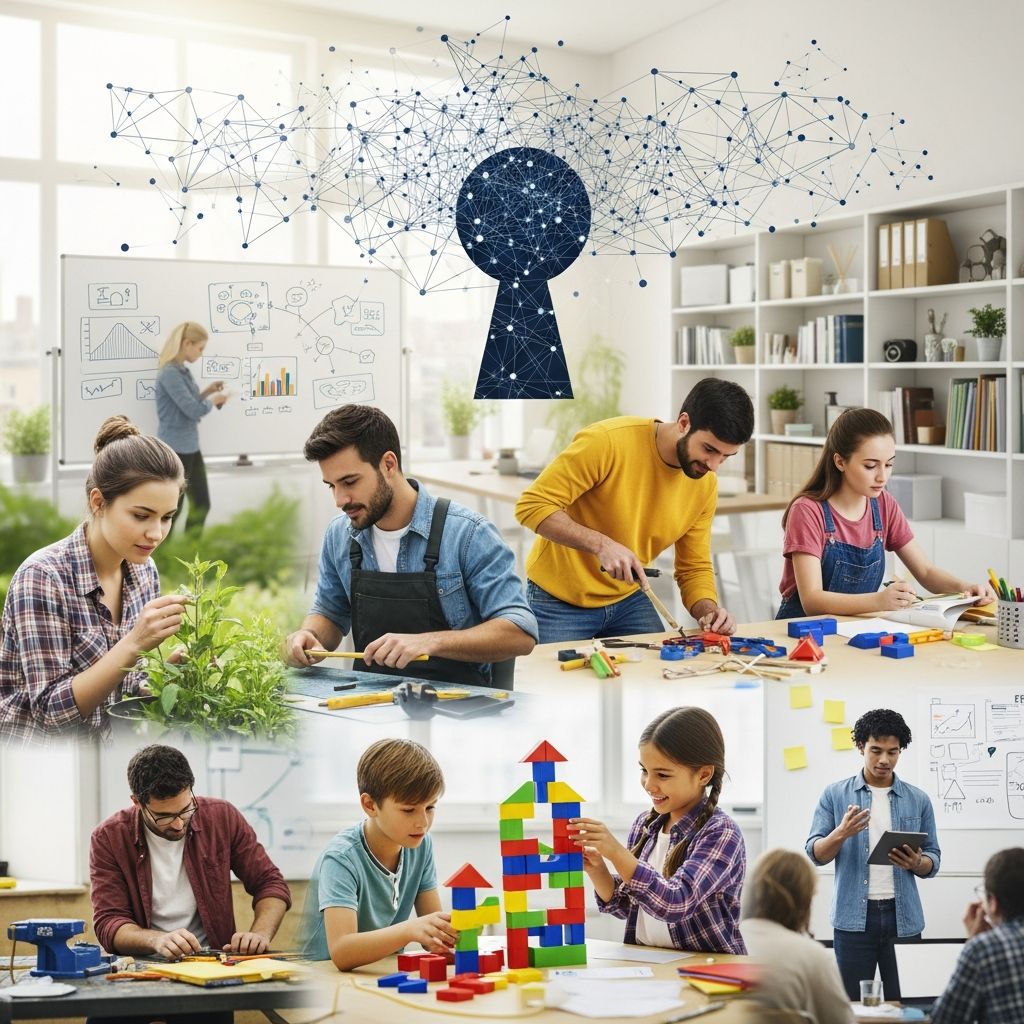
Experiential learning shifts education from passive absorption to active participation, where learners construct knowledge through direct involvement in meaningful activities. This method emphasizes doing, reflecting, and applying insights, leading to profound retention and skill development.
Defining Experiential Learning in Modern Education
At its core, experiential learning involves engaging students in real-world tasks that mirror authentic challenges, followed by structured reflection to extract lessons. Unlike traditional lectures, it prioritizes active engagement, where students grapple with problems, experiment, and iterate based on outcomes.
This approach draws from educational theories positing that knowledge is not transmitted but created through personal encounters. Educators act as facilitators, guiding rather than dictating, allowing learners to navigate uncertainty and discover solutions independently.
The Foundational Cycle of Experiential Learning
The experiential learning cycle, pioneered by David Kolb, outlines four interconnected stages that form the backbone of this pedagogy: concrete experience, reflective observation, abstract conceptualization, and active experimentation.
- Concrete Experience: Learners dive into an activity, such as conducting a field experiment or simulating a business scenario, providing a tangible foundation for learning.
- Reflective Observation: Participants review the experience, noting what worked, what failed, and why, often through discussions or journals.
- Abstract Conceptualization: Insights from reflection are linked to broader theories or principles, helping students form generalizations.
- Active Experimentation: New ideas are tested in fresh contexts, closing the loop and preparing for future cycles.
This cyclical process ensures learning is iterative, building complexity with each rotation. For instance, a science class might start with a hands-on dissection (experience), discuss observations (reflection), connect to biological concepts (conceptualization), and design a follow-up experiment (experimentation).
Key Principles Guiding Effective Experiential Practices
Successful experiential learning adheres to principles that differentiate it from mere ‘hands-on’ activities. Reflection and application are non-negotiable, transforming raw action into lasting knowledge.
| Principle | Description | Educator Role |
|---|---|---|
| Student Initiative | Learners make decisions and own outcomes, fostering accountability. | Set boundaries and support exploration |
| Real-World Relevance | Activities tie to practical problems, enhancing motivation. | Design authentic scenarios |
| Reflection Integration | Structured debriefs turn experiences into insights. | Facilitate discussions and prompting questions |
| Risk and Uncertainty | Embracing failure as a teacher builds resilience. | Ensure safety while allowing natural consequences |
These principles create semi-structured environments where cooperation thrives over competition, promoting collaborative problem-solving.
Advantages of Adopting Experiential Methods
Experiential learning yields measurable benefits, including heightened engagement and retention. Students think critically, work diligently, and retain more when actively involved.
- Deeper Comprehension: Applying concepts in context solidifies understanding beyond rote memorization.
- Skill Development: Builds practical abilities like teamwork, adaptability, and decision-making.
- Motivation Boost: Relevance to real life sparks intrinsic interest.
- Lifelong Learning: Encourages curiosity and self-directed growth.
Research supports these outcomes; for example, youth in experiential programs demonstrate improved problem-solving and higher achievement. In higher education, it aligns with competency-based models, preparing graduates for professional demands.
Practical Strategies for Classroom Implementation
Integrating experiential learning requires intentional planning. Start by aligning activities with learning objectives, ensuring they fit course goals.
- Plan Thoroughly: Identify resources, timelines, and assessment methods. Prepare flexible contingencies based on student responses.
- Incorporate Digital Tools: Use virtual simulations for inaccessible experiences, like historical recreations or virtual labs.
- Facilitate Reflection: Employ guiding questions: ‘What surprised you?’ or ‘How does this connect to prior knowledge?’.
- Assess Formatively: Monitor progress through observations and self-reflections, adjusting as needed.
For youth programs, a five-step model—experience, share, process, generalize, apply—provides a scaffold. In universities, tie experiences to capstones or internships for credit.
Real-World Applications Across Educational Levels
Experiential learning adapts seamlessly to diverse settings. In K-12, project-based units like community gardens teach science and citizenship.
Higher education leverages internships and service-learning, where students apply theory in professional environments, reflecting via portfolios.
Even corporate training uses role-plays and simulations to develop leadership skills, mirroring Kolb’s cycle.
Overcoming Common Challenges in Experiential Learning
While powerful, challenges like time constraints and resource limitations arise. Solutions include starting small with low-prep activities and leveraging free digital platforms.
- Time Management: Embed short cycles within lessons rather than full-day events.
- Equity Issues: Ensure all students access opportunities through inclusive design.
- Assessment: Use rubrics focusing on process and growth, not just products.
Educators must also guard against bias, maintaining neutrality to support diverse learning styles.
Advanced Tools and Technologies Enhancing Experiences
Modern tech amplifies experiential learning. Virtual reality immerses students in historical events or remote ecosystems, enabling safe experimentation.
Online platforms facilitate global collaborations, such as virtual exchanges where students co-solve problems across cultures.
Frequently Asked Questions
What is the difference between experiential learning and hands-on activities?
Hands-on activities involve doing, but experiential learning adds deliberate reflection and application, making it a complete cycle for deeper insight.
How can teachers without resources implement this?
Use everyday materials, digital simulations, or community partnerships to create low-cost, high-impact experiences.
Does it work for all subjects?
Yes, from math (real-budget projects) to humanities (role-plays), it adapts universally.
How do you measure success?
Through student reflections, skill demonstrations, and pre/post assessments tracking growth.
Is it suitable for large classes?
Absolutely, via group projects and peer facilitation, scaling effectively.
This approach revolutionizes education by making learning relevant, memorable, and transformative, equipping students for a dynamic world.
References
- Experiential Learning Guide — University of Minnesota Extension. 2023. https://extension.umn.edu/youth-learning-and-skills-resources/experiential-learning-guide
- Getting Started With Experiential Learning — Edutopia. 2022-10-12. https://www.edutopia.org/article/getting-started-experiential-learning/
- Exploring Experiential Learning and Reflection Guide — Valdosta State University. 2023. https://qep.valdosta.edu/exploring-experiential-learning-reflection-guide/
- Experiential Learning — Northern Illinois University Center for Innovative Teaching and Learning. 2024. https://www.niu.edu/citl/resources/guides/instructional-guide/experiential-learning.shtml
- A Guide To Experiential Learning, Internships, Capstones — University of Utah Online. 2024. https://online.utah.edu/blog/posts/learning-experiences.php
- Five Tips for Creating Experiential Learning Opportunities — Discovery Education. 2023. https://www.discoveryeducation.com/blog/teaching-and-learning/five-tips-for-creating-experiential-learning-opportunities/

Medha Deb is an editor with a master's degree in Applied Linguistics from the University of Hyderabad. She believes that her qualification has helped her develop a deep understanding of language and its application in various contexts. Medha specializes in the areas of beauty, health, sports, and wellness and is committed to ensuring that the content on the website is…