
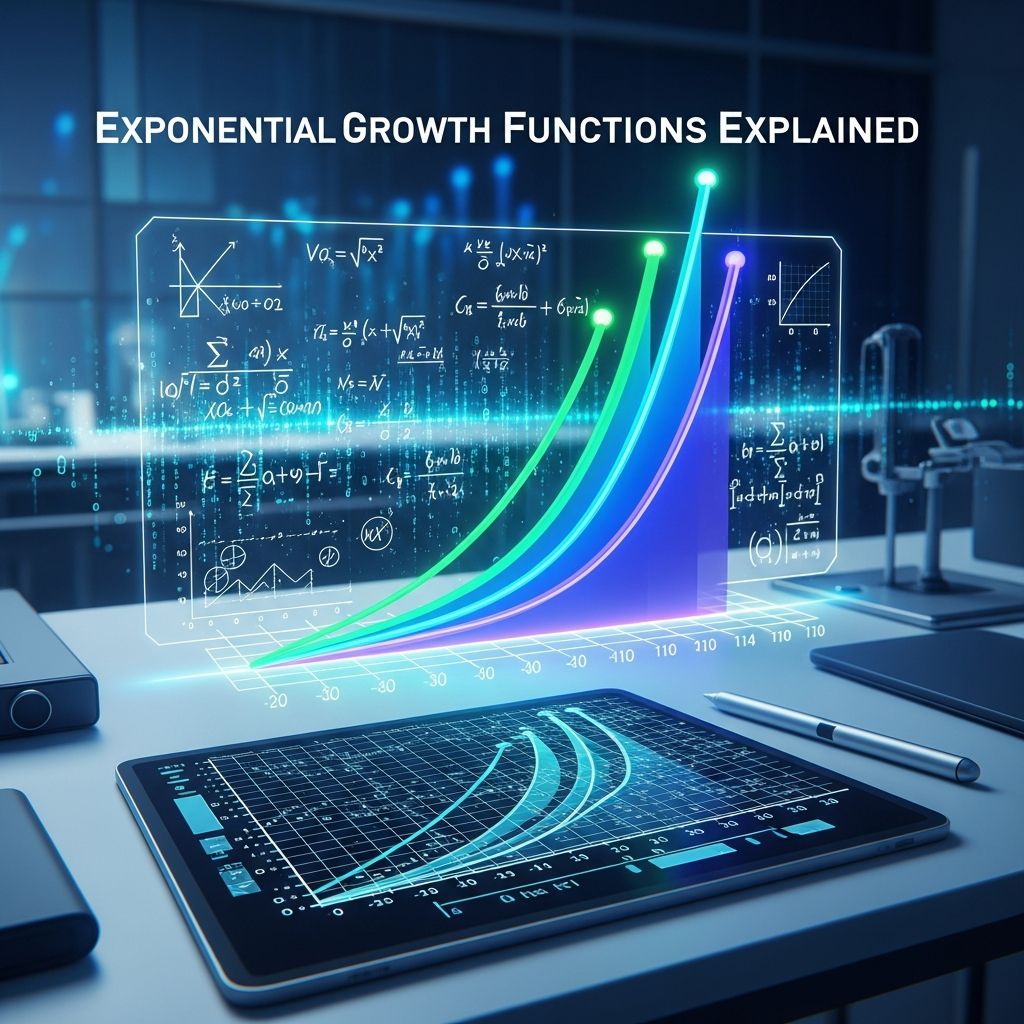
Exponential growth functions describe processes where a quantity increases at a rate proportional to its current value, leading to rapid acceleration over time. These models are essential in fields like biology, economics, and finance.
Defining Exponential Growth in Mathematical Terms
At its core, exponential growth occurs when the rate of increase of a quantity is directly proportional to its existing amount. Unlike linear growth, which adds a fixed amount periodically, exponential growth multiplies the current value by a constant factor.
The general form is y = a * b^x, where a is the initial value, b is the growth factor greater than 1, and x represents time or iterations. For continuous scenarios, it becomes P = P_0 * e^(kt), with e as the base of natural logarithms and k as the growth constant.
Core Formulas for Modeling Growth
Several formulas capture exponential growth, each suited to different contexts:
- Discrete Growth:
f(x) = a(1 + r)^x– Used for compound interest or population with fixed intervals. - Continuous Growth:
P(t) = P_0 e^(kt)– Ideal for ongoing processes like radioactive decay or viral spread. - General Form:
x(t) = a * b^(t/τ)– Incorporates e-folding time τ.
Key parameters include doubling time T, where T = (ln 2)/k, showing how long it takes to double.
Visualizing Exponential Growth Through Graphs
Graphs of exponential functions start slowly but curve steeply upward, forming a classic J-shape. For y = 2^x, values are:
| x | y |
|---|---|
| 0 | 1 |
| 1 | 2 |
| 2 | 4 |
| 3 | 8 |
| 10 | 1024 |
This table illustrates doubling every unit of x, highlighting rapid escalation.
Real-World Applications Across Disciplines
Biological Populations and Epidemics
In biology, bacteria colonies double every fixed period, modeled as N(t) = N_0 * 2^(t/T). During early COVID-19 stages, infection rates followed exponential patterns before plateauing due to interventions.
Financial Compound Interest
Investments grow via A = P(1 + r/n)^(nt), approaching continuous compounding A = Pe^(rt) as n increases. A $1000 investment at 5% annual rate yields $1051 after one year discretely, but continuously it’s about $1051.27.
Technology Adoption Curves
Moore’s Law observes transistor counts doubling roughly every two years, an exponential trend driving computing power surges.
Exponential Growth vs. Linear Growth: A Comparison
| Aspect | Linear Growth | Exponential Growth |
|---|---|---|
| Formula | y = mx + b | y = a * b^x |
| Growth Pattern | Constant addition | Proportional multiplication |
| Long-Term Behavior | Steady increase | Rapid acceleration |
| Example | Salary raise of $1000/year | Population tripling yearly |
Exponential outpaces linear eventually; a linear function at 2x per step loses to 2^x.
Step-by-Step Problem Solving Examples
Example 1: Population Projection
A city starts with 10,000 people, growing 3% annually. Find population in 10 years.
Using P = 10000 * (1.03)^10 ≈ 13439.
Example 2: Doubling Time Calculation
For k=0.05, doubling time T = (ln 2)/0.05 ≈ 13.86 years.
Example 3: Investment Growth
$5000 at 4% continuous compounding for 5 years: A = 5000 * e^(0.04*5) ≈ 6083.
Common Pitfalls and How to Avoid Them
- Mistaking for Linear: Early stages mimic linear; check ratios, not differences.
- Unit Consistency: Ensure time units match across formula.
- Limits of Model: Real growth saturates; exponential applies to initial phases.
Advanced Concepts: From Growth to Decay
Exponential decay mirrors growth with b<1 or negative k, like y = a(1 – r)^x for half-lives in radioactivity. The growth constant k flips sign.
Frequently Asked Questions (FAQs)
What distinguishes exponential from linear growth?
Linear adds fixed amounts; exponential multiplies by a factor, causing acceleration.
How do you find doubling time?
Use T = (ln 2)/k for continuous models.
Can exponential growth last forever?
In reality, no—resources limit it—but mathematically, yes.
What’s the role of ‘e’ in these functions?
e (≈2.718) bases continuous growth, simplifying limits of compounding.
Applications in finance?
Compound interest formulas derive from exponential models.
References
- Exponential growth – Wikipedia — Wikipedia Contributors. 2023-10-01. https://en.wikipedia.org/wiki/Exponential_growth
- An Intuitive Guide To Exponential Functions & e — BetterExplained. 2022-05-15. https://betterexplained.com/articles/an-intuitive-guide-to-exponential-functions-e/
- Exponential Growth Formula – Formulas, Examples — Cuemath. 2024-01-20. https://www.cuemath.com/exponential-growth-formula/
- Exponential Functions: Introduction — Purplemath. 2023-08-10. https://www.purplemath.com/modules/expofcns.htm
- Exponential Growth and Decay — MathBitsNotebook(A1). 2023-11-05. https://mathbitsnotebook.com/Algebra1/Exponentials/EXGrowthDecay.html

- Integrated M.A. in Applied Linguistics, University of Hyderabad
- 5+ years in editorial, instructional, SEO, and research-based writing
Sneha is a relationships and lifestyle writer with a strong foundation in applied linguistics and certified training in relationship coaching. She brings over five years of writing experience to theskillvault, crafting thoughtful, research-driven content that empowers readers to build healthier relationships, boost emotional well-being, and embrace holistic living. Her writing and insights reflect the belief that beauty, happiness, and wellness…