
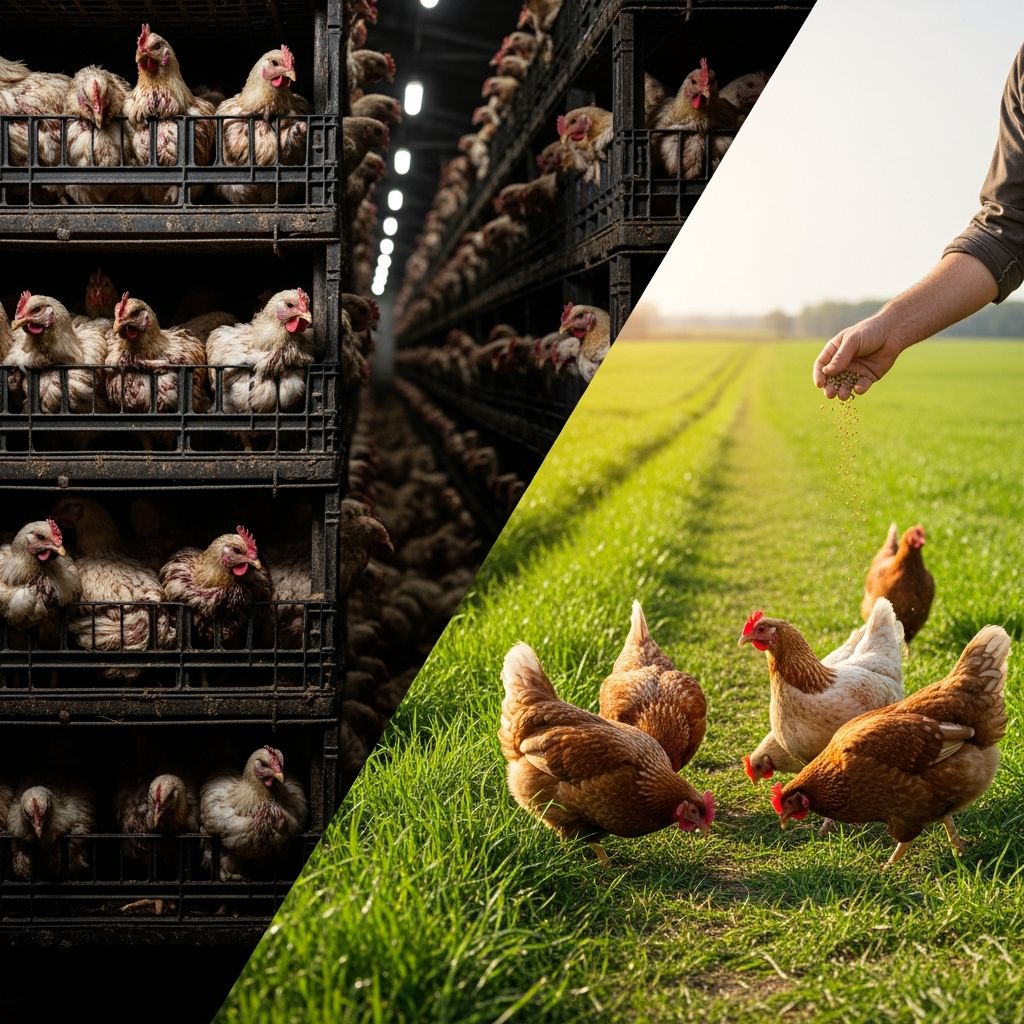
Factory farming, also called industrial or intensive animal agriculture, is one of the largest sources of animal suffering on the planet. It also contributes significantly to environmental damage, public health risks, and global inequality. For people who want to use their careers or resources to do the most good, understanding this problem is essential.
What Do We Mean by Factory Farming?
Factory farms are large-scale facilities that confine thousands—or even millions—of animals in cramped, controlled environments in order to produce meat, eggs, and dairy as cheaply as possible. These operations prioritize efficiency and uniformity, often at the expense of animal welfare and environmental protection.
- Concentrated Animal Feeding Operations (CAFOs): US regulators use this term for facilities that confine large numbers of animals in small spaces, often with little or no access to pasture.
- Key features commonly include indoor sheds, cages or crates, automated feeding and waste systems, and heavy reliance on antibiotics.
- Global reach: Once concentrated in high-income countries, intensive systems are expanding rapidly in middle-income regions as demand for animal products grows.
Although not all animal agriculture is industrial, the majority of farmed animals worldwide now live in intensive conditions, especially chickens, pigs, and egg-laying hens.
Why Factory Farming Is a Major Moral Problem
The central ethical concern is the staggering scale of suffering. Tens of billions of animals spend most of their lives in barren, crowded environments where they cannot perform basic natural behaviors like walking freely, nesting, or dustbathing.
Conditions Inside Industrial Farms
- Extreme confinement: Many pigs and hens are kept in cages or crates so small they can barely turn around. Movement is limited to maximize space efficiency.
- Physical mutilations: Beak trimming, tail docking, and other painful procedures are often performed without adequate pain relief to reduce injurious behavior caused by crowding and stress.
- Rapid growth and health problems: Animals are selectively bred to grow or produce at unnaturally fast rates, leading to bone fractures, heart failure, and chronic pain, especially in broiler chickens and turkeys.
- Psychological stress: Lack of stimulation and inability to engage in natural behaviors can cause frustration and stereotypic behaviors such as bar-biting or feather pecking.
From an ethical standpoint, the combination of immense numbers of animals and long durations of poor welfare makes factory farming one of the largest ongoing sources of suffering on Earth.
Scale Compared to Other Global Problems
Food production as a whole uses about half of the world’s habitable land and is responsible for over one-quarter of global greenhouse gas emissions, much of it linked to livestock. Within that system, industrial farms house the great majority of land animals raised for food, suggesting that the number of animals affected and the intensity of harm are both extremely high.
| Dimension | Factory Farming | Why It Matters |
|---|---|---|
| Number of animals | Tens of billions of land animals per year | Vast population directly experiencing conditions |
| Duration | Most of life spent in confinement | Long-term suffering, not brief episodes |
| Intensity | Severe restrictions and health issues | High welfare costs per individual |
| Spillover effects | Climate, pollution, health risks | Affects humans and ecosystems |
Environmental Damage from Intensive Animal Agriculture
Industrial livestock production is a major driver of environmental degradation, from greenhouse gas emissions to water and air pollution.
Greenhouse Gas Emissions and Climate Change
- Share of global emissions: Animal agriculture accounts for roughly 14.5% of all human-caused greenhouse gas emissions worldwide, comparable to all transport combined.
- High-impact gases: Livestock produce large amounts of methane and nitrous oxide, gases far more potent than carbon dioxide at trapping heat.
- Factory-farm emissions: One analysis from a major animal protection NGO estimates that intensive farms alone contribute at least 11% of the emissions that drive climate-related disasters, especially affecting vulnerable regions in the Global South.
Emissions arise at multiple stages: growing feed crops, manufacturing fertilizers, operating long supply chains, and managing manure.
Water Use and Water Pollution
- Heavy water consumption: Industrial animal agriculture uses large volumes of freshwater for feed irrigation, cleaning, and drinking. In some countries, livestock production consumes a majority of agricultural water resources.
- Manure lagoons and runoff: Factory farms in the US alone generate hundreds of millions of tons of manure every year, often stored in pits or “lagoons” and applied to fields with minimal treatment.
- Dead zones in rivers and coasts: Nutrients like nitrogen and phosphorus from manure and fertilizer wash into waterways, fueling algal blooms that deplete oxygen and create dead zones where aquatic life cannot survive.
Land Use and Biodiversity Loss
Food production already occupies about 50% of habitable land, and livestock—including grazing and feed crops—account for most of that area. Factory farming intensifies land pressure because animals are fed energy-dense crops like soy and corn grown on vast monocultures instead of grazing on mixed landscapes.
- Deforestation to expand cropland for feed destroys habitat and releases large stores of carbon.
- Chemical inputs—fertilizers and pesticides—further degrade soil health and threaten non-target species, including pollinators.
- Loss of traditional systems as industrial models displace diversified, low-input farming, particularly in emerging economies.
Public Health Risks and Social Impacts
Factory farming does not only affect animals and ecosystems; it also creates serious risks for human health and rural communities.
Antibiotic Resistance and Disease
- Routine antibiotic use: Crowded, stressful conditions increase the risk of disease, so many operations use antibiotics not just to treat illness but also to promote growth and prevent outbreaks.
- Antimicrobial resistance (AMR): Overuse of antibiotics in animals contributes to the evolution and spread of drug-resistant bacteria, undermining the effectiveness of essential medicines for humans.
- Emerging infections: Large populations of genetically similar animals create ideal conditions for viruses to mutate and potentially jump to humans, raising concerns about future pandemics.
Air Pollution and Local Communities
Industrial livestock facilities release harmful gases and fine particles that damage health and quality of life for nearby residents.
- Ammonia and hydrogen sulfide from manure can cause respiratory problems, headaches, and eye irritation.
- Fine particulate matter from dust and emissions increases the risk of asthma and cardiovascular disease.
- Environmental justice concerns: These operations are often clustered in low-income or marginalized communities that have less political power to resist new facilities or enforce regulations.
Food Security and Global Inequality
Using large areas of fertile land to grow crops for animal feed instead of directly feeding people can reduce the efficiency of global food systems. Some analyses warn that as intensive livestock production expands in the Global South, it may crowd out small-scale producers and deepen vulnerability to climate shocks.
Why Factory Farming Is a Priority for Effective Altruism
Effective altruism (EA) seeks to direct resources where they can do the most good. Factory farming appears to score highly on several criteria that EAs often use to prioritize problems:
- Scale: Tens of billions of sentient beings are affected every year, often in extremely poor conditions.
- Neglectedness: Compared to its scale, animal welfare in agriculture receives a small fraction of philanthropic funding, policy attention, and research effort.
- Tractability: There is evidence that interventions—such as corporate welfare campaigns, product innovation, and policy reform—can measurably improve conditions or reduce the number of animals farmed.
For people choosing careers or donation targets, this combination suggests that work on factory farming could be unusually impactful per unit of effort.
Promising Approaches to Reducing Harm
Multiple strategies can reduce the number of animals in factory farms or improve their welfare. Some target consumer behavior, others aim at corporate practices, technology, or public policy.
Corporate and Policy Reforms
- Welfare standards: Campaigns to eliminate the worst practices—like battery cages for hens or gestation crates for pigs—can affect millions of animals at once when major companies or regulators adopt new standards.
- Labeling and transparency: Clear labels and public reporting requirements can help consumers and investors hold producers accountable.
- Regulating pollution and antibiotics: Stronger environmental and drug-use rules can reduce external harms and constrain the most harmful production systems.
Alternative Proteins and Food Innovation
Technological innovation may reduce dependence on industrial animal products.
- Plant-based foods: Modern plant-based meats and dairy analogues aim to replicate taste and convenience while circumventing animal suffering and reducing environmental impacts.
- Fermentation and cultivated products: Emerging technologies use microbes or animal cells to produce proteins without raising whole animals, though these approaches are still developing and face economic and regulatory hurdles.
Dietary Shifts and Cultural Change
- Reducing consumption of meat, eggs, and dairy—especially from intensive systems—can directly lower demand for factory-farmed products.
- Institutional purchasing: Universities, companies, hospitals, and governments can adopt procurement policies that favor higher-welfare or plant-based options, leveraging large buying power.
- Public awareness: Education campaigns that highlight animal welfare, environmental, and health consequences can gradually reshape social norms.
How Individuals Can Contribute
You do not have to work on a farm or in a lab to help address factory farming. Different people can contribute in different ways, depending on skills, resources, and values.
High-Impact Career Paths
- Policy and advocacy: Working on agricultural, environmental, or public health policy can influence regulations that govern factory farming.
- Nonprofit work: Roles in campaigning, research, communications, or leadership at farmed-animal or food-systems organizations can help drive change.
- Research and innovation: Scientists, engineers, and entrepreneurs can develop alternative proteins, welfare-improving technologies, or better metrics for animal wellbeing.
- Cause prioritization and grantmaking: Analysts and funders can identify the most promising interventions and allocate resources accordingly.
Personal Choices and Philanthropy
- Dietary changes: Moving toward more plant-based meals, or at least choosing higher-welfare animal products, can reduce your contribution to demand for factory-farmed goods.
- Targeted donations: Supporting evidence-oriented farmed-animal advocacy groups can multiply your impact through large campaigns and policy wins.
- Share information: Thoughtful conversations, writing, or organizing events can bring the issue to communities that have not yet considered it seriously.
Key Trade-offs and Open Questions
Even among people who agree that factory farming is a serious problem, there are debates about priorities and tactics.
- Incremental reform vs. abolition: Some focus on reducing suffering within existing systems, while others prioritize phasing out animal farming entirely. Both perspectives raise important strategic questions.
- Short-term vs. long-term effects: Policies that marginally improve welfare might also entrench intensive systems; conversely, radical proposals may be less tractable in the near term.
- Animal-focused vs. climate-focused arguments: Emphasizing animal welfare, environmental harm, or health risks can attract different allies but may also suggest different types of solutions.
For people interested in effective altruism, these uncertainties highlight the value of careful research, experimentation, and transparent evaluation of interventions.
Frequently Asked Questions (FAQs)
Q: Is all animal farming equally harmful?
A: No. Intensive systems with high stocking densities and confinement typically cause far worse welfare outcomes than smaller, pasture-based or high-welfare farms. However, even more extensive systems can involve painful procedures and stressful handling. From an impact perspective, reforms that affect large industrial operations will usually reach the greatest number of animals.
Q: If I eat animal products from local or organic farms, am I avoiding factory farming?
A: Not necessarily. Labels like “local” or “organic” may correlate with some improvements, such as reduced pesticide use or slightly lower stocking densities, but they do not guarantee the absence of severe confinement or mutilations. Verifying specific welfare standards—such as access to outdoors, limits on stocking density, and bans on cages—is more informative than relying on broad marketing claims.
Q: How does factory farming compare to climate and global health as a cause area?
A: Climate change and global health clearly remain central priorities. However, factory farming stands out because it involves vast numbers of non-human animals who can suffer intensely, receives comparatively little funding, and has promising, evidence-backed interventions. Many effective altruists see it as complementary to, not a replacement for, work on human-focused issues.
Q: Are alternative proteins really better for the environment?
A: Current data suggest that most plant-based meat alternatives have substantially lower greenhouse gas emissions and land use than conventional meat, particularly beef and lamb, when assessed across their full life cycles. The exact benefits depend on ingredients, energy sources, and production methods, but in general they appear significantly less resource-intensive than factory-farmed animal products.
Q: Where should I start if I want to help?
A: Useful first steps include learning more about animal welfare science and food systems, experimenting with more plant-based meals, supporting evidence-driven animal advocacy organizations, and exploring career paths in policy, research, or mission-aligned companies. Small changes at the individual level can complement systemic work aimed at transforming how food is produced.
References
- Factory farms contribute at least 11% of emissions causing climate disasters — World Animal Protection. 2023-11-28. https://www.worldanimalprotection.org/latest/press-releases/11-emissions-climate-disasters/
- The Massive Impact of Factory Farming on our Environment — New Roots Institute. 2021-03-25. https://www.newrootsinstitute.org/articles/massive-environmental-impacts
- Fact Sheet: Air Pollution from Factory Farms — Environmental Integrity Project. 2011-11-03. https://environmentalintegrity.org/wp-content/uploads/FACT-SHEET-on-air-pollution-from-factory-farms.pdf
- Factory Farming: A Recipe for Disaster for Animals & Our Planet — ASPCA. 2020-09-15. https://www.aspca.org/protecting-farm-animals/factory-farming-environment
- What’s Wrong With Factory Farming? — Jeff Sebo & Anne Barnhill, The Hastings Center Report (via PubMed Central). 2022-09-20. https://pmc.ncbi.nlm.nih.gov/articles/PMC9757169/
- Environmental impacts of food production — Our World in Data. 2023-07-10. https://ourworldindata.org/environmental-impacts-of-food
- Environmental Damage of Factory Farming — Compassion in World Farming. 2019-06-01. https://www.ciwf.org.uk/factory-farming/environmental-damage/

Medha Deb is an editor with a master's degree in Applied Linguistics from the University of Hyderabad. She believes that her qualification has helped her develop a deep understanding of language and its application in various contexts. Medha specializes in the areas of beauty, health, sports, and wellness and is committed to ensuring that the content on the website is…