
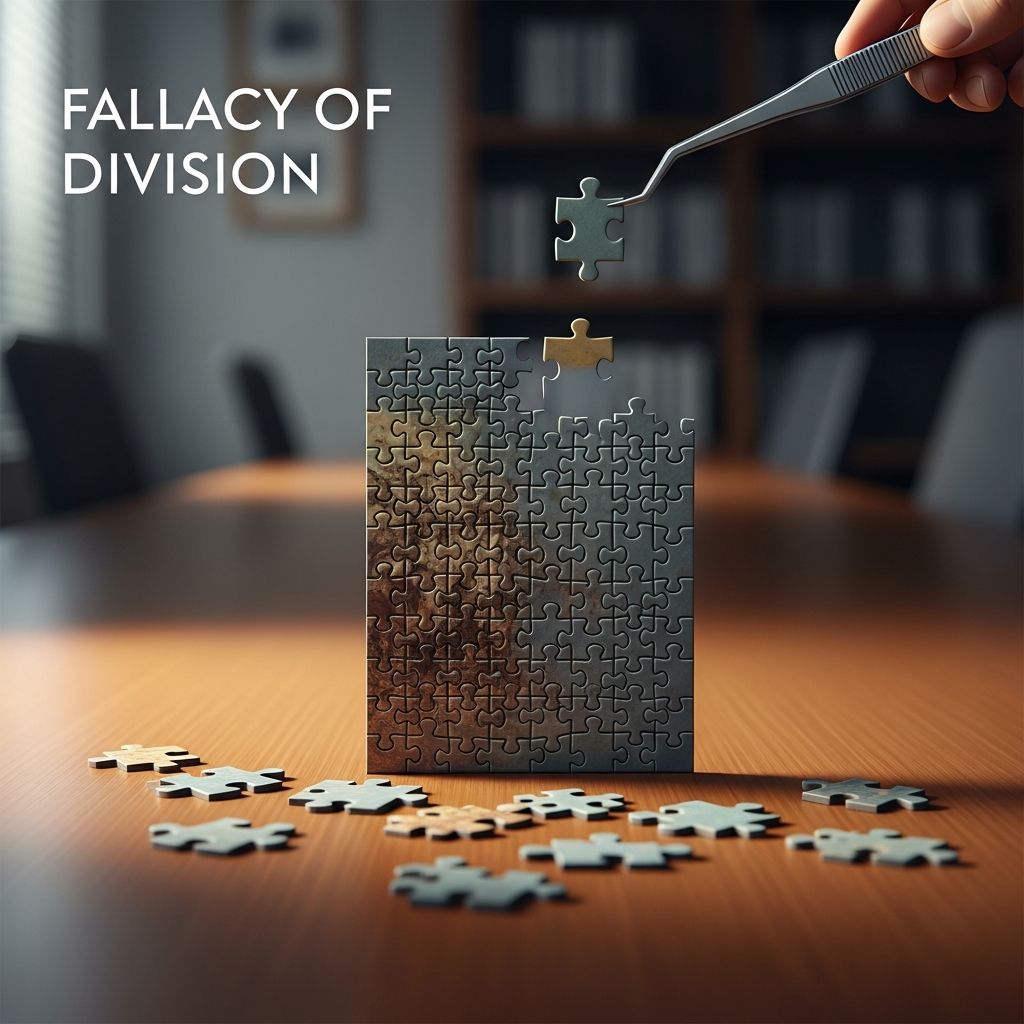
The fallacy of division occurs when someone incorrectly assumes that characteristics true of a whole must also apply to its individual parts. This error undermines logical arguments across philosophy, science, politics, and daily discussions by oversimplifying complex relationships between wholes and parts.
Defining the Core Concept
At its heart, this fallacy reverses valid inference by claiming properties of a collective entity transfer directly to components. Unlike sound logic, where wholes emerge from parts, division fallaciously pushes traits downward without evidence. Philosophers identify it as an informal fallacy because it relies on intuitive but flawed assumptions rather than formal invalidity.
Consider a team winning a championship: the group’s success doesn’t mean every player is individually elite. Emergence plays a key role—wholes can exhibit traits absent in parts due to interactions, like liquidity in water from non-liquid hydrogen and oxygen molecules.
Historical Roots in Logic
Ancient thinkers like Aristotle touched on part-whole confusions in categories, but modern formalization came in 19th-century logic texts. John Stuart Mill warned against such errors in A System of Logic, emphasizing empirical testing over assumption. Today, it’s taught in critical thinking curricula to combat pseudoscience and bias.
In ontology, this fallacy challenges reductionism—the idea that everything reduces to atomic properties. Quantum mechanics exemplifies non-reductive wholes, where particle behaviors differ from observable wholes.
Two Primary Forms of the Fallacy
- Uniform Part Assumption: Claiming every part shares the whole’s trait equally, e.g., a heavy machine implies heavy gears.
- Collection-to-Individual Transfer: Attributing group stats to members, like average team height meaning tall players.
These forms highlight why context matters: definitional links (e.g., gold nugget parts are gold) avoid fallacy, but emergent properties do not.
Everyday Examples Across Contexts
Politics: “The economy is booming, so every worker must be thriving.” Ignores inequality.
Sports: “The orchestra sounds harmonious, so each musician plays perfectly.” Harmony emerges from coordination.
Daily Life: “This salad is healthy, so every vegetable in it is nutritious alone.” Preparation and combination matter.
| Context | Flawed Argument | Why It’s Fallacious |
|---|---|---|
| Business | The company is profitable; thus, every employee earns high wages. | Profits fund operations, not uniform pay. |
| Science | The universe is 13.8 billion years old; each atom is too. | Atoms recycle; age is systemic. |
| Society | Our nation is wealthy; every citizen is rich. | Wealth distribution varies widely. |
Contrasting with Fallacy of Composition
Division’s mirror is composition: assuming part traits define the whole, e.g., “Each brick is light, so the wall is light.” Division flows whole-to-part; composition part-to-whole. Both ignore emergence.
| Fallacy | Direction | Example |
|---|---|---|
| Division | Whole → Part | Team wins gold; every player is a champion. |
| Composition | Part → Whole | Players are fast; team is unbeatable. |
Spotting pairs sharpens analysis: arguments crossing levels need justification.
Why This Fallacy Persists
Cognitive biases fuel it. Representativeness heuristic leads us to stereotype groups onto individuals. Availability bias amplifies vivid wholes over nuanced parts. In groups, social proof reinforces errors, as in mob mentality assuming collective wisdom equals individual sagacity.
Cultural factors: Collectivist societies may overemphasize group traits, while individualist ones reverse via composition. Education gaps exacerbate, as many lack formal logic training.
Advanced Examples from Philosophy and Science
Philosophy: Hegel’s dialectics warn against atomistic division, stressing holistic Geist. In ethics, “Society values justice; every person is just” ignores moral variance.
Science: Ecosystems are stable; thus, each species is stable? Biodiversity buffers wholes.
Economics: GDP growth means personal prosperity for all—fallacy ignores bubbles, debt.
Strategies to Detect and Refute
- Question Emergence: Ask if the property arises from interactions, not parts alone.
- Seek Counterexamples: Find parts lacking the trait, e.g., mosaic tiles aren’t rectangular despite rectangular whole.
- Demand Evidence: Require proof linking whole to part, like statistical distributions.
- Test Definitions: Check if part inherently carries the property.
Practice: Dissect ads claiming “90% effective vaccine means you’re safe”—efficacy is probabilistic.
Real-World Implications in Debates
Politics: Election wins don’t mean voter unanimity. Media: “Nation obese; you’re obese” shames individuals wrongly.
Law: Corporate guilt doesn’t auto-implicate employees without evidence. Science comms: Climate models predict warming; doesn’t mean every weather event is warmer.
Improving Reasoning Skills
Train via Socratic questioning: “Does the whole’s trait necessitate part’s?” Read Mill, study Bayesian updates for probabilities. Debate clubs expose flaws.
Tools: Logic apps, fallacy checklists. Mindfulness counters bias.
Frequently Asked Questions
What distinguishes fallacy of division from valid generalization?
Valid cases have definitional or causal links; fallacies lack them.
Can data prove division fallacies?
Yes, variance stats show non-uniformity.
Is it common in AI reasoning?
Yes, early models overgeneralized aggregates to instances.
How to teach kids to avoid it?
Use toys: Lego castle sturdy; bricks aren’t.
Exceptions exist?
Rarely, like mass: heavy whole from heavy parts.
References
- Fallacy of Division and Composition — Southeastern Baptist Theological Seminary (ses.edu). Accessed 2026. https://ses.edu/fallacy-of-division-and-composition/
- The Fallacy of Division — YouTube (Philosophy Portal). 2023. https://www.youtube.com/watch?v=KGkOD0U6OUo
- Fallacy of Division – Definition and Examples — logical-fallacy.com. Accessed 2026. https://www.logical-fallacy.com/articles/fallacy-of-division/
- Fallacy of Division — Logically Fallacious. Accessed 2026. https://www.logicallyfallacious.com/logicalfallacies/Fallacy-of-Division
- Fallacy of division — Wikipedia. Accessed 2026. https://en.wikipedia.org/wiki/Fallacy_of_division

- Integrated M.A. in Applied Linguistics, University of Hyderabad
- 5+ years in editorial, instructional, SEO, and research-based writing
Sneha is a relationships and lifestyle writer with a strong foundation in applied linguistics and certified training in relationship coaching. She brings over five years of writing experience to theskillvault, crafting thoughtful, research-driven content that empowers readers to build healthier relationships, boost emotional well-being, and embrace holistic living. Her writing and insights reflect the belief that beauty, happiness, and wellness…