
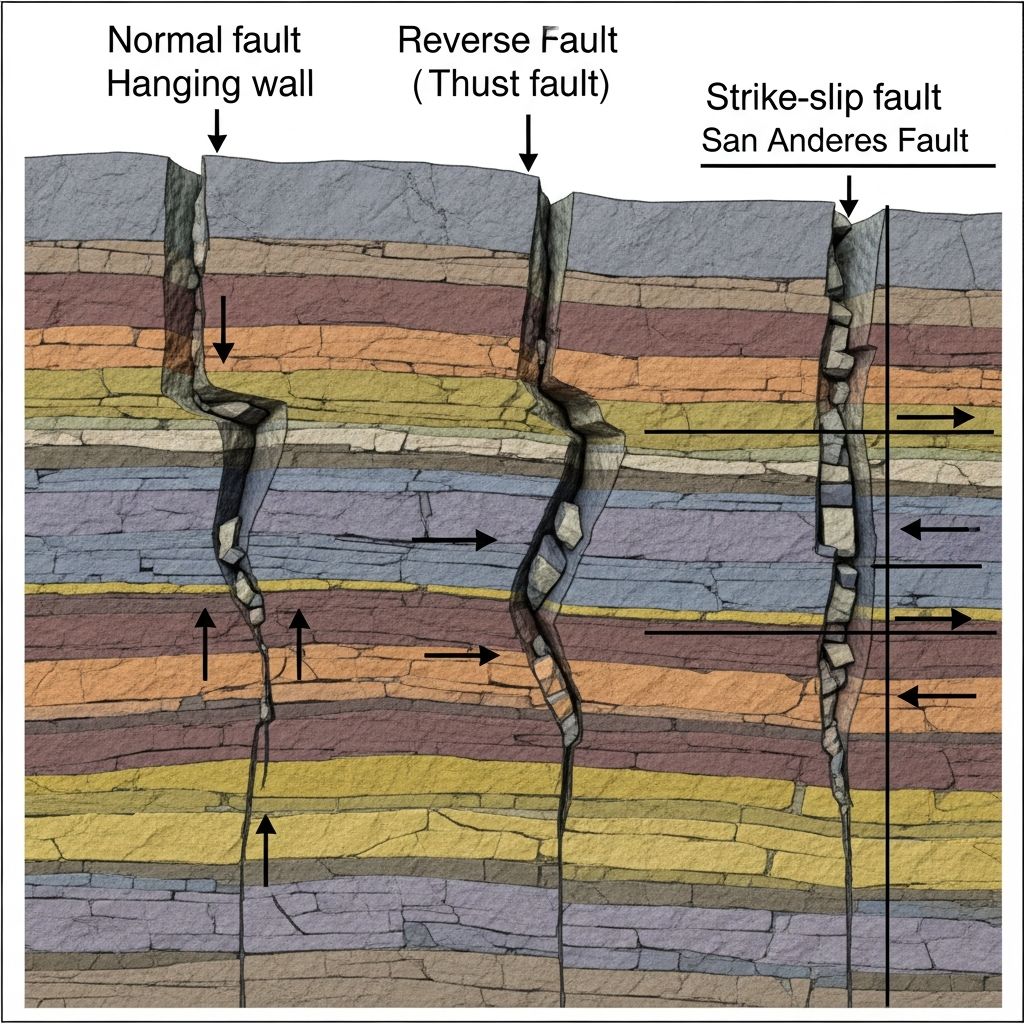
Geological faults represent critical fractures in the Earth’s crust where rock blocks shift relative to one another, driven by tectonic forces. These structures not only trigger earthquakes but also sculpt landscapes and reveal insights into planetary dynamics.
The Nature and Formation of Faults
A fault forms when stress exceeds the rock’s strength, causing a break along which movement occurs. This can happen abruptly during seismic events or gradually through creep. Key terms include the hanging wall (rock above the fault plane) and footwall (rock below), essential for classifying fault types.
Tectonic stresses—tension (pulling apart), compression (squeezing together), and shear (sliding past)—dictate fault behavior. Fault planes vary in dip (angle from horizontal) and strike (compass direction of the line formed by plane and horizontal intersection).
- Tensional stress: Leads to extension, common at divergent boundaries.
- Compressional stress: Causes shortening, typical at convergent margins.
- Shear stress: Produces lateral movement along transform boundaries.
Primary Categories of Dip-Slip Faults
Dip-slip faults involve vertical movement predominantly, with displacement parallel to the dip direction. They dominate in regions of crustal extension or contraction.
Normal Faults: Extension in Action
In normal faults, the hanging wall drops relative to the footwall under tensional stress. These faults dip at 45-70 degrees and create rift valleys or basins. For instance, they form horst-and-graben structures where uplifted blocks (horsts) flank down-dropped basins (grabens).
Visualize a normal fault: the fault plane slopes, and the upper block slides down, often producing parallel sets in extensional zones like mid-ocean ridges.
Reverse Faults and Thrust Variants
Reverse faults occur under compression, where the hanging wall rises over the footwall. Dips are typically 20-45 degrees. A low-angle reverse fault (<30 degrees) is a thrust fault, propelling older rocks over younger ones in mountain belts.
Thrust faults drive fold-thrust belts, as seen in the Appalachians or Himalayas, where massive rock sheets advance tens of kilometers.
| Fault Type | Stress Regime | Typical Dip Angle | Key Feature |
|---|---|---|---|
| Normal | Tension | 45-70° | Hanging wall down |
| Reverse | Compression | 20-45° | Hanging wall up |
| Thrust | Compression | <30° | Low-angle reverse |
Strike-Slip Faults: Horizontal Drama
Strike-slip faults feature near-vertical planes with horizontal, strike-parallel motion. No significant vertical offset occurs, making them hallmarks of transform boundaries.
- Right-lateral (dextral): Opposite sides appear to move right when viewed across the fault.
- Left-lateral (sinistral): Opposite sides shift left.
The San Andreas Fault exemplifies right-lateral strike-slip, where the Pacific Plate slides northwest past the North American Plate.
Oblique-Slip Faults: A Hybrid Movement
Oblique-slip faults blend dip-slip and strike-slip components, resulting from mixed stresses. Slickenlines—grooves on fault surfaces—indicate the slip vector direction.
Right-lateral oblique-slip pairs right-lateral shear with normal or reverse dip-slip, common where plates converge obliquely.
Specialized and Complex Fault Types
Listric Faults: Curved Extensional Paths
Listric faults are curved normal faults, steep near the surface and flattening with depth, like a banana peel. They facilitate hanging wall rollover during extension, prevalent in rift basins.
Conjugate and Duplex Systems
Conjugate faults form pairs at acute angles to the stress direction: normal conjugates in tension, reverse in compression, strike-slip in shear.
Duplexes involve stacked thrust faults (horses) between floor and roof thrusts, building thrust belts through sequential faulting.
Transform, Detachment, and Growth Faults
Transform faults offset ridges at right angles, active only between segments. Detachment faults are low-angle normals decoupling crust layers. Growth faults grow with sediment loading in basins.
Fault Rocks and Slip Indicators
Faulting produces distinctive rocks: brittle zones yield incohesive breccias; ductile settings form cohesive mylonites. Slickenlines and fault breccia provide movement clues.
Global Examples and Tectonic Contexts
Normal faults shape the East African Rift; reverse/thrust build the Rockies; strike-slip define the Alpine Fault in New Zealand. Blind thrust faults, buried under folds, pose seismic risks without surface rupture.
Frequently Asked Questions (FAQs)
What causes most earthquakes?
Sudden slip along faults, especially strike-slip and thrust types, releases built-up stress.
How do geologists identify fault types in the field?
By measuring offset markers, slickensides, and relative hanging wall movement.
Are all faults visible at the surface?
No, blind faults remain subsurface, detectable via seismicity or geophysics.
What’s the difference between a fault and a joint?
Faults show displacement; joints are fractures without movement.
Can faults be active without earthquakes?
Yes, through aseismic creep, as on parts of the San Andreas.
Implications for Hazards and Exploration
Faults influence seismic hazard mapping, oil/gas traps (e.g., rollover anticlines on listric faults), and geothermal energy. Understanding them aids mitigation and resource extraction.
References
- Types of Faults With Photos — Geology In. 2024-09-01. https://www.geologyin.com/2024/09/types-of-faults-with-photos.html
- Faults and Joints — ETH Zurich Structural Geology. 2020-01-01. https://www.files.ethz.ch/structuralgeology/jpb/files/english/3faults.pdf
- Chapter 5 Faults — SDSU Geological Sciences. 2009-06-01. https://earth.sdsu.edu/visualgeology/naturaldisasters/Chapters/Chapter5Faults.pdf
- Faults – Physical Geology Laboratory — VIVA Pressbooks. 2023-01-01. https://viva.pressbooks.pub/physicalgeologylab/chapter/faults/
- 10.3 Faulting – A Practical Guide to Introductory Geology — Open Educational Alberta. 2023-01-01. https://pressbooks.openeducationalberta.ca/practicalgeology/chapter/10-3-faulting/
- What is a fault and what are the different types? — USGS.gov. 2024-01-01. https://www.usgs.gov/faqs/what-a-fault-and-what-are-different-types
- Fault Systems — SC DNR Geology. 2020-01-01. https://www.dnr.sc.gov/geology/pdfs/education/Faults-pg.pdf

- Integrated M.A. in Applied Linguistics, University of Hyderabad
- 5+ years in editorial, instructional, SEO, and research-based writing
Sneha is a relationships and lifestyle writer with a strong foundation in applied linguistics and certified training in relationship coaching. She brings over five years of writing experience to theskillvault, crafting thoughtful, research-driven content that empowers readers to build healthier relationships, boost emotional well-being, and embrace holistic living. Her writing and insights reflect the belief that beauty, happiness, and wellness…