
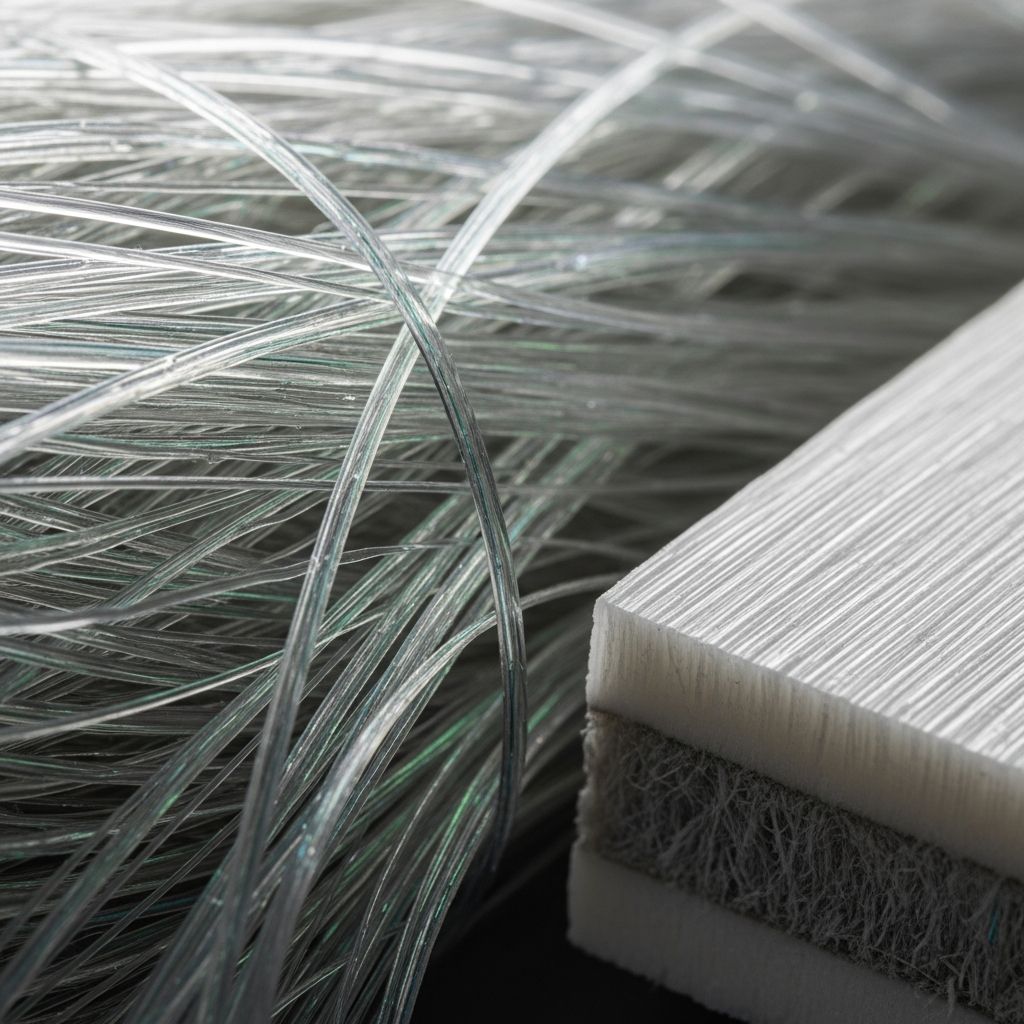
Fiberglass represents a cornerstone of modern composite materials, combining fine glass fibers with a polymer resin to create a lightweight yet robust substance widely utilized across multiple industries. This material excels due to its exceptional strength-to-weight ratio, corrosion resistance, and versatility in molding complex shapes.
Defining Fiberglass and Glass Fiber
At its core, fiberglass is a composite where glass fibers serve as the reinforcement embedded in a resin matrix, distinguishing it from pure glass fiber, which consists solely of extruded glass strands. Glass fibers are thin filaments primarily made from silica and other oxides, offering high tensile strength but requiring a binder like resin to form a structural material. The resin—often polyester, epoxy, or vinyl ester—binds these fibers, enhancing rigidity and environmental durability.
This synergy results in a product stronger than many plastics and lighter than metals, making it ideal for demanding applications. Unlike solid glass, which is brittle, the fibrous structure and resin integration provide flexibility and impact resistance.
The Intricate Manufacturing Process of Fiberglass
Producing fiberglass begins with melting glass at high temperatures, typically around 1,400°C, followed by extrusion through tiny platinum bushings to form continuous filaments. These strands are then gathered into rovings or chopped into shorter lengths, sized with lubricants for handling.
Key steps include:
- Melting and Forming: Raw materials like silica sand, limestone, and soda ash are fused and drawn into fibers.
- Texturizing: Fibers are textured or chopped based on the desired form—continuous for weaving or discrete for mats.
- Resin Impregnation: Fibers are coated with resin via processes like hand lay-up, spray-up, or filament winding.
- Curing: The resin-hardened composite is cured under heat or at room temperature, achieving final rigidity.
Advanced techniques such as pultrusion pull fibers through a resin bath and heated die for precise profiles, while compression molding suits high-volume production. These methods allow customization for specific performance needs.
Key Properties That Drive Fiberglass Popularity
Fiberglass boasts properties that make it indispensable: a tensile strength up to 3,400 MPa for certain types, density around 2.5 g/cm³ (half that of steel), and thermal stability up to 500°C. It resists corrosion from chemicals, saltwater, and UV exposure better than metals, and its non-conductive nature suits electrical applications.
| Property | Value/Characteristic | Comparison to Steel |
|---|---|---|
| Tensile Strength | 1,400–3,400 MPa | Comparable or higher per weight |
| Density | 1.8–2.6 g/cm³ | ~1/4 of steel |
| Corrosion Resistance | Excellent | Superior in harsh environments |
| Thermal Conductivity | Low (insulator) | Far lower |
These attributes stem from the fiber-resin matrix, where fibers bear loads and resin protects against environmental degradation. However, it can be brittle under sharp impacts, necessitating hybrid designs with other materials.
Exploring the Various Types of Fiberglass
Fiberglass variants are tailored by glass composition and fiber arrangement. Common types include:
- E-Glass: Borosilicate-based, standard for electrical insulation and general use, comprising 90% of production.
- S-Glass: Higher silica content for superior strength, used in aerospace and ballistics.
- C-Glass: Corrosion-resistant for chemical tanks and pipes.
- AR-Glass: Alkali-resistant for cement reinforcement.
Fiberglass forms vary too: chopped strand mat for isotropic strength, woven cloth for directional reinforcement, and continuous rovings for filaments winding in pipes or poles. Resin choice further modifies properties—epoxy for adhesion, polyester for cost-effectiveness.
Broad Industrial Applications of Fiberglass
In construction, fiberglass reinforces concrete, forms roofing panels, and creates insulated panels resistant to weathering. Automotive sectors employ it for body panels, reducing vehicle weight by up to 50% for better fuel efficiency.
Marine applications dominate with boat hulls, leveraging corrosion resistance in saltwater. Aerospace uses high-modulus variants for aircraft components, cutting fuel costs. Other uses span wind turbine blades, sports equipment, and consumer goods like bathtubs and surfboards.
Forms and Fabrication Techniques
Fiberglass arrives in diverse formats:
- Mats: Randomly oriented for uniform strength in moldings.
- Woven Fabrics: For layered laminates in high-stress parts.
- Rovings: Bundled strands for braiding or winding.
- Chopped Fibers: For injection molding with thermoplastics.
Fabrication includes open molding (spray-up/lay-up), closed molding (RTM), and automated processes like pultrusion for profiles. These enable complex geometries unattainable with metals.
Advantages, Limitations, and Innovations
Advantages include cost-effectiveness (cheaper than carbon fiber), design flexibility, and recyclability via grinding for fillers. Limitations: moderate impact resistance, potential styrene emissions during production, and UV degradation without gel coats.
Recent innovations hybridize fiberglass with carbon for balanced performance and bio-resins for sustainability. Additive manufacturing integrates fiberglass for 3D-printed composites.
Frequently Asked Questions (FAQs)
What is the primary difference between glass fiber and fiberglass?
Glass fiber refers to the raw strands, while fiberglass is the composite with resin binding those fibers for structural integrity.
Is fiberglass stronger than steel?
By weight, yes—fiberglass offers higher tensile strength per unit mass, though steel excels in absolute stiffness.
Can fiberglass be used in high-temperature environments?
Certain types withstand up to 500°C short-term, but resins limit long-term exposure; specialty variants extend this.
How environmentally friendly is fiberglass?
It’s durable and recyclable, reducing material use, but production energy is high; eco-resins mitigate impacts.
What industries benefit most from fiberglass?
Construction, automotive, marine, aerospace, and renewable energy lead adoption due to its versatile properties.
References
- Fiberglass: History, Characteristics, Types, Forms, and Properties — Xometry. 2023-05-15. https://www.xometry.com/resources/materials/what-is-fiberglass/
- Glass Fiber vs Fiberglass — PersiaResin. 2024-02-10. https://persiaresin.com/en/glass-fiber-vs-fiberglass/
- How to Differentiate Between Glass and Glass Fiber — Yayang Minerals. 2023-11-20. https://www.yayangminerals.com/resources/how-to-differentiate-between-glass-and-glass-fiber.html
- Fiberglass — Wikipedia (referencing standards). 2026-01-01. https://en.wikipedia.org/wiki/Fiberglass
- The Different Types and Forms of Fiberglass and How They Are Used — Tencom Ltd. 2024-03-05. https://www.tencom.com/blog/the-different-types-and-forms-of-fiberglass-and-how-they-are-used
- Fiberglass – Types, Properties, and Applications Across Industries — Phelps Gaskets. 2023-08-12. https://www.phelpsgaskets.com/blog/fiberglass–types-properties-and-applications-across-industries
- What Is Fibreglass or Fiberglass? — Tricel Composites. 2024-06-18. https://www.tricelcomposites.co.uk/construction-and-building/what-is-fibreglass-or-fiberglass/

Medha Deb is an editor with a master's degree in Applied Linguistics from the University of Hyderabad. She believes that her qualification has helped her develop a deep understanding of language and its application in various contexts. Medha specializes in the areas of beauty, health, sports, and wellness and is committed to ensuring that the content on the website is…