
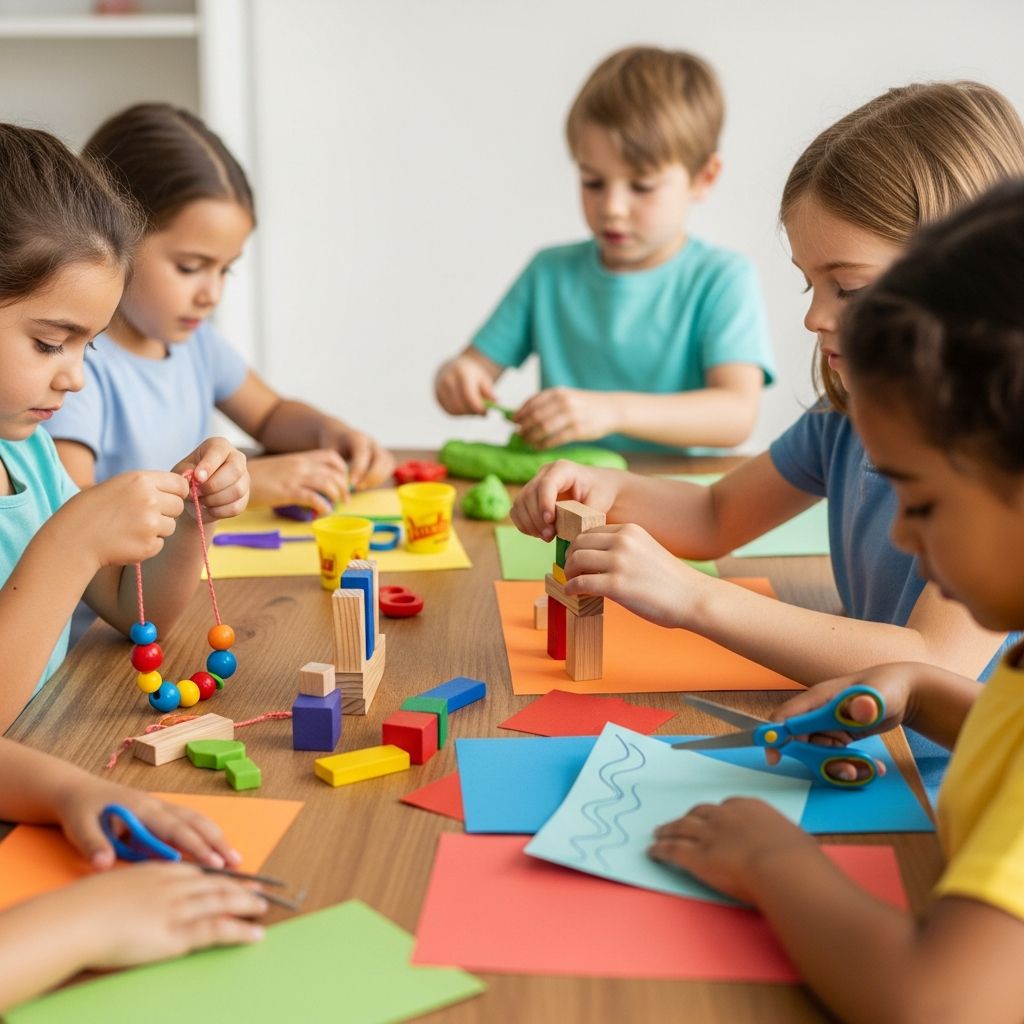
Understanding Hand and Finger Development in Children
The ability to control small muscles in the hands, fingers, and wrists represents a critical milestone in childhood development. These capabilities extend far beyond simple grasping—they encompass the precision, strength, and coordination necessary for children to perform everyday activities such as self-feeding, dressing, and eventually writing. As children grow, their capacity to manipulate objects with increasing accuracy directly influences their readiness for academic tasks and their independence in daily routines.
Understanding the importance of these developmental milestones helps parents and educators create environments where children can naturally progress through play-based activities. Rather than viewing these skills as something to be taught through formal instruction, they emerge organically when children engage in purposeful, enjoyable activities that challenge their growing abilities.
Why Purposeful Play Strengthens Muscle Control and Coordination
Children develop hand strength most effectively through activities they find genuinely engaging. When play feels like fun rather than exercise, children maintain focus longer and repeat movements that build muscle memory. This repetition is essential because developing hand control requires consistent practice over time. Activities that require children to manipulate objects, apply varying levels of pressure, and adjust their grip position naturally strengthen the intrinsic hand muscles.
Additionally, these activities improve the connection between what children see and what their hands do—a relationship known as visual-motor coordination. When a child threads beads onto a string or places stickers within drawn circles, they practice the eye-hand synchronization needed for writing, drawing, and other precise tasks.
Texture-Based Learning Through Moldable Materials
Moldable materials provide immediate tactile feedback and allow children to work at their own developmental level. When children manipulate playdough, putty, or clay, they strengthen hand muscles while experimenting with cause-and-effect. Rolling, squeezing, pinching, and stretching motions engage different muscle groups throughout the hand.
Parents can enhance these activities by introducing tools and challenges:
- Encourage rolling dough into balls and snakes, which develops controlled pressure application
- Introduce plastic scissors for safe cutting practice with moldable materials
- Hide small objects within the material for children to find and extract
- Create recognizable shapes that model everyday items, connecting fine motor practice to conceptual learning
The beauty of moldable materials lies in their versatility—they require no special skills to use, can be homemade affordably, and accommodate children across a wide developmental spectrum.
Construction and Spatial Reasoning Through Building
Building activities with blocks, bricks, and interlocking systems develop hand strength while simultaneously advancing spatial awareness and problem-solving abilities. When children manipulate construction pieces, they practice precision gripping, learn to apply appropriate force, and develop the dexterity required for future writing and typing.
Different building materials serve different developmental purposes:
- Larger construction blocks work well for younger children developing initial grasping patterns
- Interlocking brick systems require snapping and unsnapping motions that build precise finger control
- Traditional unit blocks challenge balance and bilateral coordination as children stack and balance pieces
- Small-scale systems like classic building sets demand pinpoint accuracy and sustained concentration
As children progress, you can encourage increasingly complex structures that require sustained effort and problem-solving, naturally extending the duration and intensity of practice.
Precision Practice Through Threading and Stringing Activities
Threading activities demand that children coordinate their fingers with their visual perception, a fundamental skill underlying handwriting. When children string beads, cereal pieces, or other objects, they practice isolating specific fingers while maintaining focus on a small target.
Progressive stringing activities include:
- Starting with rigid threading implements like pipe cleaners that hold their shape
- Progressing to less structured materials like yarn or string once confidence builds
- Using objects with varying hole sizes to adjust difficulty levels
- Adding timing or counting elements to increase engagement
These activities develop the pincer grasp—the thumb-and-finger grip essential for holding pencils—while also building patience and focus.
Artistic Expression and Motor Development Through Painting
Painting in its various forms offers multiple pathways for developing hand control while fostering creative expression. Different painting techniques strengthen different aspects of motor development:
Finger painting allows children to directly manipulate paint with their hands, building hand and finger strength while providing sensory feedback. The absence of tools in finger painting means children focus entirely on hand movements and pressure control.
Brush painting introduces tool control—an essential precursor skill to pencil use. As children learn to manipulate brushes, they develop the grip patterns and pressure modulation needed for future writing. Paint-by-numbers activities add an additional challenge, requiring children to work within boundaries and practice containment.
The cognitive aspects of painting—deciding which colors to use, how bold to make strokes, and where to place elements—develop problem-solving abilities alongside motor skills.
Real-World Practice Through Culinary Activities
Involving children in food preparation provides authentic, motivating practice for hand skills. The sensory richness and concrete results of cooking make these activities particularly engaging:
- Stirring batter develops wrist rotation and arm strength
- Rolling dough teaches pressure control and bilateral coordination
- Decorating cookies or cupcakes demands precision and fine finger control
- Peeling fruits like clementines and bananas teaches coordinated use of both hands simultaneously
- Removing grapes from bunches (halved lengthwise for safety) practices pincer grasp
Food preparation activities bridge motor development with practical life skills, making them doubly valuable for child development.
Hand-Eye Coordination Games and Challenges
Structured games and activities that challenge coordination and focus keep children engaged while building essential skills. These activities make practice feel playful rather than instructional:
- Bubble poking requires reaching, tracking, and precise finger movements—children can poke with one finger, pinch with two, or grab with their whole hand, adjusting difficulty independently
- Maze tracing improves hand-eye coordination and visual-motor integration while building path-following skills
- Board and card games demand precision when manipulating small game pieces
- Marble and peg activities build timing, coordination, and control through rolling and placing
Outdoor Physical Activities for Integrated Development
Outdoor play develops hand skills within the context of whole-body coordination and strength. Natural environments provide diverse challenges that build multiple aspects of development simultaneously:
- Sidewalk chalk drawing builds hand and finger strength, improves coordination, and stimulates creativity through large-scale drawing
- Garden activities like digging and planting work small hand muscles while lifting watering cans strengthens grip and arm control
- Playground equipment such as climbing structures, slides, and hanging bars builds upper-body strength and reinforces grip strength in hands and fingers
- Hopscotch develops wrist flexibility while improving balance and coordination
Everyday Household Materials as Development Tools
Many household items provide excellent opportunities for motor practice without requiring specialized equipment or expense:
- Pulling grapes from bunches (halved for safety) practices isolation and controlled pulling motions
- Peeling bananas teaches bilateral coordination, as one hand stabilizes while the other pulls
- Operating reusable zipper bags introduces practical living skills alongside motor development
- Sharpening pencils with mechanical sharpeners develops rotational hand control
- Removing stickers practices controlled pinching and improves visual targeting when placing them in designated areas
Progressive Difficulty and Age-Appropriate Sequencing
Effective activity planning considers each child’s current abilities and gradually introduces greater challenges. A child beginning to develop hand skills might enjoy large construction blocks, while the same child months later engages with smaller, more intricate building systems. This natural progression keeps activities engaging and ensures children experience achievable challenges rather than frustration or boredom.
Observable signs of readiness for increased difficulty include sustained focus, independent problem-solving attempts, and requests for harder activities. Rather than moving children forward on a fixed timeline, responsiveness to individual development ensures each child receives appropriate challenge levels.
Frequently Asked Questions
Q: At what age should children begin developing these hand skills?
A: Development begins in infancy with grasping reflexes and progresses through toddlerhood and preschool years. Even very young children can engage in activities like texture exploration and large-object manipulation. Age-appropriate activities should match current developmental levels rather than forcing children into activities designed for older peers.
Q: How much time should children spend on these activities daily?
A: Rather than structured “time limits,” integrating these activities throughout daily routines proves most effective. Brief periods of engagement—10 to 15 minutes—practiced multiple times daily through natural play and routines supports development better than single lengthy sessions.
Q: Should I be concerned if my child prefers certain activities over others?
A: Children naturally gravitate toward activities matching their interests and developmental levels. Preferences indicate engagement, which enhances learning. Rather than forcing participation in non-preferred activities, introduce variety while honoring individual interests.
Q: Can these activities help children prepare for writing?
A: Yes. Building with blocks, threading activities, and tool use like painting and cutting all develop the hand strength, coordination, and control foundational to pencil use and writing.
Q: What if my child seems frustrated during these activities?
A: Frustration indicates the activity may be too challenging or not aligned with current interests. Simplify activities, provide more support, or introduce different types of engagement. The goal is enjoyable challenge, not discouragement.
References
- Fun Fine Motor Skills Activities for Kids – Physical Therapy — Go Physical Therapy Children’s Rehab Center. Accessed 2026-04-04. https://gopt.us/childrensrehabcenter/fun-fine-motor-skills-activities-for-kids/
- Fine Motor Skill Activities for Preschoolers — Excentia Human Services. Accessed 2026-04-04. https://excentiahumanservices.org/fine-motor-skill-activities-for-preschoolers/
- Fine Motor Activities You Can Try at Home — More to Say Speech & Language Pathology. Accessed 2026-04-04. https://moretosayct.com/fine-motor-activities-you-can-try-at-home/
- 35 Fine Motor Activities: Therapists’ Ultimate List — NAPA Center. Accessed 2026-04-04. https://napacenter.org/fine-motor-activities/
- 35 Fine Motor Skills Activities: The Ultimate List by an OT — NAPA Centre Australia. Accessed 2026-04-04. https://napacentre.com.au/fine-motor-activities/
- 30 Ultimate Fine Motor Activities with Household Items — OT Perspective. Accessed 2026-04-04. https://otperspective.com/household-fine-motor-activities/
- Fine Motor Skills: What They Are, Development & Examples — Cleveland Clinic. Accessed 2026-04-04. https://my.clevelandclinic.org/health/articles/25235-fine-motor-skills

Medha Deb is an editor with a master's degree in Applied Linguistics from the University of Hyderabad. She believes that her qualification has helped her develop a deep understanding of language and its application in various contexts. Medha specializes in the areas of beauty, health, sports, and wellness and is committed to ensuring that the content on the website is…