
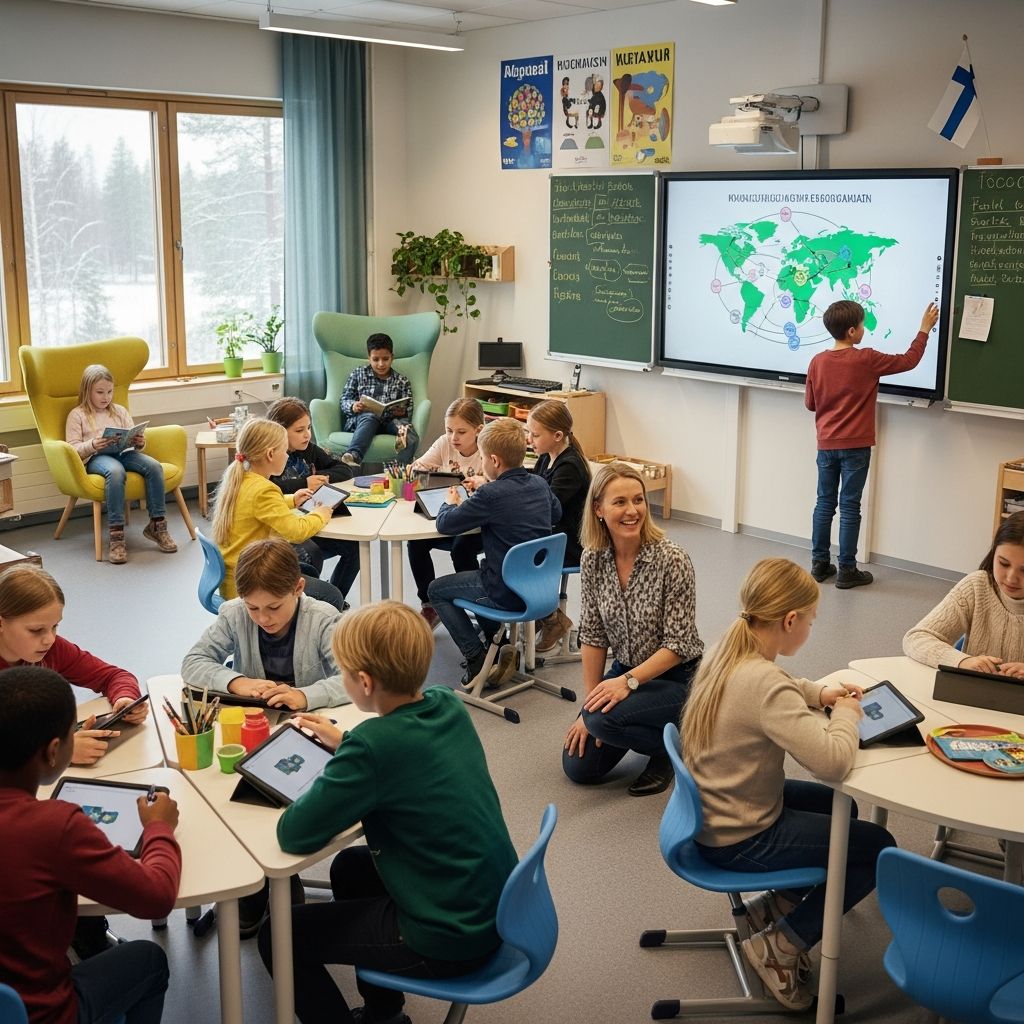
Finland’s education system stands as a global benchmark for balancing academic achievement with student well-being, achieving top rankings in international assessments like PISA through principles of equity, trust, and minimal standardized testing.
Foundations of a World-Class System
The Finnish approach to education emphasizes holistic development over rote memorization, starting from early childhood and extending through lifelong learning. Compulsory education now spans from age 7 to 18, encompassing pre-primary, basic, and upper secondary levels, ensuring every child receives free, high-quality instruction.
Public funding covers nearly all education costs, including meals, materials, and transport, with only about 2% of students in private schools that still receive public support and charge no fees. This structure promotes accessibility regardless of socioeconomic background, fostering a system where local autonomy allows schools to tailor curricula to community needs while adhering to national guidelines.
Early Childhood and Pre-Primary Years
Before compulsory schooling begins, Finland offers early childhood education and care for children from infancy, focusing on play-based learning to nurture social skills and curiosity. At age six, children enter pre-primary education, a one-year program emphasizing creativity, language development, and basic numeracy through interactive activities rather than formal lessons.
This phase sets the tone for the system’s child-centered philosophy, where the goal is to build a love for learning. Participation is nearly universal, with municipalities providing free or subsidized spots to support working parents and ensure equal starts.
Comprehensive Basic Education: Ages 7 to 16
Basic education forms the core of the system, comprising nine years from grades 1 to 9 in a single-structure comprehensive school. No tracking or streaming occurs; all students learn together, with inclusive special education integrated into classrooms to address diverse needs.
The national core curriculum outlines objectives for core subjects like Finnish/Swedish, math, science, and arts, organized by grade bands (1-2, 3-6, 7-9). Municipalities adapt these into local plans, granting teachers significant freedom in methods and pacing. Suggested time allotments ensure balance, but flexibility prevails.
- No standardized tests: Assessment is continuous and teacher-led, based on curriculum goals, minimizing stress and allowing focus on individual progress.
- Short school days: Typically 4-7 hours, with ample breaks for play and outdoor activities, prioritizing well-being.
- Free resources: Meals, books, and transport are provided, removing barriers to attendance.
Upper Secondary Pathways: Choice and Completion
Post-basic education, students aged 16-18 choose between general upper secondary (lukio) or vocational tracks (ammattioppilaitos), both lasting about three years and free until age 20. Compulsory education extends to 18, aiming to reduce dropouts by requiring completion of a qualification.
General upper secondary prepares for university with broad academics, culminating in the matriculation exam—the only national test—for higher education entry. Vocational programs offer practical training aligned with labor needs, with high completion rates.
| Track | Duration | Focus | Outcome |
|---|---|---|---|
| General Upper Secondary | 3 years | Academic subjects | Matriculation exam for university |
| Vocational | 2-3 years | Practical skills | Vocational qualification |
About half pursue each path, reflecting flexible transitions between them.
The Role of Highly Qualified Teachers
Finland’s success hinges on its teaching profession. All teachers hold master’s degrees, selected from top university applicants via rigorous processes. Training emphasizes pedagogy, research, and autonomy, with no formal mentoring required post-graduation due to high preparation standards.
Teachers enjoy high status, competitive salaries, and membership in strong unions, allowing focus on instruction without administrative burdens. Professional development is ongoing, supported nationally.
- Autonomy: Teachers design lessons and assess students independently.
- Equity focus: Special training ensures support for diverse learners.
- Low hierarchy: Flat structures promote collaboration among staff.
Equity and Inclusion at the Core
Finland eliminates disparities through decentralized funding (mostly municipal) and targeted support for remote or disadvantaged areas. Special education serves 1 in 5 students via part-time or full-time aid, preventing low achievement.
Immigrant integration includes language support, and Sami-language programs preserve indigenous rights. Recent reforms address PISA declines by expanding learning support and primary hours.
Higher Education: Accessible and Research-Driven
Universities and universities of applied sciences (UAS) offer bachelor’s, master’s, and doctorates, measured in ECTS credits (60 per year). Admission relies on matriculation scores or entrance exams; tuition is free for EU/EEA students.
Universities focus on research; UAS on applied fields. Adult education provides flexible pathways, recognizing prior learning for qualifications.
Lifelong Learning Opportunities
Finland promotes continuous education via adult programs at all levels, from liberal arts courses to vocational retraining. Competence-based assessments validate informal learning, supporting career changes and personal growth.
High participation rates underscore a culture valuing education throughout life.
Global Recognition and Challenges
Finland dominated early PISA rankings (2000s) due to equity and trust-based reforms from the 1970s. Recent slight declines prompted 2025 measures like flexible group support.
Strengths include high attainment (top OECD upper secondary rates) and well-being focus.
Frequently Asked Questions
What age does compulsory education start and end in Finland?
Compulsory education begins at age 7 with comprehensive school and extends to age 18, including upper secondary completion.
Are there standardized tests in Finnish schools?
No regular national exams exist; only the end-of-upper-secondary matriculation exam. Teachers handle ongoing assessments.
How are teachers trained in Finland?
All require master’s degrees from competitive programs emphasizing pedagogy and autonomy.
Is education free in Finland?
Yes, from pre-primary to higher education, including meals and materials.
What makes Finland’s system equitable?
No tracking, inclusive special ed, free resources, and local adaptations ensure equal opportunities.
References
- Education in Finland — Wikipedia. 2024. https://en.wikipedia.org/wiki/Education_in_Finland
- Finland — National Center for Education and the Economy (NCEE). 2025. https://ncee.org/finland/
- Finnish education system — Ministry of Education and Culture, Finland. 2026. https://okm.fi/en/education-system
- Finnish education system — Finnish National Agency for Education (OPH). 2026. https://www.oph.fi/en/education-system
- Finland’s children-centric school system: a global model for success — Humanium. 2023. https://www.humanium.org/en/finlands-children-centric-school-system-a-global-model-for-success/
- Finland – Overview — Eurydice, European Union. 2026. https://eurydice.eacea.ec.europa.eu/eurypedia/finland/overview

Medha Deb is an editor with a master's degree in Applied Linguistics from the University of Hyderabad. She believes that her qualification has helped her develop a deep understanding of language and its application in various contexts. Medha specializes in the areas of beauty, health, sports, and wellness and is committed to ensuring that the content on the website is…