
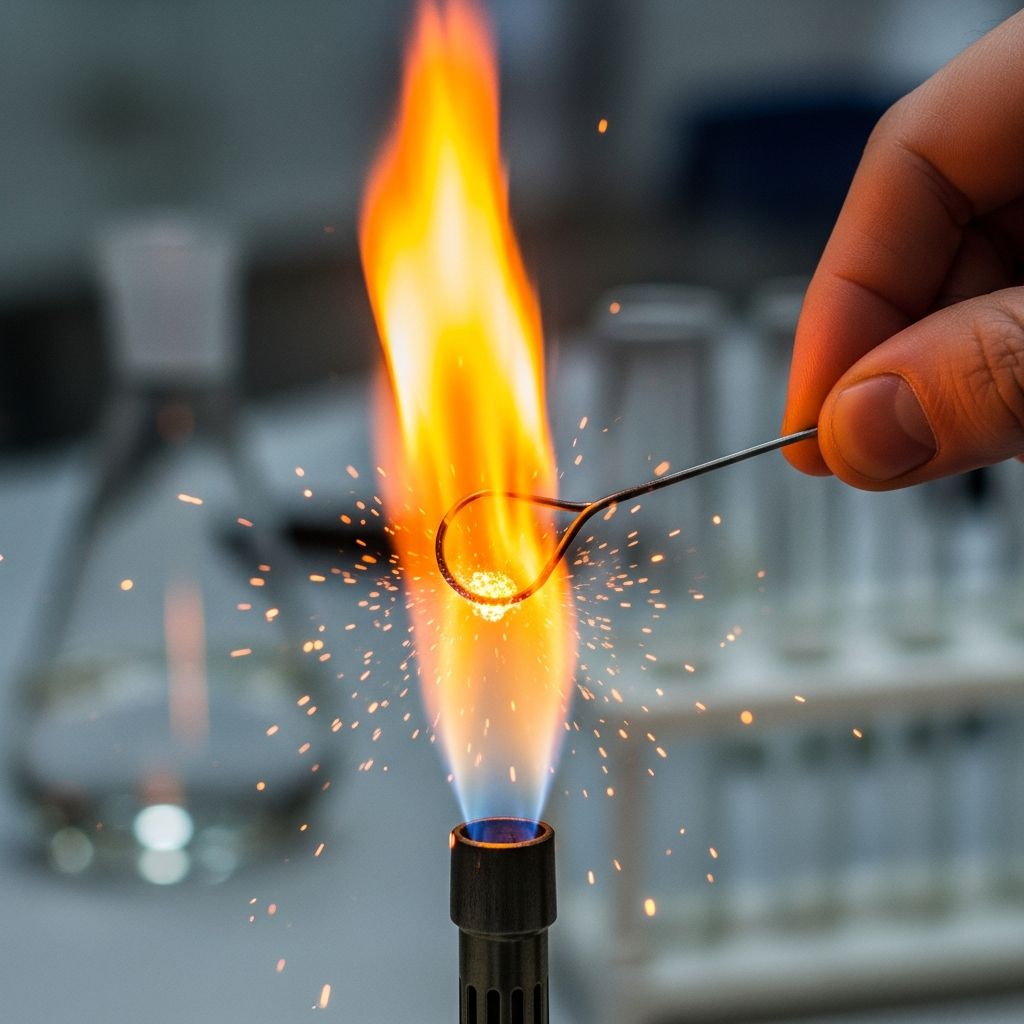
Flame tests represent a foundational technique in analytical chemistry, enabling the identification of metal ions through the observation of distinct colors produced when samples are heated in a flame. This method relies on the excitation of electrons in metal atoms, which emit light of specific wavelengths upon returning to their ground state.
Understanding the Science Behind Flame Colors
At the heart of flame tests lies atomic emission spectroscopy. When metal ions are introduced into a high-temperature flame, typically from a Bunsen burner, the thermal energy excites valence electrons to higher energy levels. As these electrons relax, they release photons corresponding to the energy difference between levels, producing visible light of characteristic colors for each element.
This phenomenon connects directly to quantum mechanics and electron configurations. For instance, sodium ions emit intense yellow light at approximately 589 nm due to transitions in the 3p orbital, while copper produces green-blue hues from d-electron excitations. Understanding these spectral lines provides insight into periodic trends and electronic structure.
Gathering Essential Equipment and Materials
To conduct effective flame tests, assemble the following items:
- Bunsen burner or gas burner for generating a hot flame.
- Wire loops made of nichrome or platinum for sample introduction.
- Metal salt solutions such as LiCl, NaCl, KCl, CaCl2, SrCl2, BaCl2, and CuCl2.
- Distilled water and hydrochloric acid (HCl) for cleaning wires.
- Safety gear including goggles, gloves, and lab coats.
- Wood splints or Q-tips as alternative sample holders.
- Cobalt glass or diffraction grating for spectral analysis.
These materials are standard in high school and undergraduate labs, ensuring accessibility while maintaining precision.
Step-by-Step Guide to Performing Flame Tests
Follow these procedures meticulously for reliable results:
- Prepare the workspace: Work in a well-ventilated area, clear flammable materials, and don protective equipment.
- Clean the wire loop: Dip the loop in HCl, then rinse with distilled water. Heat in the flame until colorless to remove contaminants.
- Collect the sample: Dip the clean loop into the metal salt solution, ensuring a sufficient bead forms.
- Observe the flame: Position the sample in the hottest, blue part of the Bunsen burner flame (cone region). Note the dominant color, intensity, and duration.
- Rinse and repeat: Clean the loop thoroughly between tests to avoid cross-contamination.
- Test unknowns: After calibrating with knowns, identify unknown samples by matching colors.
For group activities, set up rotation stations with different salts to maximize efficiency.
Characteristic Flame Colors of Common Metals
Each metal ion produces a unique signature color, aiding quick identification. The table below summarizes key observations:
| Metal Ion | Flame Color | Approximate Wavelength (nm) | Intensity |
|---|---|---|---|
| Lithium (Li⁺) | Crimson red | 671 | Medium |
| Sodium (Na⁺) | Yellow | 589 | High |
| Potassium (K⁺) | Violet/lilac | 766 | Low |
| Calcium (Ca²⁺) | Orange-red | 622 | Medium |
| Strontium (Sr²⁺) | Scarlet red | 641 | High |
| Barium (Ba²⁺) | Apple green | 524 | Medium |
| Copper (Cu²⁺) | Green-blue | 435 | High |
Data derived from standard lab observations; wavelengths represent peak emissions.
Prioritizing Laboratory Safety Protocols
Safety is paramount in flame tests due to open flames and chemicals. Key measures include:
- Wearing splash-proof goggles, gloves, and flame-resistant clothing.
- Securing long hair and loose clothing away from the flame.
- Using a fire extinguisher or water bowl nearby for emergencies.
- Avoiding inhalation of fumes by working under a fume hood if possible.
- Handling acids carefully and neutralizing spills immediately.
- Never leaving burners unattended; turn off gas after use.
Instructors should demonstrate proper techniques first and supervise all student activities closely.
Advanced Variations and Demonstrations
Elevate basic flame tests with these engaging adaptations:
- Wood splint method: Soak splints in salt solutions overnight for vivid, disposable tests.
- Beaker flame test: Mix salts with ethanol in beakers, ignite vapor for sustained colors without wires.
- Rainbow demo: Sequence splints to create a continuous color spectrum.
- Large-scale shows: Use methanol-soaked salts in balloons or dishes for auditorium displays.
- Spectral analysis: Employ cobalt glass to filter sodium’s yellow, revealing hidden colors, or use spectroscopes for line spectra.
These methods scale from individual labs to public demonstrations, enhancing visual impact.
Troubleshooting Common Issues
Challenges often arise; address them systematically:
- Faint colors: Ensure wire is clean; use fresh solutions; position in hottest flame zone.
- Sodium contamination: Ubiquitous yellow masks others—use cobalt glass viewer.
- Inconsistent results: Standardize soaking time for splints; avoid moist samples.
- Safety flares: If flames spread, cover dishes or use damp cloth to extinguish.
- Weak violet for K: View through blue glass to enhance.
Practice with knowns builds confidence for unknowns.
Educational Value in Classroom Settings
Flame tests bridge theory and practice, illustrating atomic structure, energy quantization, and spectral analysis. Students calculate photon energy using E = hc/λ, linking color to frequency. Integrate with periodic table discussions on group trends—alkali metals show similar reds, alkaline earths oranges.
This lab fosters inquiry skills: hypothesize colors, test predictions, analyze data in tables like the one above. Extensions include fireworks chemistry (strontium for red, barium for green) or forensic ion detection.
Applications Beyond the Lab
Flame tests inform real-world fields:
- Fireworks and pyrotechnics: Precise color mixing for displays.
- Geology/Mining: Ore prospecting via field-adapted tests.
- Forensics: Trace metal identification in evidence.
- Environmental monitoring: Detecting metal pollutants in water.
- Historical pigment analysis: Authenticating art via metal signatures.
Though qualitative, it complements quantitative methods like AAS.
Frequently Asked Questions (FAQs)
What causes the colors in a flame test?
Colors arise from excited electrons dropping energy levels, emitting photons of specific wavelengths unique to each metal.
Why is sodium’s yellow flame so persistent?
Sodium is common in sweat, glassware, and air; its strong emission at 589 nm overwhelms subtler colors.
Can flame tests identify all metals?
No, limited to those with visible emissions; pairs like K/Na require filters.
Is this safe for home experiments?
Not recommended without lab training; risks include burns and toxic fumes—use supervised settings.
How do flame tests relate to spectra?
Flame colors are broad bands from multiple lines; spectroscopes reveal discrete lines for precise ID.
Quantitative Analysis: Calculating Emission Energies
Extend observations by computing energies. For a 589 nm sodium emission:
Frequency ν = c/λ = (3.00 × 10⁸ m/s) / (589 × 10⁻⁹ m) = 5.09 × 10¹⁴ Hz
Energy E = hν = (6.626 × 10⁻³⁴ J·s)(5.09 × 10¹⁴ s⁻¹) = 3.37 × 10⁻¹⁹ J per photon.
Per mole: 2.03 × 10⁵ J/mol (203 kJ/mol). Such calculations reinforce Planck’s relation.
In labs, students tabulate wavelengths from color charts, plot energies, and compare to electron transitions.
References
- Flame Tests Chemistry Lab for High School — Amy Brown Science. 2014-03-01. https://www.amybrownscience.com/2014/03/flame-tests-favorite-chemistry-lab.html
- Flame Tests — University of Washington Department of Chemistry. Accessed 2026. https://chem.washington.edu/lecture-demos/flame-tests
- Flame Test — MEL Chemistry. Accessed 2026. https://melscience.com/US-en/chemistry/experiments/flame-v3_green-sparkles/
- Teaching Guide: Scaling a Flashy Demonstration — Purdue University Chemistry. Accessed 2026. https://www.chem.purdue.edu/bcce/Scaling_a_flashy_demonstration.pdf
- Flame Tests and Atomic Spectra (Experiment) — Chem LibreTexts (UC Davis). 2023-08-15. https://chem.libretexts.org/Ancillary_Materials/Laboratory_Experiments/Wet_Lab_Experiments/General_Chemistry_Labs/Online_Chemistry_Lab_Manual/Chem_9_Experiments/05:_Flame_Tests_and_Atomic_Spectra_(Experiment)

- Integrated M.A. in Applied Linguistics, University of Hyderabad
- 5+ years in editorial, instructional, SEO, and research-based writing
Sneha is a relationships and lifestyle writer with a strong foundation in applied linguistics and certified training in relationship coaching. She brings over five years of writing experience to theskillvault, crafting thoughtful, research-driven content that empowers readers to build healthier relationships, boost emotional well-being, and embrace holistic living. Her writing and insights reflect the belief that beauty, happiness, and wellness…