
Understanding Florida’s Most Recognizable Flying Insects
When spring arrives in Florida, residents brace themselves for an inevitable natural phenomenon that transforms windshields into splattered memorials and prompts countless calls to pest control companies. These are lovebugs, small insects that have become as synonymous with Florida as sunshine and orange juice. Yet despite their prominence in the state’s seasonal landscape, widespread misconceptions surround their origins, behavior, and ecological significance. Understanding what lovebugs truly are requires looking beyond the urban legends and examining the scientific reality of these peculiar creatures.
Taxonomic Classification and Physical Characteristics
Lovebugs, scientifically identified as Plecia nearctica, belong to the Bibionidae family, commonly known as march flies. These diminutive insects measure approximately a quarter inch in length, making them relatively inconspicuous when observed individually. However, their significance becomes immediately apparent when they gather in massive swarms during their active seasons. The insects share evolutionary relationships with gnats and fungus flies, though they lack the aggressive behavioral traits associated with mosquitoes or biting flies.
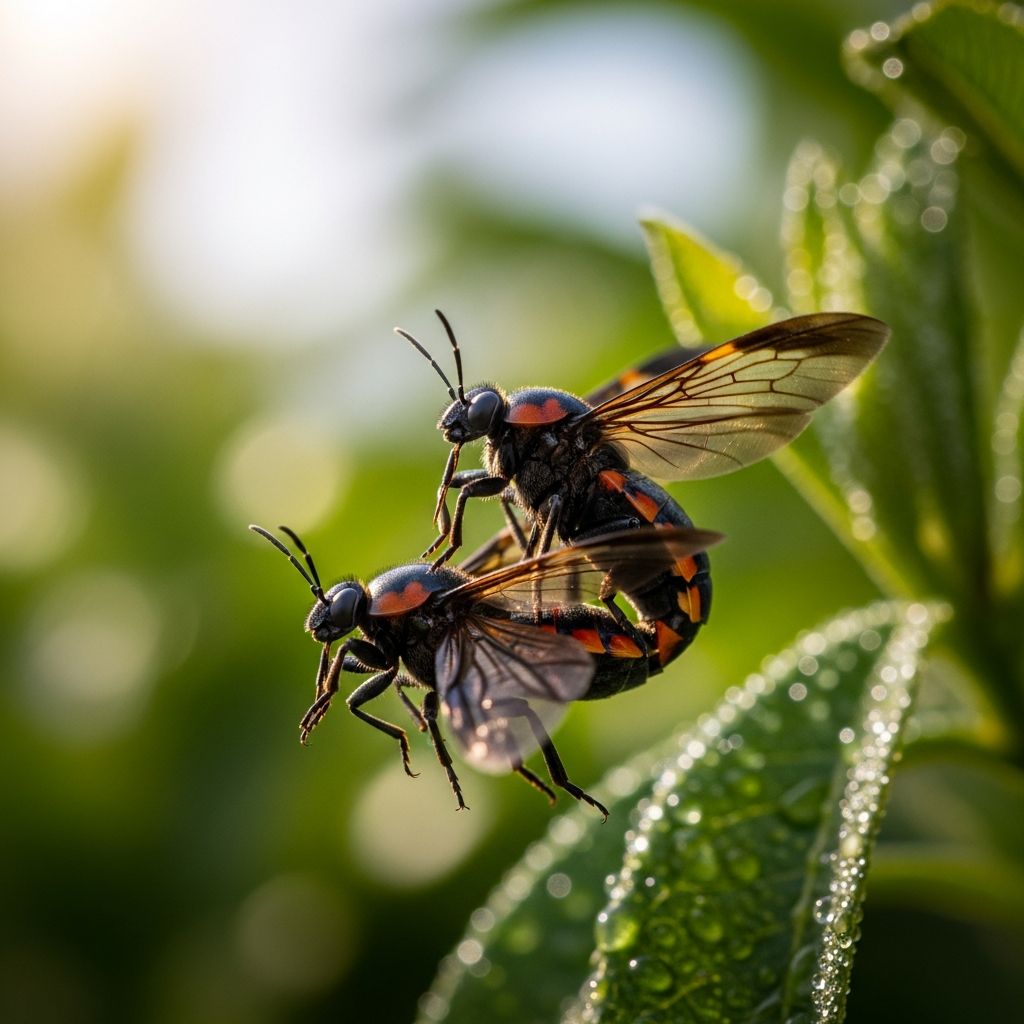
Physically, adult lovebugs display a dark coloration that aids in their recognition. Their most distinctive feature becomes apparent only when observing their behavior in flight—a characteristic that inspired their colloquial name and cemented their place in popular culture.
The Remarkable Mating Behavior That Defines Their Identity
The defining characteristic of lovebugs emerges from their extraordinary mating strategy. Unlike most insect species where males and females briefly engage in reproductive activities before separating, lovebugs maintain physical connections that persist for extended periods. Pairs remain attached for periods ranging from several hours to multiple days, flying together in coupled formation while continuing to feed and navigate their environment. This prolonged attachment, during which sperm transfer requires approximately 12.5 hours, creates the distinctive “double-bodied” appearance that gives these insects their romantic nickname.
During their coupled phase, lovebugs maintain simultaneous engagement in multiple activities. While physically connected, the paired insects continue feeding on nectar from available flowering plants, particularly goldenrod and pepper plants. They also navigate their environment and travel considerable distances before finally separating to pursue their individual missions of egg-laying and survival completion.
Life Cycle and Developmental Stages
The complete life cycle of lovebugs spans approximately six months, divided into distinct phases that shape their ecological presence throughout the year. Adult insects, the visible stage that garners so much public attention, live only three to four days—a remarkably brief existence. During this short window, their singular focus remains on mating and reproduction, with little energy devoted to other activities that might contribute significantly to ecosystem processes.
After mating concludes, females deposit their eggs in the ground, typically beneath decaying plant material that provides optimal environmental conditions and nutritional resources for developing offspring. A single female can lay between 200 to 300 eggs, establishing large populations for the following generation. These eggs develop underground for extended periods, undergoing transformation through larval stages before eventually emerging as adults. The larval phase comprises the majority of the lovebug’s life history, during which the insects play a meaningful ecological role by decomposing organic matter and enriching soil nutrient composition.
Seasonal Emergence Patterns and Geographic Distribution
Floridians have come to recognize two distinct lovebug seasons as reliably as meteorological summer or autumn. The primary emergence occurs in late spring, typically spanning April through May, while a secondary population emerges in late summer through September. These seasonal peaks result from temperature triggers and moisture conditions that signal optimal emergence conditions for adults.
Lovebugs are most frequently observed during daylight hours when ambient temperatures exceed 68 degrees Fahrenheit, with peak activity occurring between 10 a.m. and 6 p.m. when conditions reach approximately 84 degrees Fahrenheit. This daytime preference, combined with their seasonal emergence patterns, creates the predictable cycles that residents have adapted to over decades.
Originally from Central America, lovebugs expanded their geographic range northward during the 20th century, traveling through Texas and Louisiana before establishing populations in Florida by 1949. From this foothold, they have since spread throughout the state and beyond, becoming increasingly recognized across the southern United States. However, recent decades have witnessed declining populations in many areas, with some regions showing substantially reduced lovebug abundance compared to historical patterns.
Ecological Contributions and Environmental Significance
While adult lovebugs often receive negative attention for their automotive windshield encounters, their larval stage contributes meaningfully to ecological processes. Larvae actively decompose dead plant material, leaf litter, and other organic debris, facilitating nutrient cycling and soil enrichment. This decomposition process, though unglamorous, represents an important ecosystem service that many organisms depend upon indirectly. Without such decomposers, organic matter would accumulate excessively, disrupting soil chemistry and plant growth patterns.
Adult lovebugs, by contrast, provide minimal direct ecological benefit despite their abundance. Their nectar feeding contributes negligibly to pollination services, as their short adult lifespan and restricted activity patterns limit their interaction with diverse flowering plant species. Unlike honeybees or butterflies, which extensively visit varied flowers throughout their extended adult lives, lovebugs focus narrowly on reproduction and immediate survival needs. However, they do serve as food sources for predators including spiders, dragonflies, and various bird species, contributing to broader food web dynamics.
Debunking Persistent Urban Legends
Few insects have generated as many myths and misconceptions as the humble lovebug. Perhaps the most enduring false claim suggests that University of Florida scientists genetically engineered lovebugs as biological control agents against mosquitoes. This narrative, despite widespread circulation, lacks any factual foundation. Lovebugs are herbivorous insects lacking the predatory mandibles or locomotion speed necessary to hunt mosquitoes. Additionally, their daytime activity patterns contrast sharply with the twilight emergence preferences of most mosquito species, making predation biologically implausible.
| Myth | Factual Reality |
|---|---|
| University of Florida scientists created lovebugs through genetic engineering | Lovebugs naturally migrated from Central America through Texas and Louisiana to Florida |
| Lovebug acid completely destroys vehicle paint | Macerated lovebugs become acidic only after 24 hours; prompt washing prevents permanent damage |
| Lovebugs intentionally attack automobiles | Females mistake vehicle exhaust chemicals for decomposing organic matter at egg-laying sites |
| Lovebugs continuously mate during their paired phase | Sperm transfer requires 12.5 hours; pairs remain attached for feeding and travel afterward |
| Lovebugs possess no natural predators | Spiders, dragonflies, and birds actively predating on lovebugs |
Another common misconception attributes lovebugs’ attraction to vehicles as a deliberate or targeted behavior. Reality proves more nuanced: female lovebugs utilize UV-irradiated aldehydes present in vehicle exhaust as chemical cues, mistaking these compounds for odors released by decomposing organic matter at suitable egg-laying sites. This misidentification results from evolutionary adaptations developed in natural environments where such chemical signals reliably indicated suitable reproductive habitat.
Many drivers also fear permanent paint damage from lovebug splatter, assuming their bodies contain caustic substances that immediately dissolve automotive finishes. In actuality, lovebugs only develop acidic properties approximately 24 hours after maceration, meaning prompt washing prevents any permanent deterioration. The unsightly staining results from organic matter decomposition rather than chemical corrosion.
Population Dynamics and Potential Decline
Recent scientific investigations have documented concerning trends in lovebug populations across Florida, with some regions experiencing marked reductions in abundance over the past three to four years. Urban areas in north-central Florida have witnessed particularly dramatic declines, with lovebugs virtually disappearing from their previously predictable locations while persisting in rural farmland and pasture environments where larval habitat remains undisturbed. This geographic unevenness suggests that habitat alteration may be driving population reductions.
Climate change emerges as a plausible explanation for observed population dynamics. Lovebugs, originating from tropical regions, demonstrate sensitivity to temperature and moisture conditions outside their evolutionary comfort range. Warming climates may disrupt the seasonal synchronization that triggers emergence, potentially altering the precise timing that enables successful mating and reproduction. Simultaneously, changes in soil moisture patterns—whether through increased drying or excessive rainfall—could compromise larval survival in underground developmental habitats.
Paradoxically, while declining populations might relief frustrated drivers, ecologists express concern about what this reduction represents. Lovebugs’ decline signals broader insect population collapses occurring globally, with approximately 40% of all insects experiencing population reductions worldwide. When a once-abundant species suddenly disappears, it raises troubling questions about concurrent losses among species that fulfill more critical ecosystem functions.
Why Pest Control Proves Ineffective Against Lovebugs
Frustrated homeowners and business operators often seek professional pest control services to combat lovebug invasions, only to learn that conventional approaches provide minimal effectiveness. Unlike structured pest infestations such as termite colonies or cockroach populations, lovebugs present fundamentally different control challenges. Insecticides, sprays, and traps designed for mosquitoes or ants show little promise against lovebugs, primarily because of their outdoor mating behavior, brief adult lifespan, and massive population volumes.
Lovebugs reproduce in open environments, lay eggs in dispersed soil locations, and complete their adult lives within days—a lifecycle pattern incompatible with traditional pest management models. Their erratic flight patterns and weather-dependent population booms resist predictable treatment schedules. Additionally, the sheer numerical abundance during peak seasons renders individual removal strategies impractical at the population level. These biological realities explain why Florida residents have simply learned to coexist with lovebug seasons rather than attempting eradication.
Practical Considerations for Affected Residents
While lovebugs present no direct danger to humans or pets, their presence warrants practical management strategies. Drivers frequently encounter these insects on roadways and windshields, creating visibility hazards and requiring frequent cleaning. Prompt washing of affected vehicles minimizes the cosmetic impact of lovebug splatter and prevents any minor corrosion that could develop after 24 hours.
Lovebugs accidentally entering vehicles typically perish within hours due to their absolute requirement for outdoor moisture and nectar sources. Unlike cockroaches or other indoor pests, they cannot establish populations within human structures or vehicles. This limitation provides reassurance that lovebug encounters remain superficial rather than representing genuine infestations requiring professional intervention.
Common Questions About Florida’s Love Bugs
Q: When exactly should Floridians expect peak lovebug activity?
A: Primary emergence occurs in April and May, with secondary populations appearing in August and September. Peak mating periods typically last approximately four weeks during these seasonal windows.
Q: Are lovebugs truly harmless to humans?
A: Yes, lovebugs cannot inflict physical harm to people or animals. They lack biting or stinging capabilities and pose no disease transmission risk.
Q: Will lovebugs disappear from Florida permanently?
A: Unless catastrophic environmental disruptions occur involving major temperature or rainfall pattern changes, lovebugs will almost certainly continue appearing annually in Florida. However, declining populations suggest their abundance may continue decreasing in coming years.
Q: How can vehicle owners minimize lovebug damage?
A: Prompt washing prevents cosmetic damage and minor corrosion. Avoid allowing lovebug splatter to dry or bake in direct sunlight before cleaning.
Q: What natural predators help control lovebug populations?
A: Spiders, dragonflies, and various bird species actively prey on lovebugs, though predation rates appear insufficient to significantly suppress population levels.
References
- Love Bugs in Florida: What They Are & How to Deal with Them — Hoffer Pest Control. 2025. https://www.hofferpest.com/blog/2025/july/love-bugs-in-florida-what-they-are-how-to-deal-w/
- Florida’s declining lovebug population may make for cleaner windshields but it signals a troubling trend — WUFT Public Radio. 2024-10-21. https://www.wuft.org/environment/2024-10-21/floridas-declining-lovebug-population-may-make-for-cleaner-windshields-but-it-signals-a-troubling-trend
- What Makes Lovebugs Appear and Disappear? — University of Central Florida College of Sciences. https://www.youtube.com/watch?v=9Q2J_zmWLbE
- Are lovebugs disappearing from Florida? Here’s what we know — Click Orlando. 2024-09-20. https://www.clickorlando.com/news/florida/2024/09/20/are-lovebugs-disappearing-from-florida-heres-what-we-know/
- Lovebugs In Florida: What They Are & Why They’re A Hazard — Antipesto Pest Control. https://www.antipesto.com/blog/post/florida-lovebugs-what-are-they-and-why-are-they-such-a-hazard
- The Coming Season: Lovebugs — Fish & Wildlife Foundation of Florida. https://wildlifeflorida.org/the-coming-season-lovebugs/
- Sustainability-Love Bugs — University of Florida IFAS Extension. https://sfyl.ifas.ufl.edu/natural-resources/sustainability-love-bugs/

Medha Deb is an editor with a master's degree in Applied Linguistics from the University of Hyderabad. She believes that her qualification has helped her develop a deep understanding of language and its application in various contexts. Medha specializes in the areas of beauty, health, sports, and wellness and is committed to ensuring that the content on the website is…