
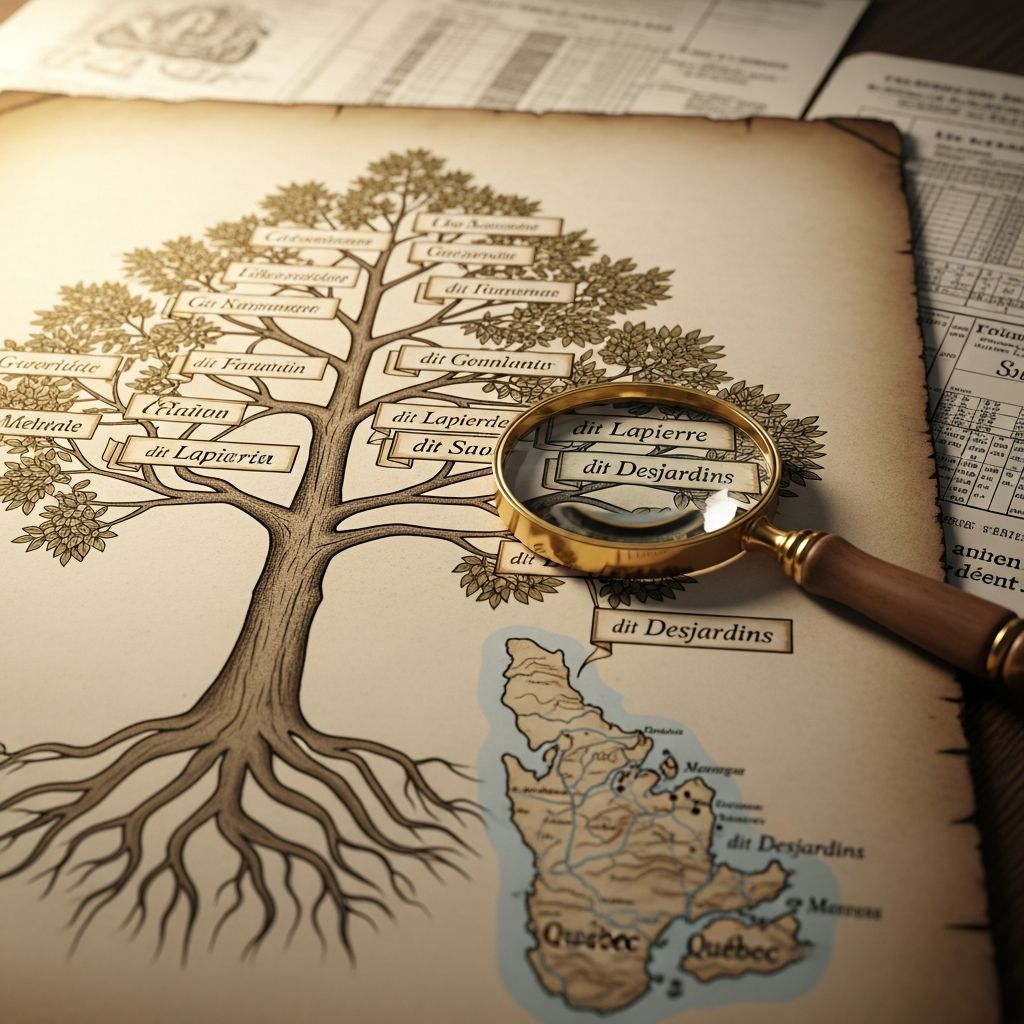
French-Canadian genealogy often encounters the intriguing custom of dit names, secondary surnames connected by ‘dit’ or ‘dite’ that served as aliases for entire families. These names, translating to ‘called’ or ‘known as,’ emerged to distinguish households sharing primary surnames in colonial New France and persisted into later centuries.
Origins and Historical Context of Dit Names
The tradition of dit names traces back to France, where it helped differentiate families in close-knit communities. Soldiers in pre-revolutionary armies adopted them as nom de guerre, nicknames reflecting exploits or traits. Upon migrating to New France (modern Quebec), settlers carried this practice, applying it to civilian life amid sparse populations and common surnames.
In Quebec, dit names proliferated from the 1600s to the mid-1800s, appearing in church records, censuses, and land deeds. Both the primary surname and dit name held equal legal validity, used interchangeably for baptisms, marriages, and inheritances. This duality sometimes evolved into hyphenated forms like Miville-Deschênes, blending both permanently.
- Military Influence: Recruits picked evocative aliases during service, later passed to descendants.
- Community Needs: In parishes with multiple Tremblay or Gagnon families, dit names prevented mix-ups.
- Cultural Spread: Similar customs appeared in Jersey, Italy, and Scottish clans, but flourished uniquely in French Canada.
How Dit Names Were Formed and Assigned
Dit names drew from diverse inspirations, creating a rich tapestry of identifiers. Families adopted them organically, often without formal registry, leading to variations across generations.
| Category | Examples | Explanation |
|---|---|---|
| Geographic Origins | Lavallee, Lamontagne, Le Picard | Referenced hometowns, regions, or countries like Picardie or Switzerland. |
| Physical Traits | Leblond (the blond), Leroux (the redhead), Le Fort | Described appearance or build. |
| Occupations | Chartier (cart maker), Meunier (miller), Vanier | Reflected trades or roles. |
| Nature Elements | Lafleur (the flower), Lafeuille (the leaf) | Drew from flora or landscapes. |
| Personal or Moral | Lebon (the good), Lesage (the wise) | Highlighted character or deeds. |
| Ancestral Names | Dit Grégoire, Dit Robert | Incorporated mother’s or father’s given names. |
Over 7,500 distinct dit names are documented in Quebec records, underscoring their prevalence. A single lineage might use multiple over time, with some fading while others dominated.
Grammatical Forms: Dit vs. Dite
The masculine ‘dit’ pairs with male subjects, as in Pierre Verger dit Bertaut. For females, ‘dite’ applies: Marie Verger dite Bertaut. This gender agreement appears consistently in vital records, aiding in parsing full names.
In practice, descendants might drop the connector, using only the dit name or hyphenating it. Genealogists must recognize these shifts to connect records accurately.
Challenges in Genealogical Research
Dit names complicate ancestry tracing, as individuals appear under varying surnames across documents. A baptism might list ‘Jean Tremblay dit Lavallee,’ while a marriage records ‘Jean Lavallee,’ and a burial ‘Tremblay.’ Without context, these seem unrelated.
- Record Variability: Clergy chose which name to emphasize based on local familiarity.
- Family Drift: Later generations favored one name, obscuring links.
- Multiple Aliases: Some families accumulated layered dit names from different ancestors.
To overcome this, researchers cross-reference parish registers, notarial acts, and censuses. Tools like PRDH (Programme de recherche en démographie historique) index both names for Quebec ancestors from 1621-1850.
Practical Strategies for Tracing Dit Names
Effective research demands systematic approaches:
- Compile All Variants: Note primary and dit names from every record.
- Examine Contexts: Geographic clues often match dit names to origins.
- Use Specialized Databases: Sites like FrenchGen and GenealogieQuebec compile dit associations.
- Study Neighbors: Dit names clarified relations in seigneuries with duplicate surnames.
- Hyphen Clues: Pre-1950 hyphens usually signal original + dit.
Example: Tracking François Hudon dit Beaulieu reveals children as Hudon, Beaulieu, or Hudon-Beaulieu, requiring vigilant searching.
Evolution and Decline of the Custom
By the 1850s, urbanization and standardized civil registration diminished dit name usage. Post-Confederation Quebec favored single surnames, though echoes persist in double-barreled names. Today, they offer invaluable heritage insights.
Modern genealogists leverage dit names for breakthroughs, revealing migrations, adoptions, or noble ties. An estimated 70-80% of early Quebec settlers’ descendants carry dit legacies in their trees.
Real-World Examples from Historical Records
Consider Adele Létoile dit L’Italien: ‘Létoile called the Italian,’ pinpointing Italian ancestry amid French surnames. Or Gareman dit Le Picard, signaling Picardie roots.
These cases illustrate how dit names preserved identity in melting pots like 17th-century Montreal or Trois-Rivières.
Frequently Asked Questions (FAQs)
What exactly is a dit name?
A dit name is a secondary surname used by French-Canadian families, connected by ‘dit’ (masc.) or ‘dite’ (fem.), meaning ‘known as’ to distinguish from others.
Why did families adopt dit names?
Primarily to differentiate from same-surname neighbors, plus origins from places, traits, jobs, or military service.
Which name is the ‘real’ surname?
Both hold equal validity; neither supersedes the other legally or genealogically.
Do dit names still exist today?
Rarely in daily use post-1900s, but hyphenated forms persist, and they’re crucial for historical research.
How do I find dit names for my ancestors?
Search Quebec church records, use dit-name dictionaries, and databases like Drouin Collection for associations.
Are dit names unique to Quebec?
No, origins in France, also in Jersey, Scotland, Italy, but most prolific in French Canada.
This comprehensive guide equips you to decode dit names, transforming potential roadblocks into genealogical treasures. With patience and the right tools, your family history unfolds vividly.
References
- What Are French ‘Dit’ Names? — FrenchGen. Accessed 2026. https://frenchgen.com/what-are-dit-names/
- Dit name — Wikipedia. Accessed 2026. https://en.wikipedia.org/wiki/Dit_name
- What is a nom dit and why did my French Canadian ancestor have… — Heritage Discovered. 2023-05-15. https://www.heritagediscovered.com/blog/nom-dit-why-french-canadian-ancestor-have
- dit Names Explained — Girouard Family. Accessed 2026. http://www.girouard.org/cgi-bin/page.pl?file=dit&n=4
- The nicknames and “dit names” of French-Canadian ancestors — The Discover Blog. 2014-01-30. https://thediscoverblog.com/2014/01/30/the-nicknames-and-dit-names-of-french-canadian-ancestors/
- What’s in a Name? Understanding French Canadian ‘dit’ Surnames — Roam Your Roots. Accessed 2026. https://www.roamyourroots.com/blog/whats-in-a-name-understanding-french-canadian-dit-surnames
- French-Canadian “dit names” and nicknames — Généalogie Québec. 2019-06-05. https://www.genealogiequebec.com/blog/en/2019/06/05/french-canadian-dit-names-and-nicknames/

Medha Deb is an editor with a master's degree in Applied Linguistics from the University of Hyderabad. She believes that her qualification has helped her develop a deep understanding of language and its application in various contexts. Medha specializes in the areas of beauty, health, sports, and wellness and is committed to ensuring that the content on the website is…