
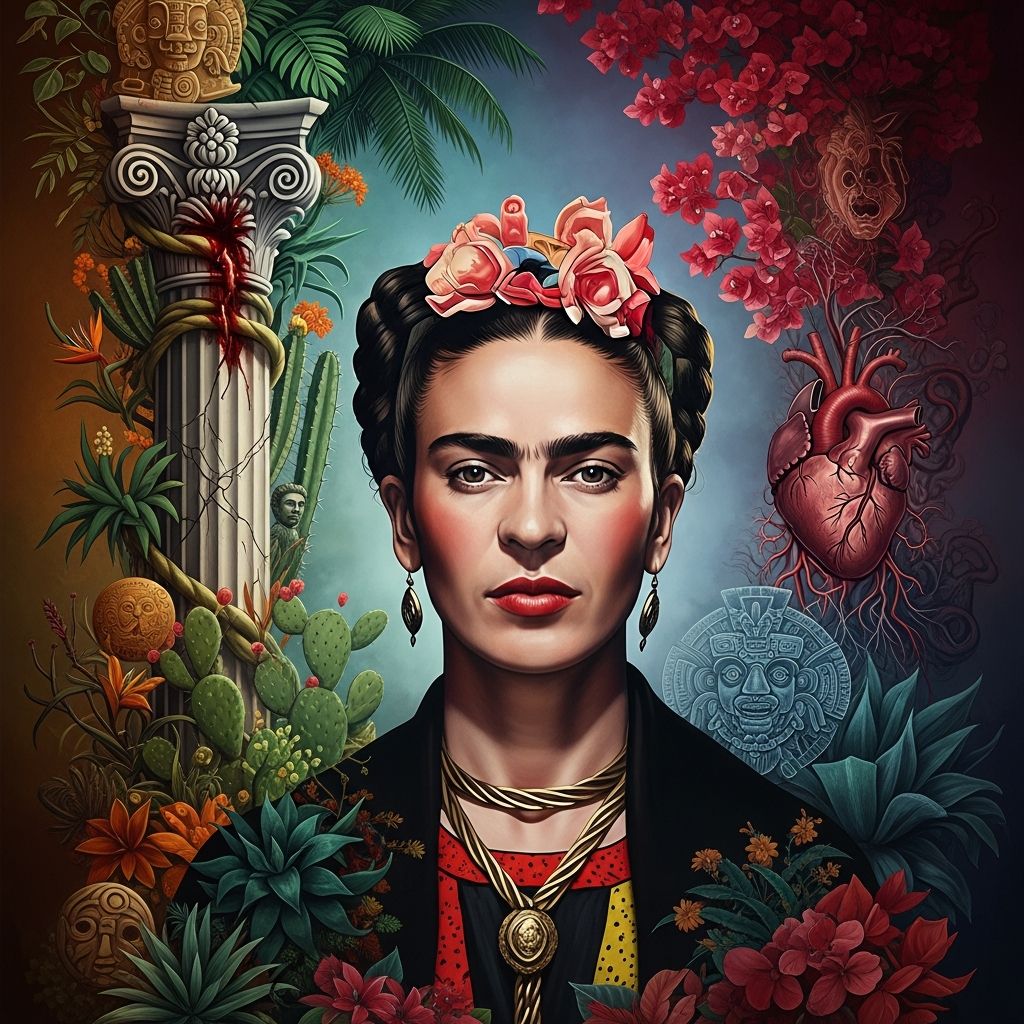
The Life and Artistic Journey of Frida Kahlo
Frida Kahlo stands as one of the most influential and celebrated artists of the twentieth century, a Mexican painter whose work transcended conventional boundaries and challenged societal norms. Born on July 6, 1907, in Coyoacán, Mexico City, Kahlo emerged from a culturally rich background that would profoundly shape her artistic vision. Her father, Carl Wilhelm Kahlo, was a German-Mexican photographer, while her mother, Mathilde Calderón, was a Mexican painter and musician. This dual heritage exposed Frida to diverse artistic traditions from her earliest years, establishing a foundation for her later experimentation with blending Mexican folk aesthetics with contemporary artistic movements.
What distinguishes Kahlo from many of her contemporaries was her ability to channel personal trauma and physical suffering into revolutionary artistic expression. Rather than viewing her challenges as limitations, she transformed them into the very essence of her creative output. Her journey from a young girl in pre-revolutionary Mexico to an internationally recognized artist represents not merely a career trajectory, but a profound statement about human resilience, cultural pride, and the power of authentic self-expression.
The Catalyzing Accident and Discovery of Art
The trajectory of Kahlo’s artistic career was fundamentally altered by a catastrophic event that would have devastated many individuals. In 1925, when she was eighteen years old, Kahlo was involved in a severe bus accident that left her with multiple life-altering injuries. The collision resulted in fractures to her spine, right leg, collarbone, and pelvis, while her shoulder was dislocated and her right foot crushed. Most tragically, an iron handrail pierced her abdomen and uterus, causing internal injuries that would plague her throughout her remaining years.
During her prolonged recovery, confined to bed and facing an uncertain future, Kahlo discovered painting as both a therapeutic outlet and a means of self-exploration. Her mother arranged for a specially designed easel that allowed her to paint while lying down, and using a mirror mounted above her bed, she began creating works that would define her artistic legacy. In 1926, she produced her first known painting, a self-portrait titled “Self-Portrait Wearing a Velvet Dress,” marking the beginning of an extraordinary artistic career born from necessity and transformed into brilliance.
Developing a Revolutionary Artistic Vision
In the late 1920s, Kahlo’s artistic style began to crystallize, drawing heavily from Mexican folk art traditions and pre-Columbian cultural elements. Her early paintings, created in the mid-1920s, showed influences from Renaissance masters and European avant-garde figures such as Amedeo Modigliani. However, as the decade progressed, she increasingly gravitated toward the vibrant, emotionally direct aesthetic of Mexican folk art, attracted to its elements of fantasy, naivety, and unflinching depiction of violence and death.
The artistic approach Kahlo developed was uniquely her own—a sophisticated synthesis that merged surrealistic elements with grounded reality, yet she famously rejected the surrealist label despite being associated with the movement. Her paintings depicted the human experience with unflinching honesty, exploring themes of identity, bodily autonomy, pain, mortality, and cultural heritage. Rather than relying on grandiose narratives or escapist fantasy, her work emerged from deeply personal introspection, making the individual experience universal and the private profoundly political.
Meeting Diego Rivera and the Marriage Years
A pivotal moment in Kahlo’s personal and professional life occurred when she joined the Mexican Communist Party in 1927, an involvement that reflected her deep political convictions and commitment to social justice. Through the party, she met Diego Rivera, the renowned Mexican muralist and political activist whose approach to art and society aligned with her own vision. The two married in 1929, despite a considerable age difference and the disapproval of many in their circles.
The marriage between Kahlo and Rivera proved tempestuous yet artistically generative. The couple traveled extensively throughout Mexico and the United States during the late 1920s and early 1930s, exposing Kahlo to new environments, artistic influences, and cultural perspectives. These travels deeply influenced her work, as she encountered diverse Mexican communities and traditions, further enriching her artistic vocabulary. However, the relationship was marked by infidelities, competing career demands, personal struggles, and eventually separation, divorce in 1939, and remarriage in 1940—a cycle of emotional turbulence that paradoxically fueled some of her most powerful artistic creations.
The Explosion of Creative Output
Following her separation from Rivera, Kahlo experienced a remarkable surge in artistic productivity. In 1937 and 1938, she painted more than she had accomplished during the entire eight years of her marriage, creating masterworks that would secure her place in art history. Works from this period include “My Nurse and I” (1937), “Memory, the Heart” (1937), “Four Inhabitants of Mexico” (1938), and “What the Water Gave Me” (1938). These paintings demonstrated an increasingly sophisticated technical approach, with carefully controlled graphic details and a shift toward quarter-length portraits that proved more commercially viable.
The early 1940s represented another peak of artistic achievement. During this period, Kahlo produced some of her most iconic and internationally recognized works, including “The Two Fridas” (1939), “Self-Portrait with Cropped Hair” (1940), “The Wounded Table” (1940), and “Self-Portrait with Thorn Necklace and Hummingbird” (1940). These paintings showcased her mastery of color, composition, and psychological depth, while maintaining the raw emotional authenticity that characterized all her work. The paintings were relatively small in scale—she produced somewhere between fewer than 150 to around 200 works throughout her entire lifetime—yet their impact far exceeded their physical dimensions.
Gaining International Recognition
During much of her lifetime, Kahlo struggled to achieve financial stability through her art, despite growing respect in creative circles. A breakthrough moment arrived in 1938 when American actor Edward G. Robinson purchased four of her paintings, marking her first major sale. That same year, she mounted her first solo exhibition at the Julien Levy Gallery in New York City, where she displayed twenty-five works and sold approximately half of them. The exhibition generated significant attention and resulted in important commissions, including one from Vanity Fair editor Clare Boothe Luce, who commissioned Kahlo to create a tribute to actress Dorothy Hale.
In 1939, André Breton, a leading figure in the Surrealist movement, invited Kahlo to exhibit in Paris. She traveled to France, where her work was featured in “Mexique,” a group exhibition at Galerie Renou et Colle organized by Breton himself. During her time in Paris, she developed friendships with influential artists including Marcel Duchamp, Pablo Picasso, Marc Chagall, and Piet Mondrian. That year also marked a significant achievement: the French government purchased her painting “The Frame,” validating her work at the governmental level.
Institutional Recognition and Teaching
Recognition of Kahlo’s artistic contributions gradually expanded throughout the 1940s. In 1940, her work was included in both the “International Exhibition of Surrealism” at Galería de Arte Mexicano in Mexico City and “Twenty Centuries of Mexican Art” at the Museum of Modern Art in New York City. In 1946, she received the National Prize for Painting for her work titled “Moses,” a significant institutional acknowledgment of her contributions to Mexican art. That same year, the Mexican government commissioned her to paint five portraits of important Mexican women, though ongoing health complications prevented her from completing the project.
From 1943 until 1954, Kahlo taught at La Esmeralda, Mexico’s premier art school. When her deteriorating health made traveling to campus difficult, she held classes from her home at La Casa Azul (The Blue House), where she lived with Rivera and which became a cultural landmark. Her teaching influenced a generation of Mexican artists and reflected her commitment to nurturing creative talent and transmitting her artistic philosophy to younger practitioners. In 1953, she mounted her first solo exhibition in her home country at Galería de Arte Contemporáneo in Mexico City—a significant milestone that occurred late in her life, when chronic illness forced her to attend the opening in bed.
Artistic Methods and Thematic Exploration
Color as Emotional Language
One of Kahlo’s most distinctive characteristics was her masterful use of vibrant, often jarring color combinations that conveyed psychological and emotional states rather than realistic representation. She drew heavily from Mexican folk art traditions, which typically employed bold, saturated hues. Her palette was never decorative in the conventional sense; instead, colors functioned as emotional signifiers, expressing inner turmoil, cultural pride, physical pain, and spiritual searching simultaneously.
The Self-Portrait as Truth-Telling
Kahlo’s extensive exploration of self-portraiture was not narcissism but rather a form of profound investigation into identity, embodiment, and existence. By painting herself repeatedly, she transformed the personal into the universal, making her individual struggles emblematic of larger human experiences and specifically Mexican historical and cultural circumstances. Her self-portraits refused conventional beauty standards and instead presented unflinching depictions of her distinctive unibrow, facial hair, and physical deformities, transforming perceived flaws into sources of artistic power and cultural authenticity.
Integration of Cultural Symbolism
Kahlo’s paintings frequently merged depictions of the cosmos, the earth, and the human body with pre-Columbian iconography, Catholic symbolism, and contemporary Mexican reality. She created works that permitted shockingly personal depictions of physical and psychological pain to bleed into the symbolic language of Mexico’s Aztec, colonial, and revolutionary history. This integration was not superficial borrowing but rather a genuine reclamation of cultural roots and an assertion of Mexican identity in the face of colonial erasure and cultural domination.
Legacy and Posthumous Recognition
Frida Kahlo died on July 13, 1954, in her beloved Blue House in Coyoacán, just one year after her leg was amputated due to gangrene—a consequence of the chronic complications that had plagued her since her 1925 accident. Though she had achieved some recognition during her lifetime, her international reputation soared posthumously, beginning in the 1980s with the publication of numerous scholarly books and biographies by feminist art historians and cultural critics. She became an iconic figure in feminist art discourse, posthumously claimed as a precursor to later feminist movements that challenged patriarchal structures and centered marginalized voices.
Today, Kahlo’s influence extends far beyond the art world. She has become a cultural symbol representing resilience, authenticity, political commitment, and cultural pride. Her imagery adorns merchandise, her quotations circulate widely, and her story has been adapted into films, theatrical productions, and popular culture. Museums worldwide feature her work, and her paintings command premium prices in the art market. More importantly, her artistic legacy continues to inspire artists, particularly women and artists from marginalized communities, who find in her work permission to create from personal experience, to claim their own narratives, and to resist assimilation into dominant cultural norms.
Key Achievements and Recognition Timeline
| Year | Achievement | Significance |
|---|---|---|
| 1926 | First known painting completed | Marks beginning of artistic career during recovery |
| 1938 | First major art sale; First solo exhibition, New York | International breakthrough and commercial validation |
| 1939 | Exhibition in Paris; Government purchase of artwork | European recognition and institutional acquisition |
| 1943 | Appointed professor at La Esmeralda art school | Institutional recognition and teaching platform |
| 1946 | National Prize for Painting awarded | Official Mexican government recognition |
| 1953 | First solo exhibition in Mexico | Domestic recognition in home country |
| 1980s+ | Posthumous scholarly revival and cultural icon status | Global recognition and feminist art discourse prominence |
Understanding Kahlo’s Artistic Philosophy
Frida Kahlo herself resisted categorical definition, famously stating “I paint my own reality,” a declaration that captures her fundamental artistic approach. She did not create art to escape reality or to construct fantasy worlds; instead, she used painting to investigate, document, and transform her lived experience into universal statements about human existence. Her refusal of the Surrealist label, despite her associations with movement figures and her inclusion in Surrealist exhibitions, reflected her insistence on grounding her work in tangible reality rather than unconscious dream logic.
Her artistic philosophy centered on authenticity, cultural rootedness, and the transformative potential of creative expression in the face of physical and psychological suffering. She demonstrated that art could emerge from limitation rather than abundance, that disability need not silence creativity, and that personal experience—particularly the experiences marginalized by dominant culture—possessed profound universal significance. Her work challenged the notion that artists must transcend their circumstances to create meaningful work; instead, she proved that deep engagement with one’s own reality, pain, and cultural heritage could generate art of extraordinary power and relevance.
Why Frida Kahlo Remains Culturally Significant
More than seven decades after her death, Frida Kahlo continues to exert remarkable cultural influence. Her relevance stems from multiple sources: her artistic innovations, her refusal to conform to beauty standards, her commitment to political engagement, her frank exploration of physical and mental suffering, and her assertion of Mexican cultural identity. In contemporary contexts marked by ongoing discussions about representation, disability rights, feminist consciousness, and cultural authenticity, Kahlo’s work speaks with undiminished force.
Her paintings invite ongoing interpretation and emotional engagement. They refuse easy resolution or comfortable viewing. They demand that observers confront pain, mortality, bodily reality, and cultural specificity—topics that dominant culture often marginalizes or aestheticizes away. In this confrontational stance, Kahlo’s art maintains its power to challenge, inspire, and transform those who encounter it, ensuring her place not merely in art history but in the broader cultural conversation about what art can accomplish and what it means to live authentically.
Frequently Asked Questions
Q: Did Frida Kahlo consider herself a Surrealist artist?
A: No, Kahlo explicitly rejected the Surrealist label despite associations with the movement and inclusion in Surrealist exhibitions. She insisted on grounding her work in tangible reality rather than unconscious dream imagery, famously stating “I paint my own reality.”
Q: How did the 1925 bus accident influence her artistic development?
A: The accident was transformative. During her recovery, bedridden and facing an uncertain future, Kahlo began painting using a specially designed easel and mirror. This trauma became the catalyst for her artistic career and deeply influenced the themes of pain, suffering, and resilience that characterize her work.
Q: What was the relationship between Frida Kahlo and Diego Rivera?
A: Their relationship was tempestuous yet artistically generative. They married in 1929, separated, divorced in 1939, and remarried in 1940. Despite personal conflicts and infidelities, their shared political commitment and artistic vision created a dynamic partnership that influenced both their careers.
Q: How many paintings did Frida Kahlo create during her lifetime?
A: Estimates vary between fewer than 150 to around 200 paintings. Despite the relatively modest quantity, her works have achieved extraordinary significance in art history and continue to command high valuations and international attention.
Q: Why did Frida Kahlo paint so many self-portraits?
A: Rather than narcissism, her self-portraits functioned as investigations into identity, embodiment, and existence. By painting herself repeatedly, she transformed personal experience into universal statements and refused conventional beauty standards, instead presenting unflinching depictions of her distinctive features as sources of artistic power.
References
- Frida Kahlo — Encyclopædia Britannica. Accessed December 9, 2025. https://www.britannica.com/biography/Frida-Kahlo
- Frida Kahlo Biography — Frida Kahlo Foundation. Accessed December 9, 2025. https://www.fridakahlo.org/frida-kahlo-biography.jsp
- Frida Kahlo – Paintings, Quotes & Art — Biography.com. Accessed December 9, 2025. https://www.biography.com/artists/frida-kahlo
- Frida Kahlo: Artist Profile — National Museum of Women in the Arts. Accessed December 9, 2025. https://nmwa.org/art/artists/frida-kahlo/
- Frida Kahlo — San Francisco Museum of Modern Art. Accessed December 9, 2025. https://www.sfmoma.org/artist/Frida_Kahlo/

- Integrated M.A. in Applied Linguistics, University of Hyderabad
- 5+ years in editorial, instructional, SEO, and research-based writing
Sneha is a relationships and lifestyle writer with a strong foundation in applied linguistics and certified training in relationship coaching. She brings over five years of writing experience to theskillvault, crafting thoughtful, research-driven content that empowers readers to build healthier relationships, boost emotional well-being, and embrace holistic living. Her writing and insights reflect the belief that beauty, happiness, and wellness…