
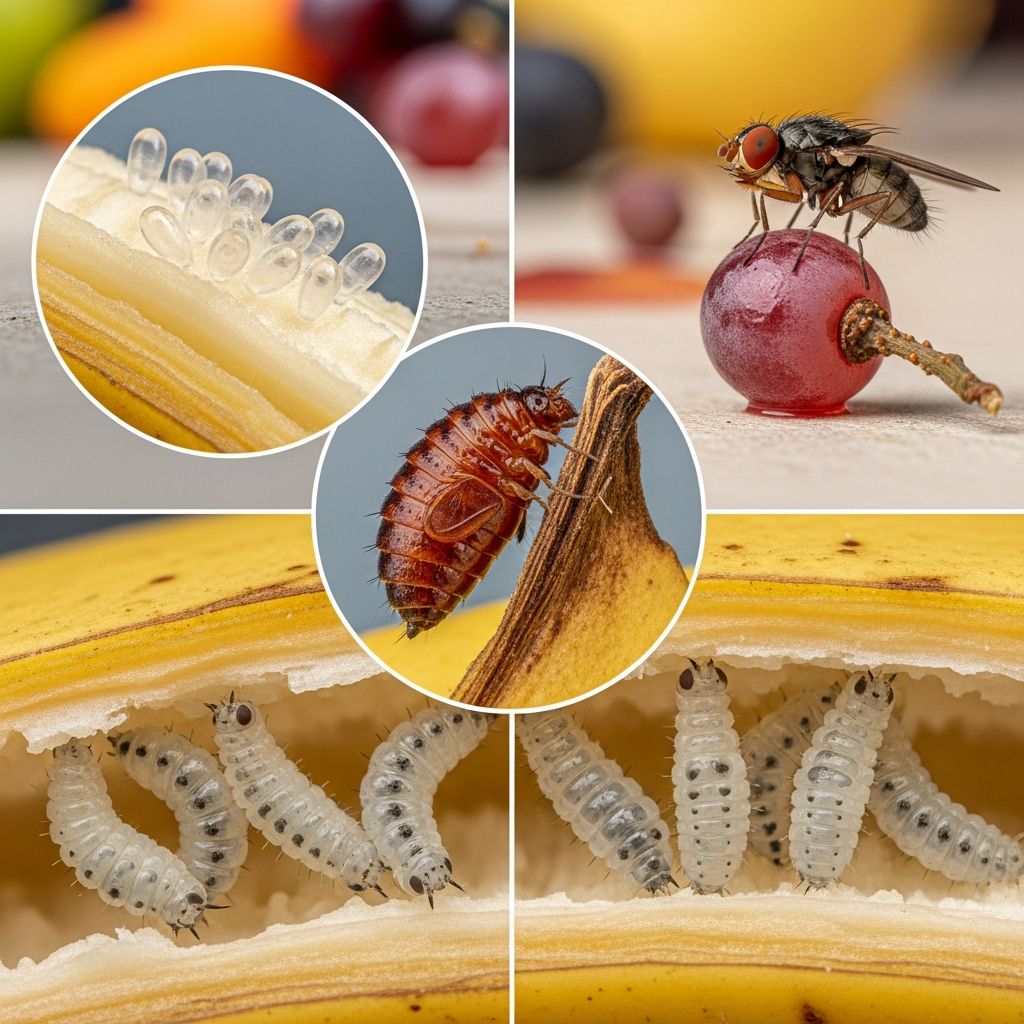
Fruit flies, those tiny nuisances buzzing around kitchens, do not materialize spontaneously. They emerge from eggs laid by adult females on specific breeding sites, primarily rotting or fermenting organic matter. Understanding their origins and biology is key to eradication.
Recognizing Fruit Fly Species in Households
Common household fruit flies belong to the Drosophila genus, notably Drosophila melanogaster, known for red eyes and attraction to overripe fruits. These flies measure about 3-4 mm long with tan bodies and red eyes. Another pest, the dark-eyed fruit fly, frequents drains and less sugary spots. Distinguishing them aids targeted control, as D. melanogaster thrives on fermenting sugars while others exploit moist, decaying areas.
The Complete Metamorphosis of Fruit Flies
Fruit flies undergo holometabolous metamorphosis, featuring four distinct stages: egg, larva, pupa, and adult. This process, from egg to flying adult, completes in 7-14 days under room temperature (around 25°C), accelerating infestations.
Egg Stage: The Hidden Beginning
Females deposit 1-20 eggs per clutch, up to 400-500 over their lifespan, directly into softening fruit skins, vegetable surfaces, or slime in drains. Eggs, microscopic white ovals, hatch in 24-48 hours. The mother often adds bacteria-laden feces to inoculate larvae with gut microbes for efficient feeding on rotting matter.
- Preferred sites: Ripening produce, banana peels, tomatoes, onions.
- Identification: Tiny white specks on blemished fruit; check spring produce for clusters.
Larval Stage: Feeding and Growth
Hatching larvae, or maggots, burrow into food sources, feeding on yeasts, sugars, and bacteria. They molt through three instars, growing larger each time by shedding exoskeletons. This stage lasts 4-5 days, causing internal rot that makes fruit drop prematurely.
- Behavior: Larvae introduce bacteria, accelerating decay; mature ones exit fruit to pupate.
- Detection: Slice open suspect produce to reveal white, wriggling maggots; look for early-falling unripe fruit.
Pupal Stage: Transformation in Secrecy
Mature larvae crawl to dry spots—soil, cracks, or container walls—forming a hard, oval puparium from their shed skin. Inside, radical changes occur over 4-6 days, developing wings, legs, and compound eyes. Pupae overwinter in colder climates.
- Timeline: Visible eye pigmentation 24 hours pre-emergence; adult pushes through operculum.
- Signs: Brownish capsules in soil under fallen fruit or sink corners.
Adult Stage: Reproduction and Dispersal
Emerging adults expand wings, darken within hours, and mate soon after. Females become fertile in 48 hours, living 30-40 days while continuously laying eggs. Males detect pheromones for courtship.
- Generations: Up to 10 per year for some species in warm areas.
- Activity: Shelter in shade, feed on fermenting liquids, target new produce.
Primary Breeding Grounds in Homes
Fruit flies invade via eggs or larvae on grocery items or enter as adults through screens. They breed where moisture and decay converge.
| Breeding Site | Why Attractive | Detection Tips |
|---|---|---|
| Overripe Fruits/Veggies | Fermenting sugars, soft flesh for egg-laying | Blemishes, premature drops, maggots inside |
| Drains & Sinks | Organic slime buildup | Adults hovering, pupae in corners |
| Garbage & Compost | Rotting scraps | Swarming near bins |
| Sponges/Mops | Food-soaked fabrics | Larvae in moist fibers |
| Recyclables | Sweet residues in bottles | Flies on cans, jars |
Store-bought produce often harbors eggs, explaining sudden outbreaks. Outdoor populations exploit gardens, entering via windows.
Debunking the Spontaneous Generation Myth
Historical beliefs in spontaneous generation—flies arising from decay—were disproven by 19th-century experiments showing maggots only from eggs. Modern infestations mimic this illusion due to the rapid, hidden early stages.
Effective Prevention Tactics
Break the cycle by eliminating breeding sites:
- Produce Management: Store in fridge; inspect and rinse groceries; freeze scraps.
- Cleanliness: Empty bins daily; wash recyclables; run hot water in drains weekly.
- Barriers: Seal cracks, use screens; dry mop heads thoroughly.
Proven Elimination Methods
Combine sanitation with traps:
- Apple Cider Vinegar Trap: Bowl with vinegar, dish soap drop, plastic wrap with holes. Attracts and drowns adults.
- Red Wine Trap: Similar to vinegar; use overripe fruit pieces.
- Sticky Traps: Commercial or DIY with tape over yellow cards.
- Steam Cleaning: Drains and surfaces to kill eggs/larvae.
- Baits: Professional options for severe cases.
Monitor with traps; repeat until no catches for a week. Vacuum adults and empty bags outside.
Seasonal Patterns and Outdoor Factors
Warm months spike populations; pupae overwinter in soil. Garden fruits like berries host spotted-wing drosophila. Protect by netting crops; till soil to expose pupae.
Frequently Asked Questions (FAQs)
Do fruit flies only come from fruit?
No, they breed in drains, garbage, and damp sponges too, anywhere with decaying organics.
How fast do fruit fly populations grow?
One female lays up to 500 eggs; full cycle in 7-10 days at room temp, leading to explosive numbers.
Can fruit flies bite or spread disease?
They don’t bite but carry bacteria from waste sites to food, posing contamination risks.
Why do they keep coming back after cleaning?
Missed eggs in produce or pupae in hidden spots; persistence needed for all life stages.
Are fruit flies harmful to humans?
Primarily a nuisance; indirect health risk via contamination, not direct vectors.
Advanced Monitoring for Long-Term Control
Use pheromone traps for early detection in homes or farms. Track generations by season: eggs in spring, peaks in summer. In labs, D. melanogaster‘s cycle informs genetics, but home focus is sanitation.
For commercial settings like restaurants, target soda lines and taps. Integrated pest management (IPM) combines cultural, mechanical, and biological controls.
References
- The Fruit Fly Life Cycle — Prevent Fruit Fly. Accessed 2026. https://www.preventfruitfly.com.au/understanding-fruit-fly/the-fruit-fly-life-cycle/
- Fruit Flies – UC IPM — University of California Agriculture and Natural Resources. Accessed 2026. https://ipm.ucanr.edu/PMG/GARDEN/FRUIT/PESTS/fruitflies.html
- Fruit Fly Metamorphosis: Life Cycle & Phases of Fruit Flies — Orkin. Accessed 2026. https://www.orkin.com/pests/flies/fruit-flies/fruit-fly-metamorphosis
- Drosophila melanogaster — Wikipedia (informed by primary sources). Accessed 2026. https://en.wikipedia.org/wiki/Drosophila_melanogaster
- Complete Life Cycle of the Fruit Fly — Insects Limited (YouTube). Accessed 2026. https://www.youtube.com/watch?v=WJ75QeNViog

- Integrated M.A. in Applied Linguistics, University of Hyderabad
- 5+ years in editorial, instructional, SEO, and research-based writing
Sneha is a relationships and lifestyle writer with a strong foundation in applied linguistics and certified training in relationship coaching. She brings over five years of writing experience to theskillvault, crafting thoughtful, research-driven content that empowers readers to build healthier relationships, boost emotional well-being, and embrace holistic living. Her writing and insights reflect the belief that beauty, happiness, and wellness…