
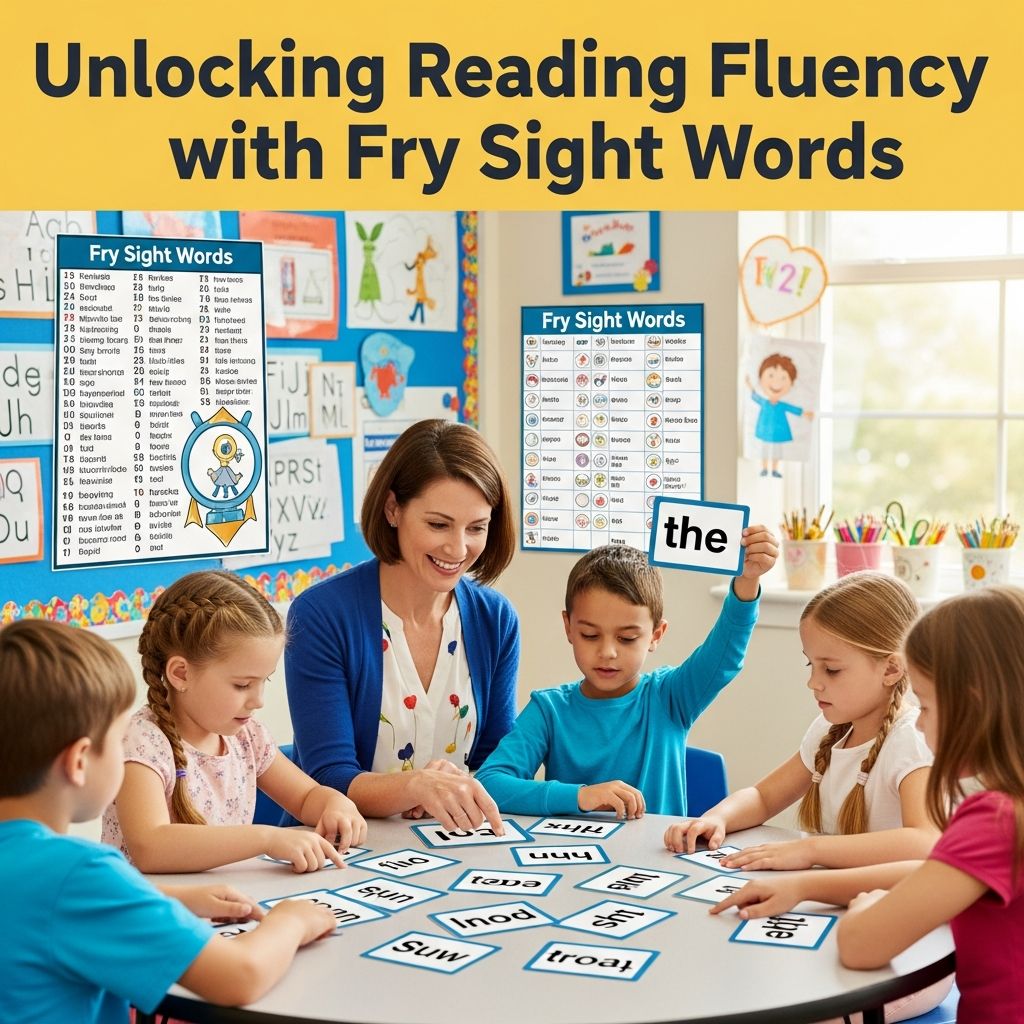
High-frequency words dominate everyday reading materials, making up a significant portion of text in books, articles, and instructions. Fry sight words, a curated collection of the 1,000 most common English words, serve as a cornerstone for developing proficient readers. Unlike phonetically regular words, many of these terms defy standard decoding rules, requiring instant recognition for smooth reading. This comprehensive guide delves into their importance, structure, and effective implementation in classrooms and homes.
The Foundation of Fry Sight Words in Literacy Development
Fry sight words emerged from extensive analysis of written English, identifying terms that appear repeatedly across diverse texts. Developed by educator Edward Fry, this list prioritizes words by frequency, ensuring learners master the building blocks of language first. Research shows that knowing just 100 of these words covers about 50% of words in typical reading passages, while the full 1,000 account for nearly 90%.
These words bridge the gap between emergent and fluent reading. Young learners often stumble on irregular spellings like ‘the,’ ‘said,’ or ‘was,’ slowing comprehension. By committing them to memory, children shift focus from decoding to understanding meaning, fostering independence and enjoyment in reading.
How Fry Sight Words Were Created and Evolved
Edward Fry compiled his list in the 1950s by sampling words from graded readers and adult materials, updating it in 1980 to reflect contemporary usage. Unlike earlier lists, Fry’s extends to 1,000 words, organized into ten groups of 100, each increasing in complexity. This progression aligns with developmental stages, from simple pre-k terms to advanced elementary vocabulary.
The list’s evolution addressed gaps in prior resources, incorporating words like ‘computer’ and ‘internet’ in modern adaptations while retaining timeless essentials. Its empirical basis—rooted in actual text frequency—makes it a reliable tool for curriculum design.
Complete Breakdown: Fry Sight Words by Frequency Levels
Fry words are divided into ten levels, starting with the most basic. Below are key examples from each, highlighting progression.
| Level | Sample Words (First 10) | Focus |
|---|---|---|
| 1st 100 | the, of, and, a, to, in, is, you, that, it | Basic articles, pronouns, prepositions |
| 2nd 100 | he, was, for, on, are, as, with, his, they, I | Common verbs, possessives |
| 3rd 100 | at, be, this, have, from, or, one, had, by, words | Conjunctions, numbers |
| 4th 100 | but, not, what, all, were, we, when, your, can, said | Negatives, questions |
| 5th 100 | there, use, an, each, which, she, do, how, their, if | Adverbs, relatives |
Continuing upward: 6th includes ‘new, sound, take, only, little, work, know, place, years, back’; 7th adds ‘give, most, very, after, thing, our, just, name, good, many’; through 10th with advanced terms like ‘action, actually, adjective, afraid, agreed’. Full lists enable systematic mastery.
Why Prioritize Fry Words Over Other Sight Word Lists?
Compared to the Dolch list (220 words, pre-1948), Fry’s offers broader coverage and modern relevance. Dolch focuses on pre-primer to third-grade words; Fry spans up to fourth-grade and beyond, including multisyllabic terms. Both overlap significantly (e.g., 60% in first 100), but Fry’s frequency-based grouping suits diverse learners.
- Broader Scope: 1,000 vs. 220 words for comprehensive fluency.
- Grade-Appropriate: Levels match curriculum progression.
- Empirical Validation: Based on current corpora, not dated primers.
Educators often blend them, using Dolch for preschool and Fry for elementary.
Proven Strategies for Teaching Fry Sight Words Effectively
Effective instruction combines repetition, multisensory engagement, and assessment. Start with 5-10 words weekly, using flashcards, games, and contextual reading.
Daily Practice Routines
- Flashcard Drills: Show words for 3 seconds; correct instantly.
- Word Walls: Display mastered words for reference.
- Choral Reading: Read passages aloud, emphasizing targets.
- Games: Bingo, memory match, or digital apps.
Track progress with checklists, aiming for 95% accuracy before advancing.
Multisensory Techniques
Incorporate movement: trace words in sand, build with magnets, or chant rhythms. For visual learners, color-code by level; kinesthetic ones clap syllables.
Age-Appropriate Activities for Every Learner
Tailor activities to developmental stages for maximum retention.
- Preschool (1st-2nd 100): Sing-along songs, puppet shows with simple sentences.
- Kindergarten (3rd-4th): Scavenger hunts in books, rainbow writing.
- 1st Grade (5th-6th): Sentence strips, partner quizzes.
- 2nd+ Grade (7th-10th): Vocabulary journals, comprehension quizzes.
Incorporate technology: apps like Sight Words Learning Games or printable worksheets from reputable sites.
Measuring Progress and Building Fluency
Assess via timed reads: fluent recognition under 1 second per word. Use progress charts:
| Week | Words Mastered | Accuracy % | Notes |
|---|---|---|---|
| 1 | 1st 25 | 85 | Focus on ‘the/of’ |
| 4 | 1st 100 | 98 | Advance to 2nd |
Fluency benchmarks: 1st graders master first 300; 3rd graders, first 600.
Integrating Fry Words into Broader Literacy Programs
Embed in phonics, writing, and comprehension. Write stories using weekly words; analyze texts for frequency. Parental involvement amplifies gains—nightly reviews yield 20% faster mastery.
Challenges like dyslexia benefit from spaced repetition and audio reinforcement, aligning with evidence-based interventions.
Frequently Asked Questions (FAQs)
What are Fry sight words exactly?
Fry sight words are the 1,000 most frequently used words in English, grouped by usage frequency to teach reading fluency.
How do Fry words differ from Dolch words?
Fry extends to 1,000 words with modern frequency data; Dolch has 220 service words for early grades.
At what age should children learn them?
Begin in preschool with first 100, progressing one level per grade through elementary school.
Can I print Fry word lists for free?
Yes, many educational sites offer downloadable checklists and flashcards.
How many Fry words for reading fluency?
First 300 cover 65% of text; full 1,000 near 90%.
Empowering the Next Generation of Readers
Mastering Fry sight words transforms struggling readers into confident ones. Consistent practice yields lifelong literacy skills. Equip classrooms and homes with these tools for enduring success.
References
- Fry Sight Words List — Sight Words: Teach Your Child to Read. Accessed 2026. https://sightwords.com/sight-words/fry/
- Fry Instant Words Checklist — Somerset Academy Village. 2014-10. http://www.somersetwm.com/wp-content/uploads/2014/10/Fry-Words-checklist-10-levels.pdf
- Fry Word List – 1,000 High Frequency Words — K12 Reader. Accessed 2026. https://www.k12reader.com/subject/vocabulary/fry-words/
- Fry’s First 100 Words — RRCS. Accessed 2026. https://www.rrcs.org/Downloads/Fry%20Words%201st%201002.pdf
- Fry’s First 100 Sight Words List — Teachers Pay Teachers. Accessed 2026. https://www.teacherspayteachers.com/browse/free?search=frys+first+100+sight+words+list
- Fry Resource Collection — The Curriculum Corner 123. Accessed 2026. https://www.thecurriculumcorner.com/thecurriculumcorner123/fry-resource-collection/
- Fry’s 1000 Instant Words quick check list — CSUSB. Accessed 2026. https://www.csusb.edu/sites/default/files/Frys1000InstantWordsquickchecklist%20(1).pdf

Medha Deb is an editor with a master's degree in Applied Linguistics from the University of Hyderabad. She believes that her qualification has helped her develop a deep understanding of language and its application in various contexts. Medha specializes in the areas of beauty, health, sports, and wellness and is committed to ensuring that the content on the website is…