
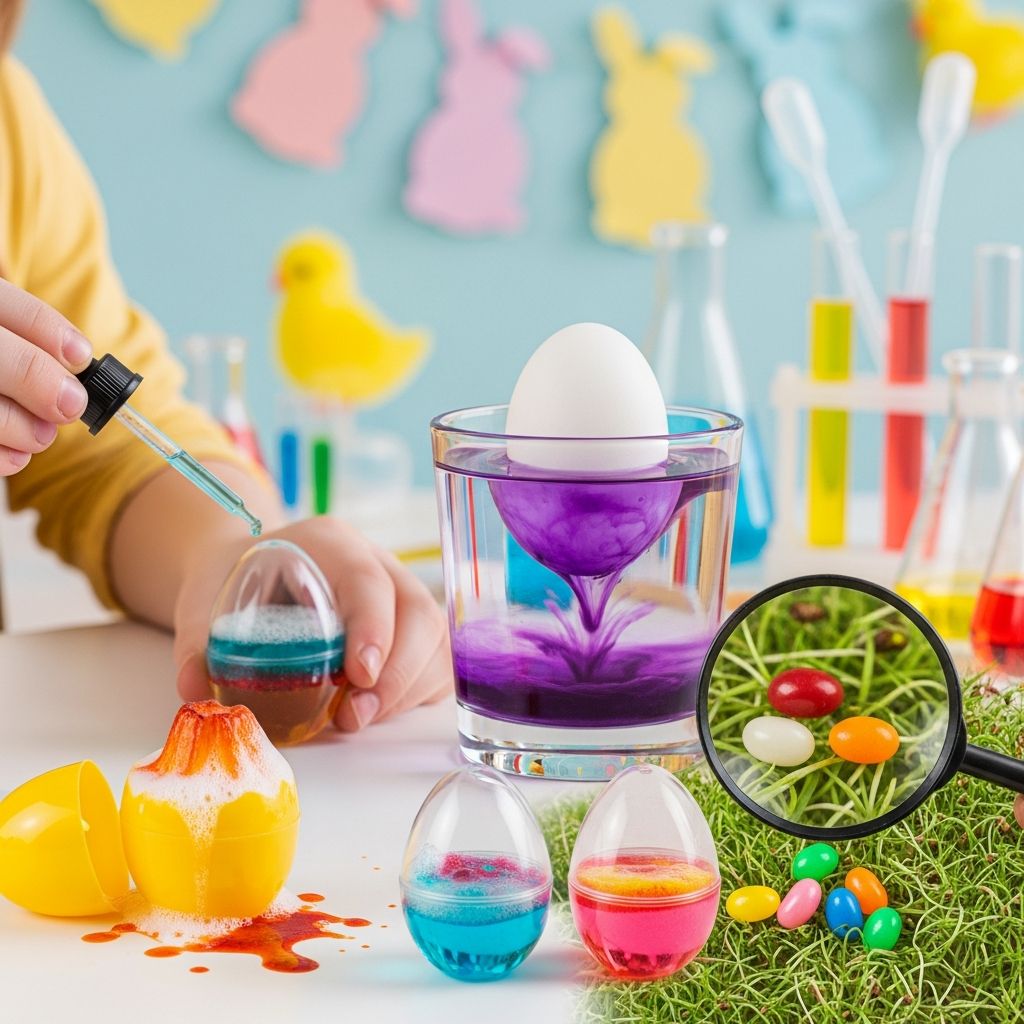
Bring the wonder of science to Easter celebrations by turning everyday holiday items like eggs, jelly beans, and chocolate into tools for discovery. These activities introduce fundamental scientific principles through play, helping children grasp concepts like chemical reactions, buoyancy, crystal formation, and forces in an enjoyable way. Designed for various ages, they require minimal supplies and setup, making them ideal for family time, classrooms, or parties.
Why Easter is Perfect for Science Exploration
Easter’s symbols—eggs representing new life, bunnies for motion, and candies for dissolution—naturally align with scientific inquiry. Children can observe how substances change states, objects interact with forces, or solutions form structures, all while celebrating the season. These experiments not only entertain but also build critical thinking, prediction skills, and a love for STEM fields.
Chemical Reactions with Easter Treats
Chemical reactions create visible excitement, perfect for young learners. Start with baking soda and vinegar inside plastic eggs to produce fizzy eruptions, demonstrating acid-base reactions where carbon dioxide gas forms bubbles.
- Materials: Plastic Easter eggs, baking soda, vinegar, food coloring, tray.
- Steps: Fill egg halves with baking soda and a drop of coloring. Pour vinegar over one half to watch the foam overflow. Discuss why the mixture bubbles (gas production).
- Learning Outcome: Introduces acids, bases, and gas formation.
Another delight is dissolving candy coatings. Place jelly beans in warm water to see colors bleed and mix, revealing how heat speeds up the breakdown of sugar shells. Predict color patterns and time the process for added challenge.
Density and Buoyancy Challenges
Explore why some things float while others sink using plastic eggs as vessels. Fill them with items like coins, feathers, rice, or mini Peeps, then test in water.
| Filler Item | Prediction | Result | Science Explanation |
|---|---|---|---|
| Feathers | Floats | Floats | Low density; air pockets make it buoyant. |
| Coins | Sinks | Sinks | High density metal displaces less water volume. |
| Jelly Beans | Sinks | Sinks or borderline | Sugar density exceeds water’s. |
| Peeps | Floats | Floats | Light, airy marshmallow structure. |
This table helps track observations. Extend by adding salt to water, creating layers where eggs ‘float’ at interfaces, teaching salinity’s effect on density.
Growing Crystals on Egg Shapes
Transform eggs into sparkling geodes by growing crystals. Use borax solution on eggshells or paper egg cutouts submerged overnight.
- Boil water, dissolve 3 tablespoons borax per cup.
- Add food coloring for Easter hues.
- Suspend eggshell halves in jars with solution using string.
- Observe crystals forming as water cools and borax molecules lattice.
Kids learn about supersaturation and nucleation, watching microscopic structures emerge macroscopically. Variations include alum or salt for different crystal shapes.
Egg-Strength and Structural Engineering
Eggshells seem fragile, yet their architecture distributes force amazingly. Test by standing on a carton of eggshells or building egg-supporting towers.
- Strength Test: Line a tray with eggshells, cover with paper, and gently step—weight spreads via arches.
- Egg Drop Contest: Design parachutes or cushions from recyclables to protect a raw egg dropped from height.
These build engineering skills: hypothesize, prototype, test, iterate. Relate to bridges or domes in real-world architecture.
Physics of Motion: Rockets and Races
Propel plastic eggs as mini rockets along strings using baking soda-vinegar thrust. Decorate with fins for aerodynamics lessons.
Or race eggs down ramps wrapped in fabrics, measuring speed to see friction’s impact. Variables: ramp angle, material texture. Use timers for data collection and graphing.
Marbled and Magical Egg Art
Oil and vinegar don’t mix, creating swirling patterns on eggs. Drop coloring in milk, add egg, swirl with toothpick for galaxy effects.
For ‘naked’ eggs, soak in vinegar to dissolve shells, revealing bouncy membranes via calcium acetate reaction. Bounce gently or shrink in corn syrup (osmosis).
Magnetism Mysteries in Easter Baskets
Hide metal clips or bells in eggs; use wands to ‘fish’ them out, discovering magnetic fields penetrate plastic. Sort magnetic vs. non-magnetic fillers blindly by attraction.
Air Pressure and Egg Tricks
Suck an egg into a bottle using heat-induced pressure drop: light paper inside hot jar, place egg on mouth, cool air contracts. Explain Boyle’s Law simply.
Chocolate and State Changes
Melt chocolate in eggshells or molds, observing solid-to-liquid transition. Cool to reverse, discussing molecular movement. Hide treats with sound clues for sensory science.
Adapting for Different Ages
Preschoolers: Sensory focus—shake eggs, watch fizz without measurements.
Elementary: Predictions, data tables, variables.
Tweens: Hypothesis testing, multiple trials, research extensions like egg osmosis graphs.
Safety: Adult supervision for vinegar, heat; no raw egg ingestion.
Frequently Asked Questions
What age group are these Easter science activities best for?
Most suit ages 4-12, with adaptations for younger kids focusing on observation and older ones on data analysis.
Do I need special equipment?
No—household items like eggs, vinegar, baking soda, plastic eggs suffice. Borax optional for crystals.
How can I make these educational?
Encourage questions: ‘What if we change X?’ Record results in journals for STEM skill-building.
Are real eggs safe for all experiments?
Use hard-boiled for drops; raw for reactions. Dispose properly to avoid bacteria.
Can these be done in groups?
Yes—perfect for classrooms. Assign roles: hypothesizer, recorder, tester.
Extending the Fun Year-Round
Swap Easter themes for other holidays: pumpkins for density, snowmen for melting. Core science endures, fostering lifelong curiosity.
References
- Easter Science Experiments for Kids — Little Bins for Little Hands. 2023-01-15. https://littlebinsforlittlehands.com/easter-science-activities-kids/
- 5 SIMPLE EASTER THEMED SCIENCE EXPERIMENTS FOR KIDS — Steleo Educational Videos. 2022-04-10. https://www.youtube.com/watch?v=GyMB5wi6pxc
- Easter Science Experiments & STEM Challenges — Lessons for Little Ones. 2023-03-20. https://lessons4littleones.com/easter-science-experiments-stem-challenges/
- Fun Easter Science Experiments for Kids — Science Sparks. 2024-02-28. https://www.science-sparks.com/fun-easter-science-experiments/
- Easter Science Experiments – just for fun! — Fizzics Education. 2023-04-05. https://www.fizzicseducation.com.au/articles/easter-science-experiments-just-for-fun/

- Integrated M.A. in Applied Linguistics, University of Hyderabad
- 5+ years in editorial, instructional, SEO, and research-based writing
Sneha is a relationships and lifestyle writer with a strong foundation in applied linguistics and certified training in relationship coaching. She brings over five years of writing experience to theskillvault, crafting thoughtful, research-driven content that empowers readers to build healthier relationships, boost emotional well-being, and embrace holistic living. Her writing and insights reflect the belief that beauty, happiness, and wellness…