
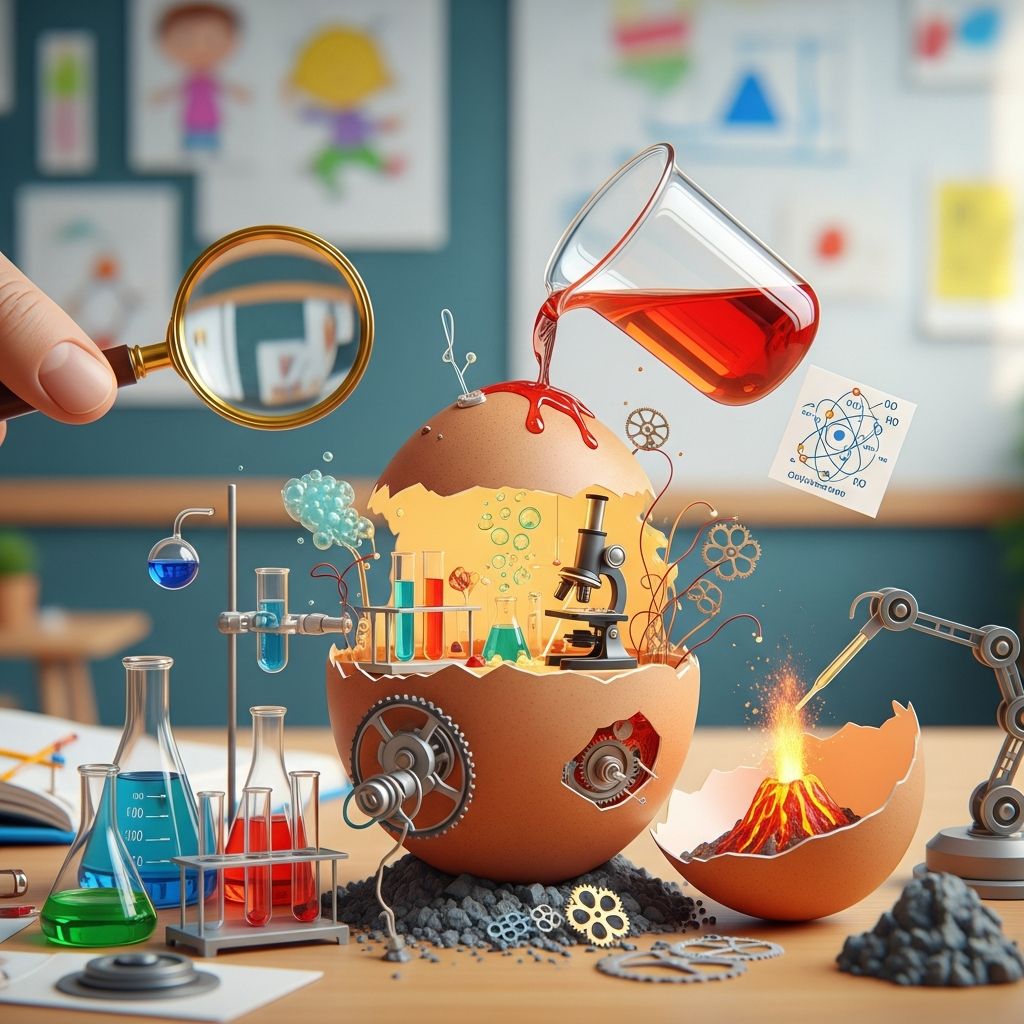
Eggs serve as remarkable tools for introducing children to fundamental scientific principles. These everyday items from the kitchen can demonstrate complex ideas in physics, chemistry, and biology through simple, engaging activities. Whether aiming to float an egg, transform its structure, or test its strength, these experiments require minimal supplies and deliver memorable lessons.
Why Eggs Excel in Home Science Labs
Eggs possess unique properties that make them ideal for educational exploration. Their shells consist primarily of calcium carbonate, which reacts predictably with acids, while the membrane regulates substance passage, illustrating biological processes. Internally, eggs contain air pockets and liquids that respond to pressure and temperature changes, perfect for physics demos. These attributes allow learners to observe phenomena like buoyancy, diffusion, and structural integrity firsthand.
Conducting egg experiments fosters critical thinking as children predict outcomes, test hypotheses, and analyze results. Such hands-on work aligns with STEM education goals, promoting problem-solving and inquiry skills. Parents and educators appreciate the low cost—often just eggs, water, salt, and vinegar—and the safety when supervised properly.
Mastering Buoyancy: The Saltwater Float Challenge
Buoyancy, the upward force exerted by fluids on immersed objects, becomes tangible when making an egg float in water. An egg sinks in freshwater due to matching densities but rises when salt increases the water’s density.
Materials Needed
- One raw egg
- Tall glass of water
- Salt (about 6 tablespoons)
- Spoon for stirring
Step-by-Step Instructions
- Fill the glass with water and gently place the egg inside; it will sink.
- Add salt one tablespoon at a time, stirring until dissolved, observing the egg rise gradually.
- Continue until the egg floats near the surface.
This activity reveals how density determines flotation, a principle vital in oceanography and engineering. Extend it by testing sugar or varying salt amounts for quantitative analysis.
Transforming Shells: Creating Bouncy Rubber Eggs
A raw egg’s shell dissolves in vinegar, yielding a flexible, translucent “rubber egg” that bounces gently. This showcases acid-base chemistry, as acetic acid in vinegar reacts with calcium carbonate to produce carbon dioxide gas and water, eroding the shell while preserving the membrane.
Gathering Supplies
- Raw egg
- White vinegar
- Glass jar
- Food coloring (optional)
Procedure
- Submerge the egg in vinegar, covering it fully; bubbles indicate the reaction.
- Wait 24-48 hours, checking periodically; the shell vanishes, leaving a rubbery orb.
- Rinse and test by squeezing or dropping from low heights.
Kids marvel at the transformation, learning about selective permeability since the membrane blocks larger molecules. According to the American Chemical Society, this reaction exemplifies dissolution: CaCO₃ + 2CH₃COOH → Ca(CH₃COO)₂ + H₂O + CO₂.
Exploring Membrane Magic: Osmosis Demonstrations
Using the rubber egg, observe osmosis—the movement of water across a semi-permeable membrane from high to low concentration areas. Placing it in distilled water causes swelling; corn syrup leads to shrinkage.
Required Items
- Rubber egg from previous experiment
- Distilled water
- Corn syrup or sugar solution
- Two glasses
How to Conduct
- Measure the egg’s circumference.
- Submerge one in water, another in syrup for 24 hours.
- Remeasure; discuss water flow directions.
This mirrors cellular processes in living organisms, as explained by the National Institutes of Health, where osmosis maintains cell turgor.
Harnessing Air Pressure: Egg-into-Bottle Trick
Demonstrate atmospheric pressure by sucking a peeled hard-boiled egg into a bottle using temperature-induced volume changes. Heating expands air inside; cooling contracts it, creating lower pressure that forces the egg in.
Preparation List
- Hard-boiled egg (peeled)
- Glass milk bottle or jar with neck matching egg size
- Matches or lighter
- Paper twist for ignition
Safe Execution Steps
- Light the paper inside the bottle briefly to warm air.
- Quickly position the egg over the mouth; watch it get drawn in.
- Remove carefully, discussing pressure differentials.
The U.S. National Weather Service notes air pressure variations drive such phenomena, akin to weather systems.
Strength Secrets: Eggshell Structural Tests
Eggshells withstand surprising loads due to arched architecture distributing force evenly. Test by standing on a carton or building bridges.
| Test Type | Setup | Expected Outcome |
|---|---|---|
| Footprint Challenge | Carton of 24 eggs under plywood | No breakage if weight spread |
| Bridge Build | Two eggs supporting cards/books | Holds 5+ pounds |
Engineering curricula from the National Science Teaching Association highlight domes’ efficiency.
Growing Wonders: Eggshell Seed Nurseries
Repurpose halves as planters to study germination. Fill with soil, plant seeds, and monitor growth in sunlight.
Steps for Success
- Empty shells cleanly.
- Add potting soil and seeds (e.g., beans).
- Water lightly; transplant when sprouted.
This promotes sustainability and biology insights per USDA guidelines.
Sparkling Transformations: Crystal-Covered Shells
Grow borax crystals on eggshells to explore supersaturation and nucleation.
Materials
- Clean eggshell halves
- Borax (3 tbsp per cup hot water)
- Food coloring
Crystal Growth Process
- Dissolve borax in boiling water.
- Suspend shells inside; cool overnight.
- Admire formations.
Engineering Triumphs: Egg Drop Parachute Challenges
Design contraptions to protect eggs from falls, testing aerodynamics and cushioning.
- Materials: Straws, tape, balloons, fabric scraps.
- Test from varying heights; iterate designs.
These align with NASA’s educational engineering modules.
Spinning Secrets: Raw vs. Boiled Motion Studies
Spin both; raw stops quickly due to liquid inertia, boiled continues steadily.
Physics principles from inertia explained by the American Physical Society.
Frequently Asked Questions
What age group suits these egg experiments?
Ideal for ages 5-12 with supervision; younger kids assist simpler steps.
Are raw eggs safe for all activities?
Use fresh eggs; discard after experiments to avoid risks.
Can these be science fair projects?
Yes—vary variables like salt quantity or drop heights for data.
What if vinegar smell lingers?
Rinse thoroughly; reactions complete in days.
Extending Learning: Journals and Variations
Encourage recording predictions, data, and reflections in science journals. Vary experiments by colors, temperatures, or multiple trials for deeper insights. These activities build confidence in scientific method application.
Egg science bridges kitchen curiosity to lab rigor, inspiring lifelong learning. With adult guidance, children safely uncover nature’s ingenuity.
References
- Acid-Base Reactions with Eggshells — American Chemical Society. 2023-05-15. https://www.acs.org/education/resources/highschool/chemmatters/past-issues/2016-2017/may-2017/eggsperiment-with-acids-and-bases.html
- Osmosis in Biological Membranes — National Institutes of Health. 2024-02-10. https://www.ncbi.nlm.nih.gov/books/NBK557743/
- Understanding Air Pressure — National Weather Service. 2025-01-20. https://www.weather.gov/jetstream/pressure
- Structural Strength in Nature — National Science Teaching Association. 2023-11-08. https://www.nsta.org/blog/science-behind-eggshells
- Seed Germination Basics — United States Department of Agriculture. 2024-06-12. https://www.ars.usda.gov/northeast-area/beltsville-md-barc/beltsville-agricultural-research-center/plant-sciences-institute/docs/seed-germination/
- Egg Drop Engineering Challenge — NASA Glenn Research Center. 2023-09-05. https://www1.grc.nasa.gov/beginners-guide-to-aeronautics/egg-drop/
- Inertia and Rotational Motion — American Physical Society. 2024-03-22. https://www.aps.org/education/outreach/programs/exhibits/spinning-egg.cfm

- Integrated M.A. in Applied Linguistics, University of Hyderabad
- 5+ years in editorial, instructional, SEO, and research-based writing
Sneha is a relationships and lifestyle writer with a strong foundation in applied linguistics and certified training in relationship coaching. She brings over five years of writing experience to theskillvault, crafting thoughtful, research-driven content that empowers readers to build healthier relationships, boost emotional well-being, and embrace holistic living. Her writing and insights reflect the belief that beauty, happiness, and wellness…