
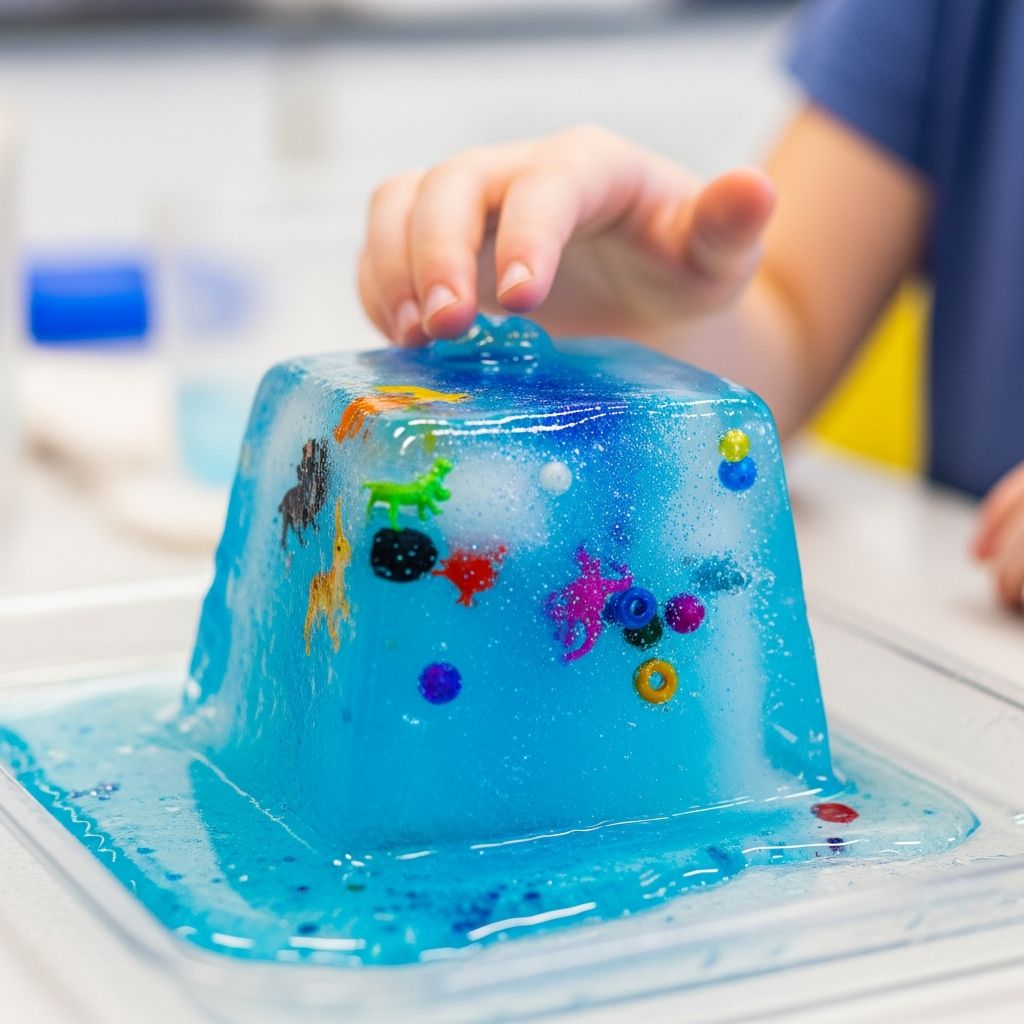
Ice offers a versatile medium for introducing children to fundamental scientific concepts like phase changes, density, and chemical reactions. These experiments use common household items to create engaging, educational experiences that foster observation, prediction, and critical thinking skills.
Understanding the Basics of Ice Formation and Melting
Water transforms into ice when cooled below 32°F (0°C), expanding to become less dense than liquid water, which is why ice floats. This property underpins many experiments, allowing kids to explore how temperature, solutes like salt, and surface area influence melting rates.
Begin with simple observations: freeze water in trays overnight and discuss why it expands. Experiments reveal how heat accelerates melting while cold slows it, building foundational knowledge in thermodynamics suitable for ages 4 and up.
Classic Melting Rate Comparisons
Test how environmental conditions affect ice dissolution. Place identical ice cubes in room-temperature water, hot water, cold water, and on a dry plate. Time their melting and record results in a chart.
- Hot water: Melts fastest due to higher kinetic energy breaking ice bonds quickly.
- Room-temperature water: Moderate rate, influenced by convection currents.
- Cold water: Slowest, as surrounding liquid absorbs minimal heat.
- Dry plate: Evaporative cooling prolongs persistence.
Extend by running tap water over ice in a colander—flowing water enhances melting through constant exposure. This demonstrates convection and is ideal for group predictions and discussions.
The Surprising Power of Salt on Ice
Salt lowers ice’s melting point by disrupting crystal structure, creating a brine that accelerates dissolution. Sprinkle salt on a large ice block and watch craters form as liquid seeps into cracks.
For interactivity, provide droppers with colored water or paint over salted areas. Colors absorb into channels, revealing ice’s internal structure dramatically. This visual effect captivates preschoolers while teaching about freezing point depression.
| Substance | Effect on Ice | Science Principle |
|---|---|---|
| Salt | Forms craters, speeds melting | Lowers freezing point |
| Sugar | Slower melting | Milder depression |
| Pepper | Minimal effect | No significant change |
Compare substances in a table like this to quantify observations quantitatively.
Floating and Sinking: Density Discoveries
Ice floats because its density (0.917 g/cm³) is lower than water’s (1 g/cm³). Place ice in a bowl and add objects to investigate buoyancy.
- Light plastics float.
- Heavy metals sink.
- Irregular shapes affect stability.
Predict and test: Does size matter? This leads to Archimedes’ principle discussions without complex math.
Colorful Transformations and Mixing
Freeze colored water cubes using natural food dyes. Place contrasting colors (red and yellow) in a bowl to observe blending into orange as they melt.
- Predict final hues.
- Chart changes over time.
- Add to juice for taste-color experiments.
This combines art and science, enhancing sensory engagement.
Creative Excavation Adventures
Embed toys like LEGO or small figures in ice blocks. Rescue them using warm water droppers, salt, or tools. Variations:
- Sensory bin: Shaved ice with hidden treasures.
- Themed digs: Dinosaurs or gems for imaginative play.
- Speed challenges: Race to excavate first.
Teaches patience and experimentation—try saltwater vs. freshwater for differential rates.
Ice Races: Motion and Temperature
Line up ice cubes on a tilted board or plate. Which melts and slides fastest? Factors:
- Surface (plate vs. fabric).
- Starting size.
- Added salt.
Perfect for races, promoting hypothesis testing.
Artistic Ice Creations
Paint directly on frozen surfaces—melting allows smooth strokes. Create frozen decorations outdoors or indoors.
- Ice painting: Black canvas for vibrant colors.
- Frozen hands: Paint salted ice sculptures.
- Hot ice: Supersaturated sodium acetate for reusable crystals (adult supervision).
Blends creativity with physics.
Kitchen Science: Edible Experiments
Make ice cream in bags: Milk, sugar, vanilla in one bag; ice and salt in another. Shake vigorously—salt chills mixture below 32°F.
Freeze juice into cubes for slushies or popsicles. Observe texture changes hourly.
Advanced: Insulators and Instant Freezing
Test materials (foil, cloth, paper) wrapping ice cubes—which lasts longest? Reveals conduction differences.
Supercool water by chilling undisturbed, then agitate for instant ice towers—teaches nucleation (demo only).
Safety Guidelines for Ice Play
Supervise young children. Use non-toxic materials. Avoid dry ice without gloves. Clean spills promptly to prevent slips.
Frequently Asked Questions
What age group are these ice experiments suitable for?
Most suit ages 3-10, with supervision. Simplify for toddlers; add measurements for older kids.
Do I need special equipment?
No—use trays, bowls, salt, droppers, food coloring from home.
Why does salt melt ice?
It dissolves into brine, lowering the melting point below 0°C.
Can these be done outdoors?
Yes, in cold weather for natural freezing; indoors anytime with a freezer.
How to make experiments educational?
Encourage predictions, charts, and ‘why’ discussions for STEM skills.
References
- Six Quick and Easy Kids Experiments with Wintry Ice — PBS SoCal. 2023-12-15. https://www.pbssocal.org/education/families/six-quick-and-easy-kids-experiments-with-wintry-ice
- 5 Easy Ice Science Experiments to Do at Home — YouTube (Science Kitchen Lab). 2024-01-10. https://www.youtube.com/watch?v=8-wR0RqINNs
- Melting Ice Experiment — NASA JPL Education. 2023-05-22. https://www.jpl.nasa.gov/edu/resources/lesson-plan/melting-ice-experiment/
- Ice and Salt Experiment for Preschool — Learning and Exploring Through Play. 2015-08-12. https://www.learningandexploringthroughplay.com/2015/08/ice-and-salt-experiment-for-preschool.html
- Easy Ice Experiments for Kids — Science Sparks. 2024-02-28. https://www.science-sparks.com/ice-experiments/
- Ice Fishing Science Experiment — Science Fun for Kids. 2023-11-05. https://www.sciencefun.org/kidszone/experiments/ice-fishing/

- Integrated M.A. in Applied Linguistics, University of Hyderabad
- 5+ years in editorial, instructional, SEO, and research-based writing
Sneha is a relationships and lifestyle writer with a strong foundation in applied linguistics and certified training in relationship coaching. She brings over five years of writing experience to theskillvault, crafting thoughtful, research-driven content that empowers readers to build healthier relationships, boost emotional well-being, and embrace holistic living. Her writing and insights reflect the belief that beauty, happiness, and wellness…