
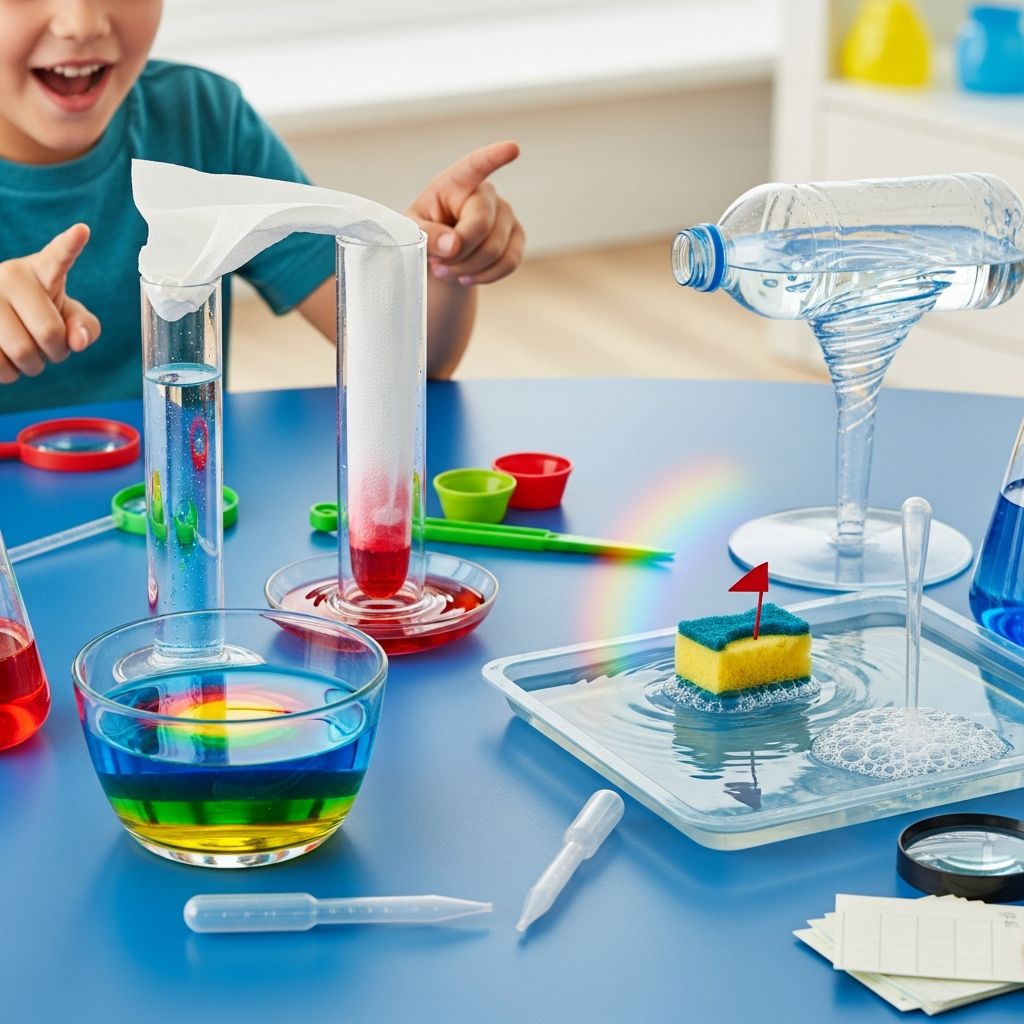
Water is everywhere and powers countless natural processes, making it an ideal medium for introducing children to scientific discovery. These experiments use everyday items to demonstrate principles like density, capillary action, surface tension, and states of matter. Designed for kids from kindergarten through elementary school, they require minimal setup and encourage observation, prediction, and hands-on learning.
Understanding Water’s Unique Properties
Before diving into activities, it’s helpful to grasp why water behaves as it does. Water molecules are polar, meaning they have positive and negative ends that attract each other, creating surface tension—the ‘skin’ on water’s surface. This property allows insects to walk on ponds and influences many experiments. Water also expands when frozen, unlike most substances, which is why ice floats. These traits lead to fascinating demonstrations that captivate young minds.
Exploring Density with Layered Liquids
Density determines if objects sink or float; it’s mass per unit volume. Heavier liquids sink below lighter ones, creating stunning visual layers.
Rainbow Density Tower
Create a colorful density column to show how sugar affects water’s density. Materials: clear jar, water, sugar (various amounts), food coloring, spoon.
- Label six glasses 1-6. Fill each with 1 cup water.
- Add 0 tsp sugar to glass 1, 1 tsp to 2, up to 5 tsp in 6. Color each differently.
- Stir until dissolved. Use a baster to layer from heaviest (glass 6) at bottom to lightest (glass 1) on top.
Observe the stable rainbow! This teaches that adding solute increases density, preventing mixing.
Floating Egg Surprise
Make an egg float in freshwater by altering density. Materials: tall glass, water, salt, egg.
- Fill glass halfway with water; gently place egg—it sinks.
- Remove egg, add salt (1/4 cup per cup water), stir to dissolve.
- Replace egg; it floats due to saltwater’s higher density.
This illustrates buoyancy: objects float when less dense than the liquid.
Surface Tension and Motion Magic
Surface tension acts like an invisible film, enabling unique water behaviors.
Soap-Powered Mini Boat
Harness surface tension for propulsion. Materials: shallow dish, water, foil, liquid soap, toothpick.
- Fold foil into a small boat shape.
- Fill dish with water; float boat.
- Dip toothpick in soap, touch water behind boat—watch it zoom!
Soap breaks surface tension unevenly, pushing the boat forward via Newton’s third law.
Bending Stream with Electricity
Static charge deflects water. Materials: faucet, balloon, wool cloth.
- Run thin water stream.
- Rub balloon on wool to charge statically.
- Hold near stream (not touching)—water bends toward balloon.
Charged balloon attracts polar water molecules.
Capillary Action and Color Transfer
Capillary action is water climbing narrow spaces against gravity, vital for plant transport.
Walking Rainbow Water
Watch colors ‘walk’ via paper towels. Materials: 6 cups, water, food coloring, paper towels.
- Fill cups 1,3,5 with water; color red, yellow, blue.
- Leave 2,4,6 empty. Connect with folded towels.
Overnight, colors mix into orange, green, purple via capillary action and diffusion.
Celery Color Climb
Visualize plant water uptake. Materials: celery stalks, colored water, glasses.
- Place celery in red/blue water.
- Observe veins coloring in hours.
Demonstrates xylem action.
States of Matter and Changes
Water cycles through solid, liquid, gas states.
Instant Ice Tower
Supercooled water freezes on contact. Materials: bottled water (frozen hours), ice plate.
- Freeze bottle upright 2-3 hours (still liquid).
- Pour slowly on ice—forms icy column.
Supercooling delays freezing until nucleation.
Evaporation Race
Test factors speeding evaporation. Materials: water dishes, heat source, fans.
- Set dishes with same water volume: shaded, sunny, windy, heated.
- Measure drying time.
Heat, air flow, surface area accelerate evaporation.
Chemical Reactions in Water
Water enables reactions like dissolution.
Candy Dissolution Spectacle
Skittles/M&Ms bleed color. Materials: plate, candies, warm water.
- Arrange candies on plate edge.
- Pour center water gently.
Colors diffuse without mixing initially due to density.
Fizzing Color Explosions
Alka-Seltzer creates fireworks. Materials: glass, water, tablets, food coloring.
- Drop colored tablet pieces in water—watch bubbles erupt.
CO2 from acid-base reaction.
Modeling Nature’s Water Cycle
Replicate Earth’s water processes.
Bag Water Cycle
Mini ecosystem. Materials: ziplock bag, water, marker, tape.
- Draw cycle; add water/blue food color, seal, tape to window.
- Watch evaporation/condensation/rain.
Simulates natural cycle.
Cloud in a Jar Rain
Make ‘rain’. Materials: jar, hot water, ice, shaving cream.
- Hot water in jar; add cream ‘cloud’.
- Blue water drops on cream—’rains’ through.
Saturated cloud precipitates.
Light and Water Interactions
Water refracts light, bending it.
Refraction Illusion
Objects distort underwater. Materials: glass, water, straw/pencil.
- Half-fill glass; insert straw—appears broken.
Light slows in water, bending rays.
Safety Guidelines for Water Play
Supervise young kids; use shallow containers; avoid ingestion. Dry areas to prevent slips. Ideal for warm days or baths.
Benefits of Water-Based Learning
| Concept | Experiment Example | Skill Developed |
|---|---|---|
| Density | Rainbow Tower | Observation |
| Surface Tension | Soap Boat | Hypothesis Testing |
| Capillary Action | Walking Water | Prediction |
| Water Cycle | Bag Model | Environmental Awareness |
These build critical thinking, aligning with STEM goals.
Frequently Asked Questions (FAQs)
What age group are these experiments for?
Most suit ages 4-12; adapt for younger with supervision.
Do I need special equipment?
No—household items suffice.
Why won’t my layers mix in density experiments?
Different densities keep them separate until disturbed.
Can these be done outdoors?
Yes, great for summer learning.
How to extend learning?
Journal predictions/outcomes; discuss real-world links like ocean salinity.
References
- Science Experiments with Water — Little Bins for Little Hands. 2023. https://littlebinsforlittlehands.com/water-science-activities-kids-stem/
- Kids Science Experiments Using Water — Free Time with the Kids. 2022. https://freetimewiththekids.com/kids-science-experiments-using-water/
- Hands-on Science Experiment: Walking Water — Arizona PBS (YouTube). 2021-10-15. https://www.youtube.com/watch?v=hSqh3zzHe7Y
- 6 Fun Science Experiments with Water — Great Wolf Lodge. 2023. https://www.greatwolf.com/blog/science-experiments-with-water/
- Kid Friendly: Easy Science Experiments With Water — Distillata. 2024. https://distillata.com/blog/kid-friendly-easy-science-experiments-with-water/

Medha Deb is an editor with a master's degree in Applied Linguistics from the University of Hyderabad. She believes that her qualification has helped her develop a deep understanding of language and its application in various contexts. Medha specializes in the areas of beauty, health, sports, and wellness and is committed to ensuring that the content on the website is…