
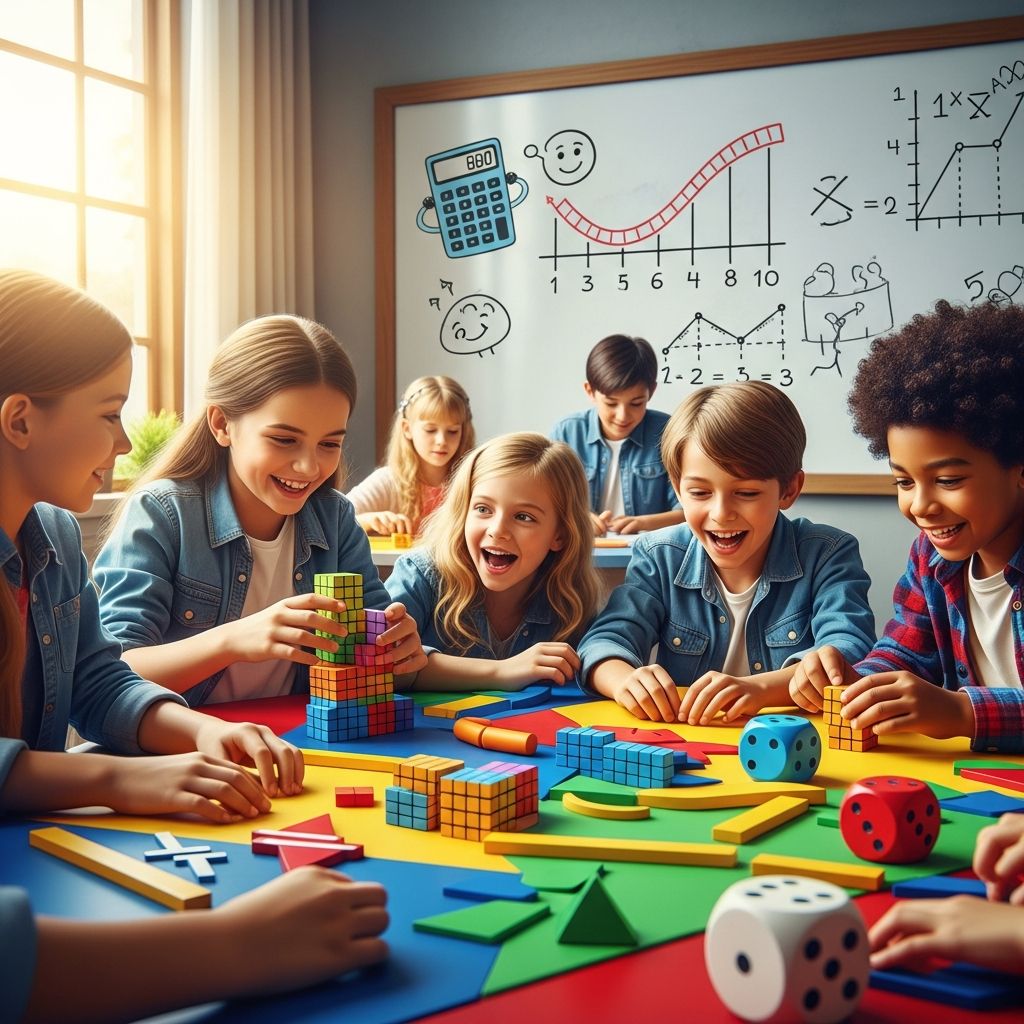
Mathematics often carries a reputation for being dry and challenging, yet it holds the power to captivate young minds when presented creatively. By shifting from rote memorization to interactive discovery, educators and parents can cultivate a genuine love for numbers and patterns. This article explores fresh approaches to infuse excitement into math sessions, drawing on play, relevance, and multisensory experiences to help children thrive.
Building a Foundation of Enthusiasm
Creating an environment where math sparks curiosity starts with mindset. Children mirror the attitudes of adults around them, so approaching numbers with optimism sets the tone. Emphasize that everyone encounters hurdles in math, but persistence leads to breakthroughs, much like mastering a sport or instrument. Share personal stories of overcoming math struggles to normalize challenges and highlight growth.
Visual aids play a crucial role early on. Charts, colorful diagrams, and digital animations demystify abstract ideas, making concepts like fractions or geometry tangible. For instance, fraction walls or pie charts divided into everyday foods help kids grasp proportions intuitively. Integrating technology, such as interactive apps, further enhances this by offering immediate feedback and progression tracking, keeping learners motivated.
Harnessing the Power of Play
Games stand out as one of the most effective tools for joyful math learning. They reduce anxiety, encourage repetition without boredom, and promote skills like strategy and quick thinking. Incorporate board games adapted for math: use Monopoly for money calculations, Battleship for coordinate grids, or custom dice rolls for probability experiments.
- Card-Based Challenges: Everyday decks like UNO teach place value, addition, and patterns through color-coded numbers and actions.
- Group Competitions: Divide classes into teams for relay-style problems, where solving equations unlocks the next clue, fostering collaboration.
- Digital Quests: Platforms with adventure-themed puzzles reward correct answers with virtual progress, blending entertainment with education.
Physical games extend this further. Sidewalk chalk grids for hopscotch reinforce multiplication tables, while scavenger hunts require measuring distances or estimating quantities. These activities make abstract skills concrete, ensuring retention through movement and fun.
Connecting Math to Daily Adventures
One of the quickest ways to make math relevant is by weaving it into routine activities. Shopping becomes a lesson in budgeting and percentages—calculate discounts or compare unit prices. Cooking sessions involve scaling recipes, measuring ingredients, and understanding ratios, turning the kitchen into a lively lab.
| Activity | Math Skill | Example |
|---|---|---|
| Grocery Shopping | Addition/Subtraction | Totaling bills and change-making |
| Baking Cookies | Fractions/Measurement | Halving dough or doubling batches |
| Planning a Trip | Time/Distance | Estimating travel duration |
| Gardening | Geometry/Area | Plotting bed sizes |
Outdoor explorations amplify this: measure shadows for time-telling, count steps for basic arithmetic, or map neighborhood routes using simple coordinates. These real-world ties demonstrate math’s utility, shifting perceptions from irrelevant to indispensable.
Hands-On Exploration with Manipulatives
Tactile tools bridge the gap between theory and understanding. Blocks, counters, and geometric shapes allow kids to build, manipulate, and visualize problems. Base-10 blocks clarify place value, while pattern blocks explore symmetry and tessellations.
Encourage free play with these items before guided lessons. Children naturally sort, stack, and compare, developing number sense organically. Extend to structured tasks: use beads for skip-counting or linking cubes for equivalence in equations.
- Counters for partitioning numbers into addends.
- Number lines for operations and inequalities.
- Geoboards for creating shapes and calculating perimeters.
For older learners, algebra tiles represent variables, making solving equations feel like a puzzle. This multisensory method suits diverse learning styles, particularly benefiting kinesthetic learners who struggle with worksheets.
Infusing Creativity Through Arts and Stories
Math and art intersect beautifully, unlocking creativity. Geometric designs in drawing teach angles and symmetry; origami folds introduce fractions and spatial reasoning. Music rhythms align with multiplication patterns, while composing beats reinforces sequencing.
Storytelling personalizes concepts. Craft tales where characters solve problems using algebra or statistics, prompting kids to predict outcomes. Books featuring math protagonists, like those involving mysteries solvable by logic, build narrative-driven comprehension.
Collaborative projects shine here: design mosaics with repeating tiles or choreograph dances with counted steps. These blend disciplines, showing math’s role in creative expression and deepening appreciation.
Grouping Learners for Dynamic Interaction
Small group rotations maximize engagement. Assign stations with varied activities—games, manipulatives, tech challenges—rotating every 15 minutes keeps energy high. Peers teach peers, reinforcing knowledge through explanation.
Differentiated tasks within groups cater to levels: beginners sort shapes, advanced design proofs. Whole-class tournaments build community, with teams earning points for accuracy and speed. Track progress on shared boards to celebrate collective wins.
Leveraging Technology and Media
Apps and videos transform solitary practice into interactive journeys. Programs like Prodigy or Khan Academy Kids adapt difficulty, gamifying progress. Virtual reality tours of mathematical wonders, such as fractal landscapes, inspire awe.
YouTube channels with animated explanations or challenges engage visually. Assign “math movie nights” reviewing concepts through fun skits. Balance screen time with offline activities for holistic development.
Cultivating Perseverance and Mindset
Embrace productive struggle—allow time for grappling before hints. Praise effort over innate talent: “You worked hard to figure that out!” Model problem-solving by verbalizing thought processes aloud.
Set growth goals, like mastering times tables through daily mini-challenges. Reflect post-activity: What was tricky? What clicked? This metacognition builds resilience and self-efficacy.
Frequently Asked Questions
What age groups benefit most from these math fun strategies?
All ages, from preschoolers with counting games to teens tackling real-world budgeting, though hands-on tools suit younger kids best.
Do I need expensive materials to make math engaging?
No—household items like cards, coins, and measuring tapes work wonders alongside free printables and apps.
How often should I incorporate fun math activities?
Daily integration yields best results, blending 20-30 minutes of play into routines without overwhelming structure.
Can these methods help kids who dislike math?
Yes, by focusing on strengths and successes, they rebuild confidence gradually through low-pressure play.
What if my child prefers screens for math games?
Curate quality apps with parental controls, alternating with physical activities for balanced learning.
Long-Term Benefits of Fun Math
Consistent joyful practice yields deeper understanding, improved retention, and positive attitudes persisting into advanced studies. Children develop critical thinking, applicable across subjects and life. Parents report heightened family bonding through shared activities, while teachers note classroom harmony from engaged groups.
Track individual growth via portfolios of projects, celebrating milestones. Adapt strategies based on feedback, ensuring sustained motivation. Ultimately, these approaches not only teach math but instill a lifelong curiosity for discovery.
References
- National Council of Teachers of Mathematics: Principles to Actions — NCTM. 2014-10-01. https://www.nctm.org/standardsandpositions/Principles-to-Actions/
- Adding It Up: Helping Children Learn Mathematics — National Academies Press. 2001-11-15. https://nap.nationalacademies.org/catalog/9822/adding-it-up-helping-children-learn-mathematics
- Game-Based Learning in Mathematics — Journal of Educational Computing Research (via Sage). 2023-05-12. https://journals.sagepub.com/doi/full/10.1177/07356331231163800
- Manipulatives and Math Learning — U.S. Department of Education, What Works Clearinghouse. 2022-08-01. https://ies.ed.gov/ncee/wwc/PracticeGuide/16
- Real-World Math Applications for K-12 — OECD Education Working Papers. 2024-02-20. https://www.oecd-ilibrary.org/education/real-world-math-applications_5a3c5b0f-en
- Playful Learning in STEM — Harvard Graduate School of Education. 2025-01-10. https://www.gse.harvard.edu/ideas/usable-knowledge/25/01/playful-learning-stem

- Integrated M.A. in Applied Linguistics, University of Hyderabad
- 5+ years in editorial, instructional, SEO, and research-based writing
Sneha is a relationships and lifestyle writer with a strong foundation in applied linguistics and certified training in relationship coaching. She brings over five years of writing experience to theskillvault, crafting thoughtful, research-driven content that empowers readers to build healthier relationships, boost emotional well-being, and embrace holistic living. Her writing and insights reflect the belief that beauty, happiness, and wellness…