
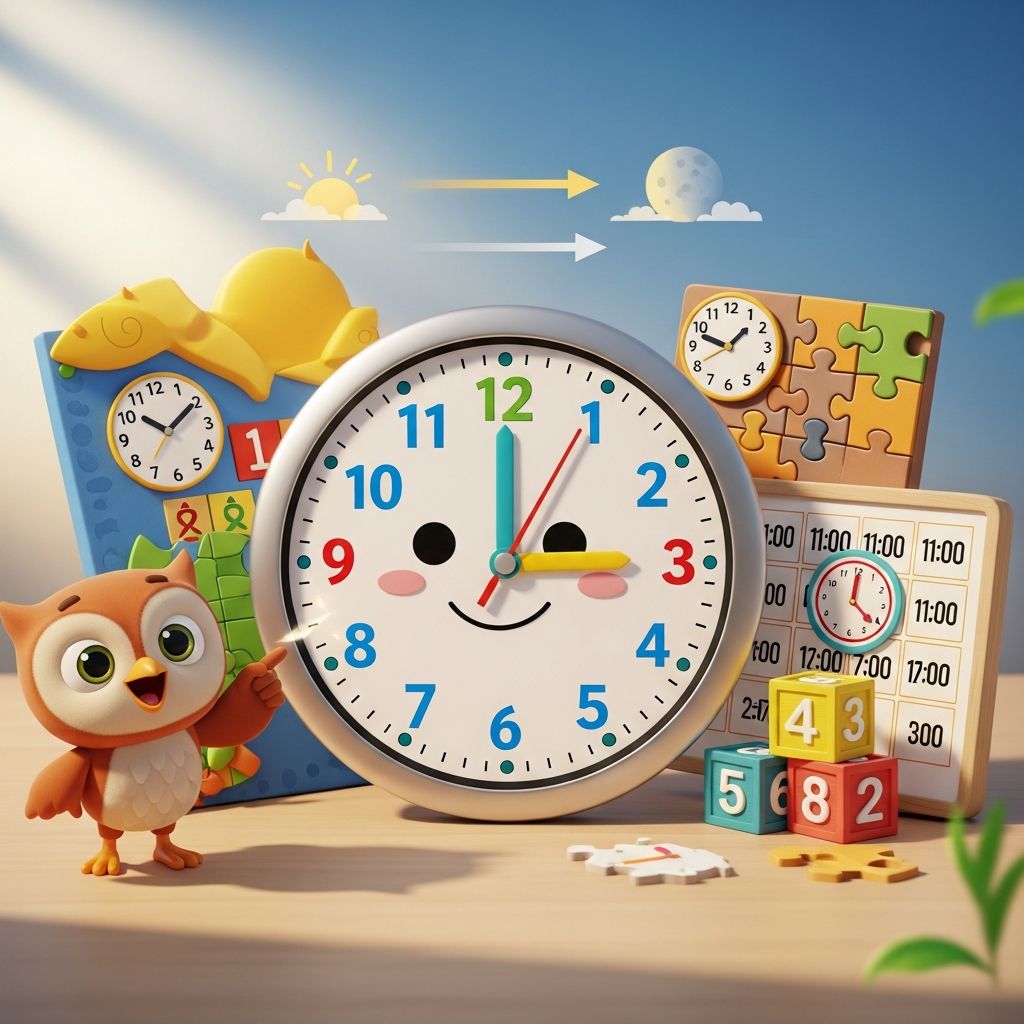
Teaching children to read analog clocks is a foundational math skill that combines number sense, fractions, and spatial awareness. Young learners often struggle with distinguishing hour and minute hands or understanding intervals like quarters and halves. This article explores innovative, hands-on methods to make time-telling accessible and enjoyable, drawing from proven classroom techniques to support mastery at various levels.
Understanding the Basics of Analog Clocks
Analog clocks feature hour and minute hands that move continuously around a circular face marked 1 to 12. The shorter hour hand indicates the hour, while the longer minute hand shows minutes past the hour. Each number represents five minutes, helping kids grasp that 60 minutes form a full circle. Start lessons by explaining these fundamentals visually, using large models for group visibility.
Break down progression: begin with whole hours, advance to half-hours, then quarter-hours, and finally minute-by-minute accuracy. This scaffolded approach builds confidence gradually.
Hands-On Clock Construction Projects
Building physical clocks reinforces concepts through tactile learning. Encourage creativity with everyday materials to demystify clock mechanics.
- Paper Plate Timers: Cut clock faces from sturdy paper plates. Students draw numbers 1-12, then attach movable brass fasteners for hands made from cardstock strips. Color-code hands—blue for hours, red for minutes—to aid differentiation. Practice by setting random times and verbalizing them.
- Cardboard Gear Clocks: Use interlocking cardboard gears to demonstrate hand movement. Link smaller gears for minutes to a larger one for hours, showing proportional speeds. Kids spin to observe realistic motion, deepening comprehension of time passage.
- Recycled Bottle Cap Clocks: Glue 12 bottle caps around a plate for hours. Insert pipe cleaners through the center as hands, bending ends for grip. This durable version withstands repeated use in centers.
Interactive Group Games for Time Practice
Games turn abstract skills into playful challenges, promoting peer learning and movement. Incorporate these into daily routines for sustained engagement.
- Clock Freeze Dance: Play music while students circle desks with toy clocks. When music stops, they freeze and read a partner’s clock time, shouting it out. Rotate to build speed and accuracy.
- Time Match Relay: Divide class into teams. Scatter clock cards (drawn faces, digital numbers, word forms like ‘quarter past three’) around the room. Teams race to match sets, first correct group wins. Adapts for indoors or outdoors.
- Musical Clock Chairs: Similar to musical chairs, but with clocks on seats. When music pauses, note the time on your chair’s clock and graph results collectively, practicing data representation alongside time-reading.
Playdough and Manipulative-Based Learning
Sensory materials like playdough make abstract concepts concrete. These activities suit kinesthetic learners perfectly.
| Activity | Materials Needed | Learning Focus | Skill Level |
|---|---|---|---|
| Playdough Hand Makers | Playdough, clock templates, recording sheets | Hand length differentiation, time setting | Beginner |
| Cube Chain Minutes | Linking cubes, large chart clock | Five-minute intervals, skip counting | Intermediate |
| Dough Disk Puzzles | Playdough, numbered mats | Matching visual/numeric/word times | Advanced |
For Playdough Hand Makers, roll two lengths: short for hours, long for minutes. Set to teacher-called times, then write digitally. Cube Chain Minutes links cubes in fives around a drawn clock, visually showing progression from 12.
Outdoor and Large-Scale Clock Adventures
Take learning outside for kinesthetic boost and scale. Fresh air enhances retention through active exploration.
- Chalk Circle Giants: Draw massive clock faces on pavement with chalk. Assign student pairs pipe cleaners as hands. Call times; groups adjust and confirm aloud. Weather permitting, add water sprayers for ‘minute marks.’
- Hula Ring Hours: Lay hoops flat, label inner rim 1-12, outer with 5-minute increments. Students stand at positions representing times, moving as a human minute hand during group counts.
- Shadow Sundial Challenge: Use sticks and stones to create outdoor clocks tracking real shadows, bridging analog to natural timekeeping.
Digital and Tech-Integrated Time Tools
Blend traditional with modern tech for diverse learners. Online platforms offer adjustable difficulty.
- Interactive apps let kids select hour-only or minute precision, with visual aids like digital counterparts.
- Projector games where classes compete to set virtual clocks fastest.
- Tablet stations with customizable clocks hiding/showing minute numbers for challenge levels.
Classroom Routines Incorporating Time Skills
Embed time-telling into daily schedules for organic reinforcement. Visual timetables with clock icons link activities to specific times, fostering independence.
- Daily Agenda Clocks: Post a large clock beside the schedule. Update hands as class transitions, verbalizing changes.
- Personal Time Journals: Students log routines like breakfast or bedtime with drawn clocks, comparing analog to digital watches.
- Shake-and-Tell Jars: Egg carton shakers with marble and clock stickers inside. Shake, land on time, graph frequencies for stats practice.
Differentiated Strategies for All Learners
Tailor activities by ability: simplify for beginners with hour-only clocks, challenge advanced with elapsed time problems. Use visuals for ESL students, verbal cues for auditory learners. Group rotations ensure personalized pacing.
Assessment and Progress Tracking
Monitor growth with simple tools: pre/post quizzes, observation checklists during games, or bingo-style mastery boards. Celebrate milestones with ‘Time Master’ badges to motivate.
Frequently Asked Questions
What age is best to start teaching analog time?
Introduce basics around age 5-6, aligning with kindergarten/first-grade curricula, progressing to minutes by second grade.
How can parents reinforce school time lessons at home?
Involve kids in cooking with timers, setting alarm clocks, or daily schedules using printable clock mats.
Why do kids confuse hour and minute hands?
The hour hand moves subtly with minutes, requiring practice to notice; hands-on models clarify this motion.
Are there free printables for time activities?
Yes, many educational sites offer customizable worksheets, bingo cards, and templates for home or class use.
How long until kids master telling time to the minute?
With consistent 10-15 minute daily practice, most achieve proficiency in 4-6 weeks.
References
- 31 Fun Telling-Time Games and Activities — We Are Teachers. 2023-05-15. https://www.weareteachers.com/5-hands-on-ways-to-teach-telling-time/
- 9 Activities for Telling Time — Saddle Up for 2nd Grade. 2022-08-10. https://saddleupfor2ndgrade.com/9-activities-for-telling-time/
- 5 Telling the Time Activities to Help Your Students Understand Analog Clocks — Teaching with Kaylee B. 2021-11-20. https://www.teachingwithkayleeb.com/5-telling-the-time-activities-to-help-your-students-understand-analog-clocks/
- Teaching Time Activities: 10 Fun Ways to Learn to Tell Time — Sweet N Sauer Firsties. 2024-10-14. https://sweetnsauerfirsties.com/2024/10/14/teaching-time-activities-10-fun-ways-to-learn-to-tell-time-2/
- Learn To Tell Time — Toy Theater. 2023-01-05. https://toytheater.com/telling-time/

- Integrated M.A. in Applied Linguistics, University of Hyderabad
- 5+ years in editorial, instructional, SEO, and research-based writing
Sneha is a relationships and lifestyle writer with a strong foundation in applied linguistics and certified training in relationship coaching. She brings over five years of writing experience to theskillvault, crafting thoughtful, research-driven content that empowers readers to build healthier relationships, boost emotional well-being, and embrace holistic living. Her writing and insights reflect the belief that beauty, happiness, and wellness…