
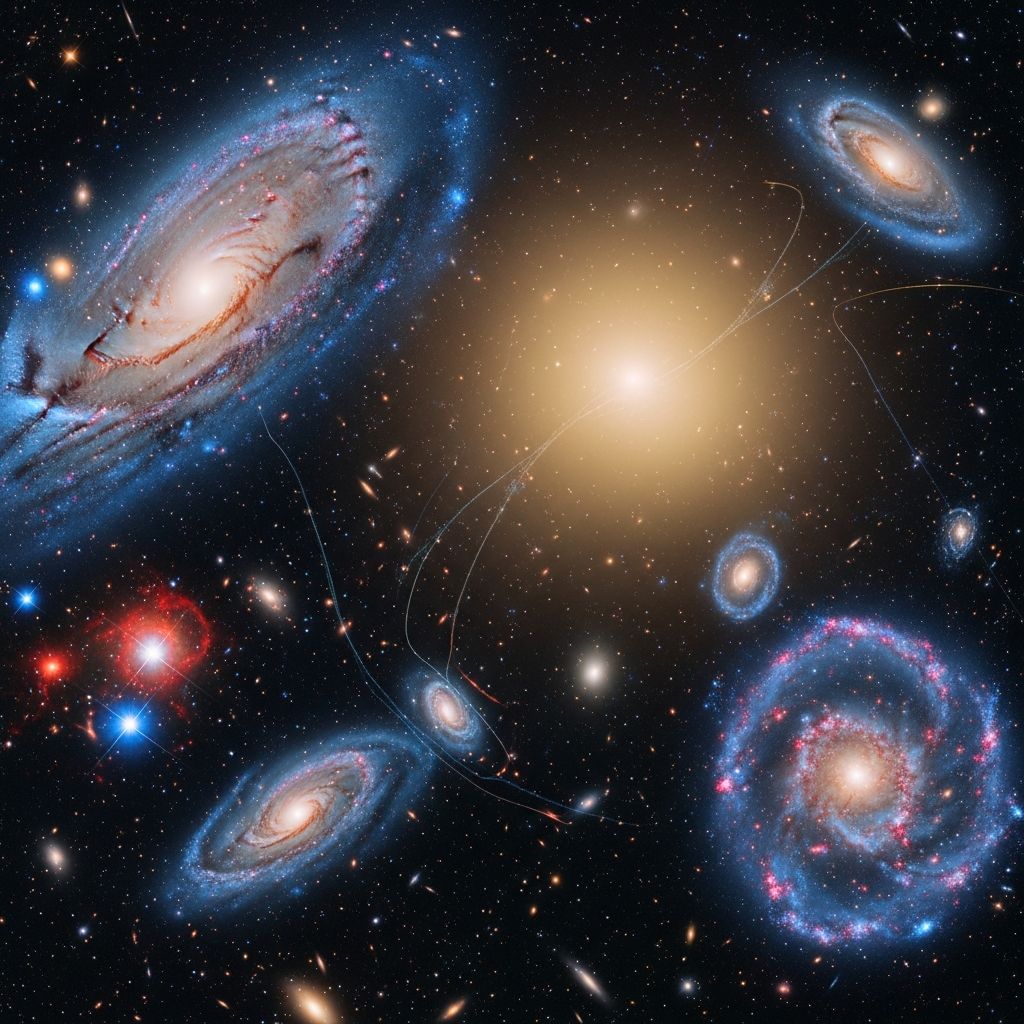
Unveiling the Cosmos: A Journey Through Galactic Structures
The universe contains an estimated 100 to 200 billion galaxies, each comprising billions of stars, gas, dust, and other cosmic materials bound together by gravitational forces. These magnificent structures represent some of the most profound mysteries in modern astronomy. Understanding their composition, classification, and origins provides crucial insights into how our universe came to exist and continues to evolve. The study of galaxies combines observational astronomy with theoretical physics, allowing scientists to piece together a comprehensive picture of cosmic history spanning more than 13 billion years.
The Foundation of Galaxy Classification Systems
The modern approach to categorizing galaxies emerged from early astronomical observations conducted during the 18th and 19th centuries. Pioneering astronomers including Sir William Herschel and his son Sir John Herschel identified that celestial objects called nebulae exhibited remarkable variation in their shapes, sizes, and brightness patterns. These initial observations laid the groundwork for systematic classification methodologies.
The most influential advancement in galaxy classification came from Edwin Hubble in the 20th century. Hubble developed a classification framework that organized galaxies primarily by their structural characteristics, a system that astronomers continue to employ today. This foundational work transformed galaxy research from descriptive astronomy into a more rigorous scientific discipline, enabling researchers to compare and analyze cosmic structures across vast distances.
The Spiral Galaxy Configuration
Spiral galaxies represent one of the two primary galaxy classifications recognized in the Hubble sequence. These structures feature a distinctive flat disk configuration with prominent spiral arms that rotate around a central nucleus. The Milky Way, our own galaxy, exemplifies this spiral morphology. Within spiral galaxies, material rotates in coordinated patterns around the galactic center, creating the characteristic spiral patterns visible from astronomical observations.
Spiral galaxies typically contain substantial quantities of gas and dust distributed throughout their disk components and spiral arms. This abundant interstellar material provides the raw resources necessary for ongoing stellar formation processes. Consequently, spiral galaxies tend to display vibrant blue coloration from massive young stars actively forming within their structures. The organized rotation of material and the presence of active star formation distinguish spiral galaxies as dynamic, evolving systems compared to other galaxy morphologies.
Elliptical Galaxies: Ancient Cosmic Structures
Elliptical galaxies constitute the second major category in the fundamental Hubble classification framework. These structures range in appearance from nearly spherical to distinctly oval or elongated configurations. Unlike spiral galaxies, elliptical galaxies display minimal internal organization and lack the prominent spiral arm structures characteristic of their spiral counterparts.
The stellar populations within elliptical galaxies present a striking contrast to those found in spiral systems. Elliptical galaxies predominantly contain ancient stars, indicating that most stellar formation occurred billions of years ago rather than continuing into the present era. The scarcity of gas and dust within elliptical galaxies substantially limits opportunities for new star formation, resulting in populations dominated by older, dimmer stellar objects. Scientists believe elliptical galaxies originate from collisions and mergers involving spiral galaxies, transforming the original disk-like structures into the spheroidal forms observed today.
Lenticular Galaxies: The Transitional Form
Between the well-defined categories of spiral and elliptical galaxies exists an intermediate morphology known as lenticular galaxies. These structures combine characteristics of both primary galaxy types, featuring a central bulge and disk structure reminiscent of spirals while lacking the prominent spiral arms. Scientists have proposed multiple theories regarding lenticular galaxy origins. One hypothesis suggests that lenticular galaxies represent aged spiral galaxies whose spiral arms have gradually faded over cosmic timescales. An alternative theory proposes that lenticular galaxies formed through mergers of spiral galaxies, with gravitational interactions gradually erasing the distinctive spiral patterns.
Irregular Galaxies: Cosmic Anomalies
Not all galaxies conform to regular spiral or elliptical morphologies. Irregular galaxies lack clearly defined structures and exhibit unique, often chaotic forms. These systems typically result from gravitational interactions, collisions, or mergers that disrupt the organized structures of parent galaxies. Irregular galaxies frequently display elevated rates of star formation resulting from the violent interactions that created their distinctive appearances.
The Fundamental Mechanisms of Galaxy Formation
The formation of galaxies remains among the most compelling questions in modern astronomy. Current scientific understanding suggests that galaxies originated from density fluctuations in the early universe, where gravity caused concentrations of matter to collapse into progressively denser structures. Within the first few hundred thousand years following the Big Bang, gravitational collapse enabled the formation of proto-galaxies from clumps of gas and dark matter. As these initial structures accumulated mass, their gravitational influence intensified, causing continued collapse and increasing internal density.
Two competing theoretical frameworks describe the subsequent evolution from proto-galaxies to the mature galaxies observed today. The top-down theory, developed in 1962, proposed that initial gravitational collapse created enormous gas clouds comparable in mass to present-day mature galaxies. These massive structures then fragmented into smaller components. Conversely, the bottom-up theory suggests that small galaxy-like structures formed initially, then merged and consolidated over billions of years to create the larger galaxies visible in the contemporary universe.
Galactic Mergers and Evolutionary Processes
Observational evidence overwhelmingly supports the conclusion that galaxy mergers represent a crucial mechanism in galactic evolution. Powerful telescopes including the Hubble Space Telescope have captured numerous instances of galactic mergers occurring in the present universe, documenting this process directly. Additionally, observations of distant galaxies—which, due to the finite speed of light, appear as they existed billions of years ago—reveal systematic differences from nearby modern galaxies. Distant galaxies typically appear smaller, less organized, and more irregular than contemporary galactic structures, suggesting substantial evolution occurred between their formation and the present epoch.
Galaxy mergers trigger dramatic transformations in galactic structure and stellar populations. When galaxies collide, gravitational interactions between their stellar populations and gaseous components create elaborate tidal effects, potentially transforming spiral galaxies into elliptical morphologies. Merger events frequently stimulate intensive episodes of star formation, producing starburst galaxies characterized by exceptionally high rates of new stellar creation. These collisional processes explain the prevalence of elliptical galaxies in the contemporary universe and support models describing systematic galactic evolution across cosmic history.
Supermassive Black Holes and Galactic Centers
Most large galaxies harbor supermassive black holes at their centers, containing masses equivalent to hundreds of thousands to billions of solar masses. Our own Milky Way galaxy contains a supermassive black hole weighing approximately 4 million times the Sun’s mass. The relationship between supermassive black holes and their host galaxies remains incompletely understood, creating fundamental questions about cosmic history.
Scientists debate whether supermassive black holes formed before or after their host galaxies. One hypothesis suggests that black holes formed initially, with galaxies subsequently assembling around these massive objects. Alternatively, galaxies may have formed first, with smaller black holes within them eventually merging and accreting material, gradually growing into the supermassive objects observed today. Resolving this fundamental question represents a major objective for advanced observatories including NASA’s James Webb Space Telescope.
Observational Evidence from Deep Space Surveys
Revolutionary observational campaigns have fundamentally transformed our understanding of galactic evolution. NASA’s Hubble Ultra Deep Field image, released in 2004, captured approximately 10,000 galaxies within a tiny region of the constellation Fornax. Remarkably, some galaxies in this image formed less than 800 million years after the Big Bang, enabling astronomers to observe galaxies at dramatically different evolutionary stages. Such observations allow direct comparison between ancient proto-galaxies and mature contemporary structures, providing empirical evidence supporting evolutionary models.
Large-scale galactic surveys including the 2DF Galaxy Redshift Survey and the Sloan Digital Sky Survey have cataloged millions of galaxies and mapped their spatial distributions throughout the universe. These comprehensive surveys reveal systematic patterns in galactic properties and distributions, advancing understanding of how galaxies evolved and assembled into the large-scale cosmic structures visible today.
Photometric Redshift and Distance Measurement
Determining accurate distances to galaxies presents fundamental challenges for astronomers. Photometric redshift techniques measure galactic distances by analyzing the characteristics of light emitted by distant objects. Galaxies moving away from Earth at greater velocities display greater redshifts, the systematic shift toward longer wavelengths in their emitted light. By measuring these redshifts, astronomers can estimate distances and determine how galaxies appeared at earlier cosmic epochs. Ultra-distant galaxies exhibiting redshifts exceeding 10 existed when the universe contained only a few hundred million years of age, providing crucial evidence about galaxy formation in the universe’s earliest era.
Comparing Ancient and Modern Galactic Structures
| Characteristic | Ancient Galaxies (Early Universe) | Modern Galaxies (Present Universe) |
|---|---|---|
| Typical Size | Significantly smaller | Larger and more developed |
| Morphology | Irregular and chaotic | Well-organized spirals and ellipticals |
| Star Formation Rate | Extremely high | Generally lower and more regulated |
| Structural Organization | Poorly defined | Clearly defined structures |
| Stellar Populations | Predominantly young stars | Mix of young and ancient stars |
The Role of Active Galaxies and Energy Emission
Certain galaxies classified as active galaxies emit extraordinarily large quantities of energy, often substantially exceeding the energy output from typical galaxies containing similar numbers of stars. The energy sources powering active galaxies frequently involve supermassive black holes at their galactic centers. Material falling into these massive black holes accelerates to extreme velocities, releasing tremendous energy through radiation and particle ejection. Understanding active galaxies provides insights into the extreme physical conditions surrounding supermassive black holes and the mechanisms driving high-energy astrophysical processes.
Frequently Asked Questions About Galactic Science
Q: How do scientists determine the age of galaxies?
A: Scientists estimate galactic ages using multiple methods including stellar population analysis, examining the types and ages of stars present within galaxies, and photometric redshift measurements that reveal when light left distant galaxies billions of years ago.
Q: Why do spiral galaxies contain more gas and dust than elliptical galaxies?
A: Spiral galaxies maintain organized disk structures that can retain significant quantities of interstellar material. Elliptical galaxies, often formed through mergers, have disrupted structures that allow gas and dust to disperse into space more readily, leaving older stellar populations behind.
Q: What happens when two galaxies collide?
A: Galaxy collisions trigger complex gravitational interactions causing tidal effects, intense star formation bursts, and potential morphological transformations. Spiral galaxies may evolve into elliptical galaxies, and material can be ejected far from the original galactic centers.
Q: How many galaxies exist in the observable universe?
A: Scientists estimate between 100 and 200 billion galaxies populate the observable universe, though this number continues to be refined as observational capabilities improve and our understanding deepens.
Q: Why is the Milky Way considered a spiral galaxy?
A: The Milky Way exhibits the characteristic flat disk structure with rotating spiral arms containing substantial quantities of gas and dust supporting active stellar formation, defining characteristics of spiral galaxy morphology.
References
- Galaxy Evolution — NASA Science. 2024. https://science.nasa.gov/universe/galaxies/evolution/
- How Galaxies Form: Theories, Variants and Growth — Space.com. 2024. https://www.space.com/how-galaxies-form
- Galaxy Types — NASA Science. 2024. https://science.nasa.gov/universe/galaxies/types/
- Galaxies: History — EBSCO Research Starters. 2024. https://www.ebsco.com/research-starters/history/galaxies
- Galaxy Formation and Evolution — Herschel Space Observatory. 2024. https://herscheltelescope.org.uk/science/distant-galaxies/
- The Evolution of Galaxy Structure over Cosmic Time — Christopher J. Conselice, Caltech. 2014. https://ned.ipac.caltech.edu/level5/March14/Conselice/Conselice1.html

- Integrated M.A. in Applied Linguistics, University of Hyderabad
- 5+ years in editorial, instructional, SEO, and research-based writing
Sneha is a relationships and lifestyle writer with a strong foundation in applied linguistics and certified training in relationship coaching. She brings over five years of writing experience to theskillvault, crafting thoughtful, research-driven content that empowers readers to build healthier relationships, boost emotional well-being, and embrace holistic living. Her writing and insights reflect the belief that beauty, happiness, and wellness…