
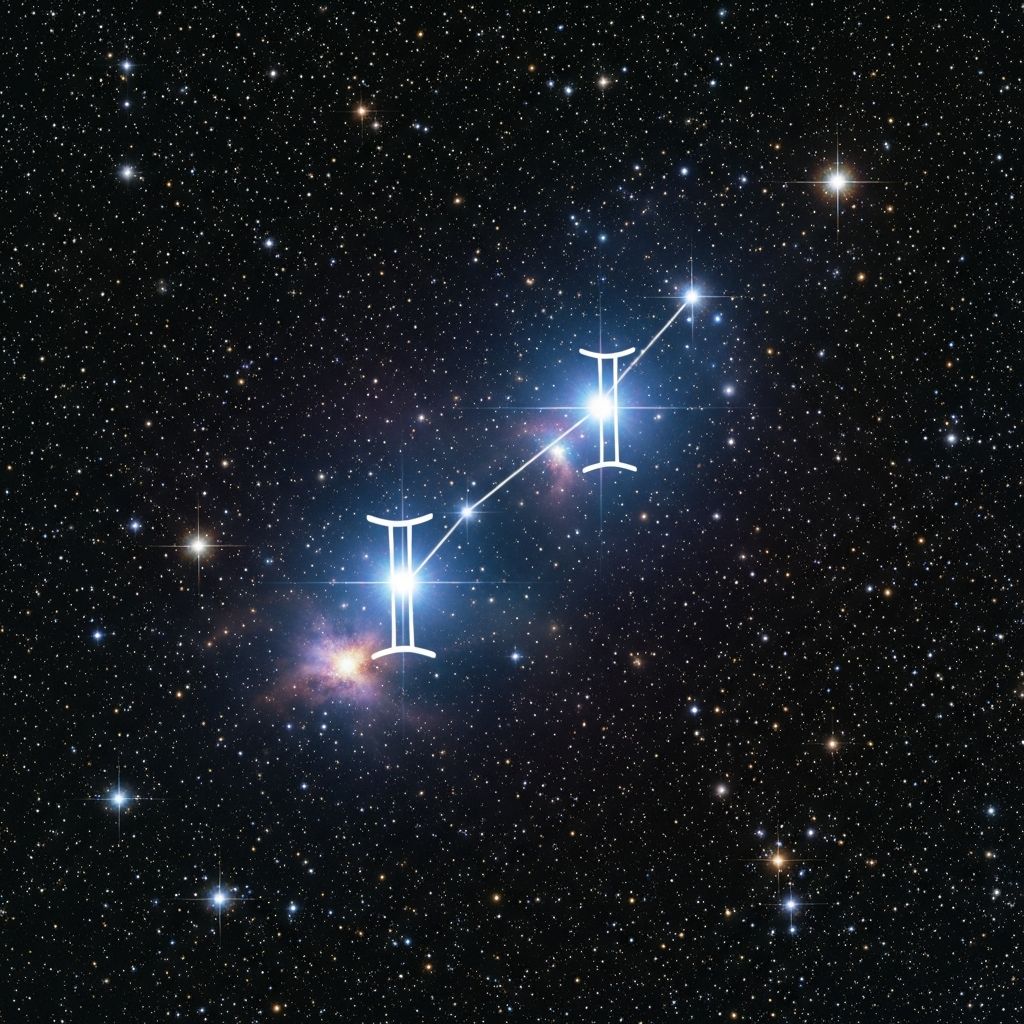
The Gemini constellation, known as the Twins, stands out as one of the most recognizable patterns in the northern celestial hemisphere. Representing the legendary brothers Castor and Pollux, it offers stargazers a blend of mythology, bright stars, and intriguing deep-sky objects. This guide provides everything needed to locate Gemini, understand its features, and enhance your observing sessions.
Position and Visibility of Gemini
Gemini spans 514 square degrees, ranking as the 30th largest constellation. It resides in the second quadrant of the northern sky (NQ2), visible from latitudes +90° to -60°. For Northern Hemisphere viewers, it shines prominently during winter evenings, rising in the east after sunset from December to February.
Neighboring patterns include Auriga to the north, Orion southwest, Taurus west, Cancer east, Lynx north, Monoceros south, and Canis Minor southeast. The ecliptic path crosses its southern edge, marking it as a zodiac sign where the Sun appears from late June to mid-July.
Step-by-Step Guide to Locating Gemini
Finding Gemini requires no equipment beyond clear skies and patience. Start with familiar landmarks.
- From Orion: Identify Orion’s Belt—three aligned stars. Extend a line from Rigel (blue-white foot star) through the Belt to Betelgeuse (red shoulder). Continue northeast to spot two bright stars close together: Castor and Pollux, the twins’ heads.
- Winter Hexagon Asterism: Trace the large hexagon: Sirius (Canis Major), Rigel (Orion), Aldebaran (Taurus), Capella (Auriga), Pollux (Gemini), Procyon (Canis Minor). Pollux anchors Gemini’s position.
- Big Dipper Method: Locate the Big Dipper. Draw a line from Megrez (bowl bottom) through Merak (bowl rim), extending opposite the handle about 45-50° to reach Castor and Pollux.
In urban areas, Castor (mag 1.58) and Pollux (mag 1.14) remain visible. Dark sites reveal a dozen stars forming stick-figure twins holding hands.
Prominent Stars in Gemini
Gemini’s allure centers on its namesake twins, but other stars add depth.
| Star Name | Magnitude | Key Features |
|---|---|---|
| Pollux (β Gem) | 1.14 | Orange giant, brightest in Gemini, 34 light-years away. Forms Winter Hexagon vertex. |
| Castor (α Gem) | 1.58 | Visual binary; actually six stars: two A-type main-sequence pairs plus faint companions. 52 light-years distant, 467-year orbit. |
| Alhena (γ Gem) | 2.15 | White star marking one twin’s knee. |
| Tejat (μ Gem) | 2.87 | Red giant, one twin’s foot. |
| Propus (ι Gem) | 3.57 | Orange giant at the other knee. |
Pollux outshines Castor slightly, despite Castor’s complex system. Seven exoplanet-hosting stars add modern intrigue.
Mythological Origins of the Twins
Gemini embodies Castor and Pollux, the Dioscuri brothers from Greek lore. Sons of Leda—Castor mortal (Tyndareus’ son), Pollux immortal (Zeus’)—they shared adventures, including the Argonauts’ quest and Calydonian Boar hunt. When Castor died, Pollux begged Zeus for shared immortality, placing them as stars guarding sailors.
Ptolemy cataloged Gemini in the 2nd century among 48 ancient constellations. Its ♊ symbol reflects duality. Romans associated them with cavalry protection, influencing names like Castor’s Polytechnic School.
Deep-Sky Treasures in Gemini
Along the Milky Way, Gemini hosts clusters and nebulae observable with binoculars or telescopes.
- Messier 35 (M35, NGC 2168): Bright open cluster 3° northwest of η Gem, mag 5.1, spans 32′. Over 200 blue giants 2,900 light-years away. Companion cluster at edge.
- Medusa Nebula (Abell 21): Planetary nebula, faint but expansive reflection/emission nebula.
- NGC 2341/2342: Galaxy pair south of ζ Gem, mag 12.6/13.7, for small scopes.
- Other Clusters: NGC 2129, NGC 2158 near M35; doubles like Castor’s components.
Supernova remnants and planetary nebulae reward advanced observers.
Meteor Showers Radiating from Gemini
Gemini spawns two annual displays.
- Geminids: Peak December 13-14, radiant near Castor. Up to 120 multi-colored meteors/hour, reliable even under moonlight. Active Dec 4-20.
- Rho Geminids: Lesser shower, peaks December 28.
Prime viewing post-midnight in dark skies.
Best Times and Tips for Observing Gemini
Optimal from Northern Hemisphere winter: December-January, high overhead by 9 PM. Southern viewers see it lower, best January-February. Avoid moonlit nights for faint objects.
- Use apps like Stellarium for simulations.
- Binoculars reveal M35; 4-6″ telescopes show doubles.
- Track planets: Jupiter often visits Gemini.
Light pollution limits to Castor/Pollux; rural spots unlock full figure.
Scientific Significance and Modern Studies
Beyond beauty, Gemini aids research. Castor’s multiplicity informs stellar evolution; Pollux’s giant status reveals aging processes. Exoplanets here fuel habitability studies. NASA’s Gemini telescopes (North/South) honor it, probing distant galaxies.
Zodiac status links to astrology, but astronomically, it’s a winter gem.
Frequently Asked Questions
What is the brightest star in Gemini?
Pollux (β Geminorum, mag 1.14) edges out Castor as the top star.
Can I see Gemini from the Southern Hemisphere?
Yes, down to -60° latitude, though lower on horizon.
What equipment do I need for M35?
Binoculars suffice; telescopes enhance detail.
Why are Castor and Pollux called twins if different?
Myth portrays brotherhood; astronomically, Castor is multiple stars, Pollux a giant.
When do Geminids peak?
December 13-14, one of year’s best showers.
References
- Gemini constellation: Facts, location and myth — Space.com. 2023-01-15. https://www.space.com/16816-gemini-constellation.html
- Gemini Constellation — Constellation Guide. 2024-05-20. https://www.constellation-guide.com/constellation-list/gemini-constellation/
- Gemini Constellation: Mythology, Stars & Stargazing Guide — Star Register. 2023-11-10. https://starregister.org/gemini.php
- Meet Gemini the Twins, home to Jupiter and 2 bright stars — EarthSky. 2024-12-01. https://earthsky.org/constellations/gemini-heres-your-constellation/
- Gemini – Constellation Guide — Free Star Charts. 2023-08-05. https://freestarcharts.com/glossary/14-guides/constellation/484-gemini-constellation-guide
- A guide to the constellation Gemini — BBC Sky at Night Magazine. 2024-02-14. https://www.skyatnightmagazine.com/advice/constellation-gemini

- Integrated M.A. in Applied Linguistics, University of Hyderabad
- 5+ years in editorial, instructional, SEO, and research-based writing
Sneha is a relationships and lifestyle writer with a strong foundation in applied linguistics and certified training in relationship coaching. She brings over five years of writing experience to theskillvault, crafting thoughtful, research-driven content that empowers readers to build healthier relationships, boost emotional well-being, and embrace holistic living. Her writing and insights reflect the belief that beauty, happiness, and wellness…