
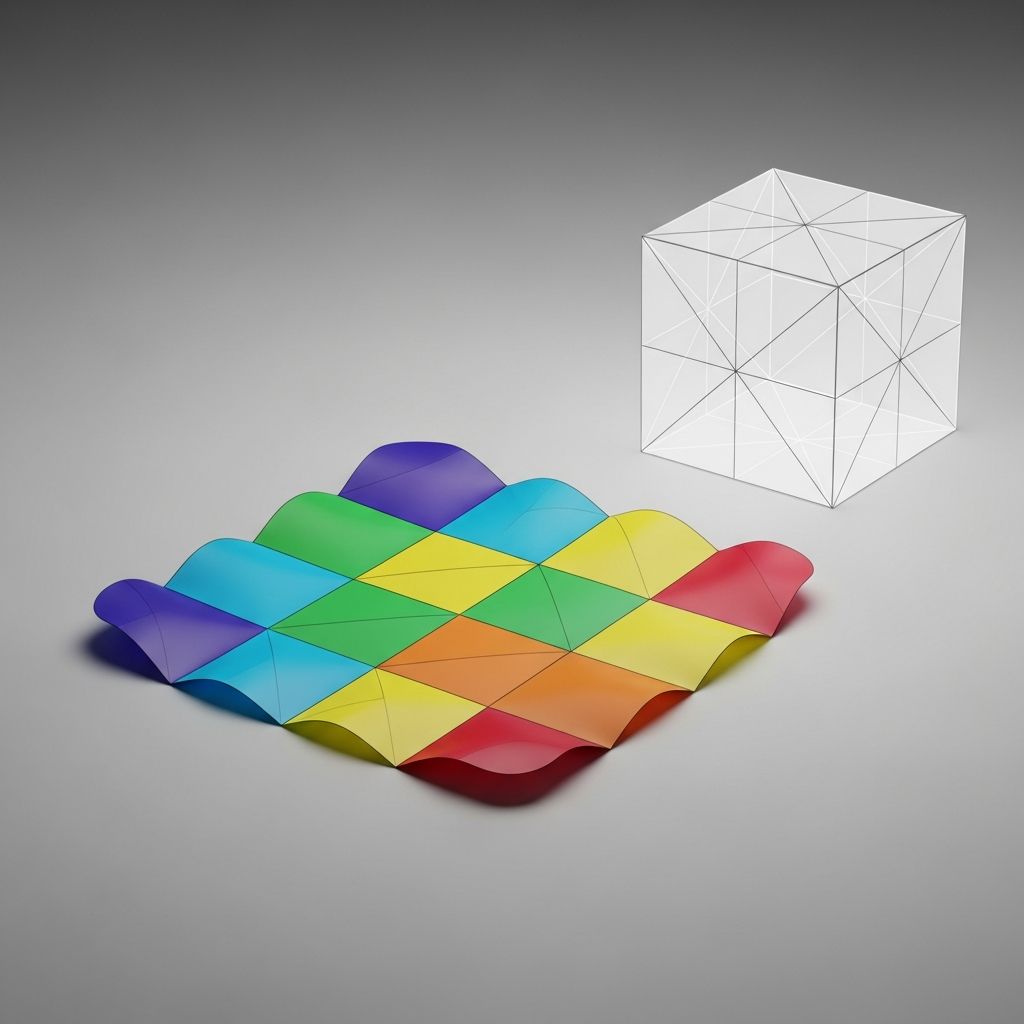
Geometric nets serve as essential tools in mathematics, offering a bridge between two-dimensional drawings and three-dimensional solids. By unfolding complex 3D objects into flat patterns, nets enable learners to visualize, construct, and analyze shapes with precision.
Understanding the Basics of Geometric Nets
A geometric net is a two-dimensional layout composed of connected polygons that, when folded along designated edges, forms a closed three-dimensional polyhedron. This concept allows for the representation of solid figures on a plane surface, making it easier to calculate properties like surface area and volume.
Key components of any 3D shape include faces, which are the flat or curved surfaces; edges, the lines where faces meet; and vertices, the points where edges converge. For instance, a cube features 6 square faces, 12 edges, and 8 vertices. Nets preserve these elements, ensuring no overlaps or gaps upon folding.
Why Nets Matter in Geometry Education
Mastering nets enhances spatial reasoning, a critical skill for problem-solving in STEM fields. They help students connect 2D representations to real-world objects, such as packaging design or architectural modeling. Recognizing valid nets from invalid ones builds intuition about shape connectivity and symmetry.
- Spatial Visualization: Improves ability to mentally rotate and assemble shapes.
- Surface Area Calculation: Directly sums areas of net polygons.
- Model Building: Facilitates hands-on creation using paper or cardstock.
- Volume Estimation: Aids in deriving formulas from unfolded views.
Common 3D Shapes and Their Nets
Polyhedra like prisms, pyramids, and platonic solids each have unique net configurations. Below, we examine prominent examples, detailing their structures and folding instructions.
Cube and Its Net Variations
The cube, a regular hexahedron, unfolds into one of 11 distinct nets, all comprising 6 squares. A popular arrangement is a cross shape: one central square with four adjacent squares and one attached to a side arm. Folding brings outer edges together seamlessly.
| Property | Cube Details |
|---|---|
| Faces | 6 squares |
| Edges | 12 |
| Vertices | 8 |
| Net Panels | 6 connected squares |
Rectangular Prism (Cuboid)
A rectangular prism extends the cube with unequal dimensions. Its net typically includes two identical rectangles for top and bottom, plus four side rectangles matching the heights and widths. Arrange as a central rectangle flanked by four others to avoid overlap when folded.
Example: For a box measuring 4x3x2 units, the net has two 4×3 rectangles, two 4×2, and two 3×2 rectangles.
Triangular Prism
Composed of two triangular bases and three rectangular lateral faces, the triangular prism net positions the triangles at ends of a rectangular strip. Equilateral triangle bases yield symmetric rectangles.
- Bases: 2 triangles
- Laterals: 3 rectangles
- Total faces: 5
Square Pyramid
Featuring one square base and four triangular faces meeting at an apex, the net places the square centrally with triangles attached to each side. Careful folding ensures triangles converge without gaps.
| Shape | Faces | Edges | Vertices |
|---|---|---|---|
| Square Pyramid | 5 | 8 | 5 |
| Triangular Prism | 5 | 9 | 6 |
Tetrahedron (Triangular Pyramid)
This platonic solid uses four equilateral triangles. A common net arranges one central triangle with others branching outward, folding into a pyramid with a triangular base.
Cylinder and Cone: Non-Polyhedral Nets
Unlike polyhedra, cylinders and cones include curved surfaces. A cylinder net has two circles and a rectangle (unrolled lateral surface). The cone net features a sector (arc for base) and attached circular sector for the slant height.
Cylinder: 3 faces (2 circles, 1 rectangle), 2 edges, 0 vertices.
Valid vs. Invalid Nets: Rules to Follow
Not every polygon arrangement forms a valid net. Criteria include: no overlapping faces when folded, all edges properly matched, and closure into a solid without holes.
Invalid examples:
- Excessive branching causing overlap (e.g., cube with 7 squares).
- Disconnected components.
- Mismatched edge lengths.
To verify, mentally fold or use paper prototypes. For cubes, only 11 of 384 possible connected arrangements work.
Calculating Surface Area Using Nets
Nets simplify surface area by displaying all faces separately. Sum individual polygon areas.
Cube Example: Side length a. Area = 6a2.
Square Pyramid: Base b2 + 4 × (½ × base × slant height).
Practice: Triangular prism with equilateral triangles (side 5 cm), height 8 cm. Rectangles: 3 × (5×8)=120 cm²; Triangles: 2 × (√3/4 ×25)≈21.65 cm² each. Total≈163.3 cm².
Applications Beyond the Classroom
Nets appear in manufacturing (packaging), architecture (facade design), and computer graphics (texture mapping). They underpin 3D printing slicing algorithms and VR modeling.
- Packaging: Cardboard boxes unfold to nets for efficient cutting.
- Art & Design: Origami and paper engineering.
- Engineering: Sheet metal fabrication patterns.
Hands-On Activities for Learning Nets
Engage learners with these exercises:
- Draw and Fold: Sketch a cuboid net, cut, and assemble.
- Net Matching: Pair 3D images with correct 2D nets.
- Design Challenges: Create nets for irregular prisms.
- Digital Tools: Use geometry software to manipulate nets virtually.
Frequently Asked Questions (FAQs)
What exactly is a geometric net?
A 2D pattern of connected faces that folds into a 3D shape, like unfolding a solid’s surface.
How many nets does a cube have?
Exactly 11 distinct nets.
Can nets be used for curved shapes?
Yes, for cylinders and cones, using rectangles and sectors for curves.
Why might a net be invalid?
If it overlaps, leaves gaps, or doesn’t close properly upon folding.
Do all polyhedra have nets?
Convex polyhedra do; some concave ones may not without cuts.
Advanced Topics: Nets of Complex Polyhedra
Beyond basics, explore platonic solids like octahedrons (8 triangular faces, 11 nets) and dodecahedrons. Goldberg’s work cataloged cube nets, inspiring algorithmic generation.
In graph theory, nets correspond to spanning trees of the polyhedron’s dual graph, ensuring connectivity without cycles that cause overlaps.
For non-regular shapes, software like GeoGebra simulates folding, revealing invalid configurations dynamically.
References
- Geometric Nets | Definition, Examples, Drawing, How to use? — Helping With Math. 2023. https://helpingwithmath.com/geometric-nets/
- Net in Math | Definition & Examples — Study.com. 2023-10-01. https://study.com/academy/lesson/definition-of-net-in-math.html
- 3D Shapes — BYJU’S. 2024. https://byjus.com/maths/3d-shapes/
- Math Nets – Math Steps, Examples & Questions — Third Space Learning. 2024. https://thirdspacelearning.com/us/math-resources/topic-guides/geometry/math-nets/
- Net (polyhedron) — Wikipedia. 2024-02-01. https://en.wikipedia.org/wiki/Net_(polyhedron)

Medha Deb is an editor with a master's degree in Applied Linguistics from the University of Hyderabad. She believes that her qualification has helped her develop a deep understanding of language and its application in various contexts. Medha specializes in the areas of beauty, health, sports, and wellness and is committed to ensuring that the content on the website is…