
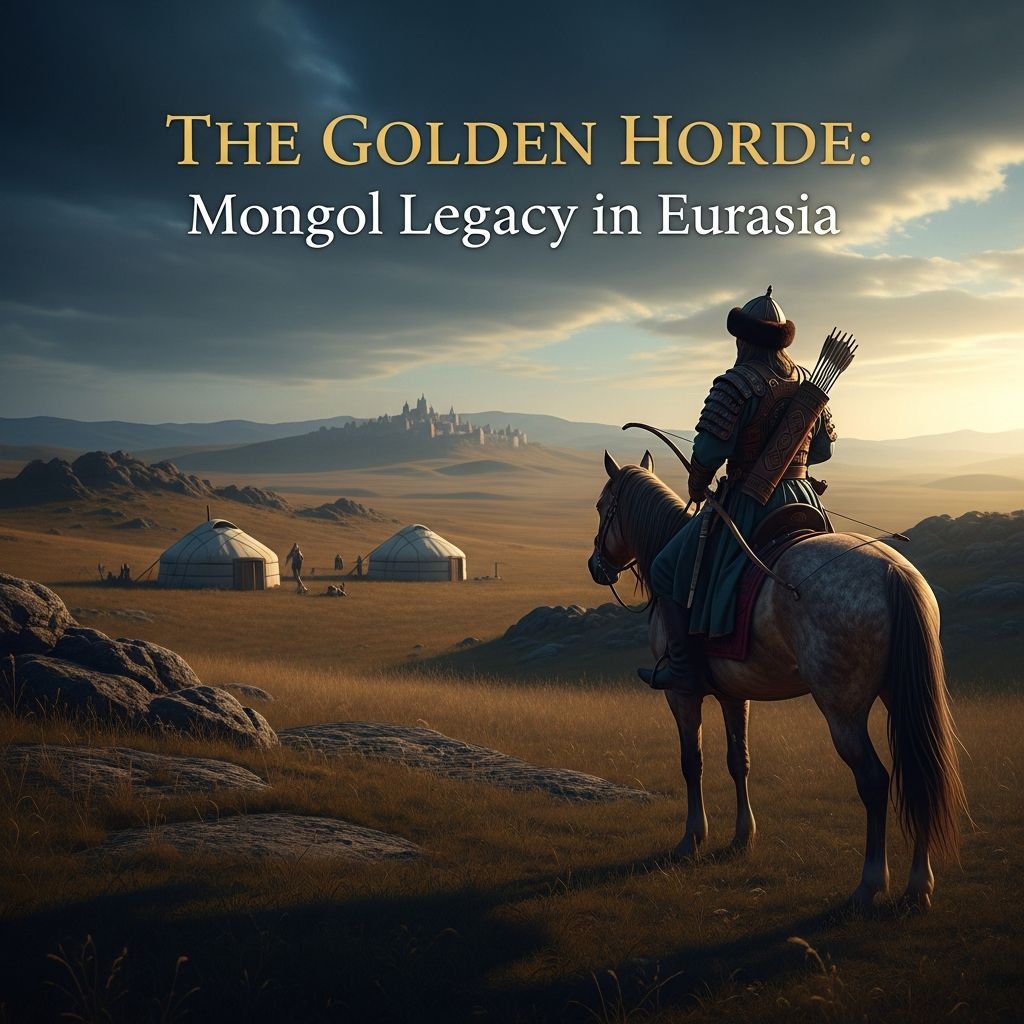
The Golden Horde stands as one of the most enduring divisions of the vast Mongol Empire, exerting profound influence over the steppes of Eurasia and the principalities of Eastern Europe for more than two centuries. Emerging in the 13th century under the leadership of Batu Khan, this khanate, also known as the Kipchak Khanate or Ulus of Jochi, transformed from a military conquest force into a sophisticated political entity that blended Mongol traditions with local Turkic and Islamic elements. At its zenith, its territories spanned from the Ural Mountains to the Danube River, encompassing vast regions of modern-day Russia, Ukraine, Kazakhstan, and beyond, shaping the political, economic, and cultural landscapes of these areas.
Foundations: From Jochi’s Ulus to Batu’s Empire
The origins of the Golden Horde trace back to Jochi, the eldest son of Genghis Khan, who received the northwestern territories of the Mongol Empire as his appanage, known as the Ulus of Jochi. Following Jochi’s death in 1225, his son Batu Khan inherited this domain and expanded it dramatically through relentless military campaigns. Batu, a grandson of Genghis Khan, led the western wing of the Mongol armies during the great invasion of Europe in the 1230s and 1240s.
These campaigns began with devastating incursions into Russian lands. In the winter of 1237-1238, Batu’s forces razed Riazan, Vladimir, and the emerging settlement of Moscow, reducing major centers of power to ruins. By 1240, Kiev, the ancient capital of Rus’, fell after a brutal siege, marking the subjugation of the Russian principalities. Batu established his capital at Sarai on the lower Volga River, a strategic location that facilitated control over trade routes and tribute collection. This new khanate, dubbed the ‘Golden Horde’ possibly due to the opulence of its leader’s tent or its vast wealth, became functionally independent after the Mongol Empire’s fragmentation in 1259.
Territorial Reach and Administrative Mastery
The Golden Horde’s domain at its peak was immense, stretching from the Caspian Sea and Caucasus in the south to Siberia in the north, and from the Urals westward to the borders of Eastern Europe. It bordered the Ilkhanate in the southwest and incorporated the former Cuman-Kipchak confederation, which it supplanted. This vast expanse was not held through direct occupation but via a sophisticated system of indirect rule.
Administratively, the Horde drew from diverse influences: Mongol military organization, Uyghur bureaucracy, Chinese fiscal practices, and Turkic-Islamic customs from the Volga and Caspian regions. The khans appointed basqaqs (tax collectors) and later darughas (governors) to oversee vassal states, particularly the Russian principalities, which were required to send princes to Sarai for yarlyks—patents of legitimacy. Tribute, known as the ‘Mongol Yoke’ in Russian historiography, included silver, furs, and slaves, funneled through a census system that ensured efficient extraction.
The Horde’s economy thrived on the Silk Road trade, with Sarai becoming a bustling multicultural hub where Muslim merchants, Orthodox Christians, and nomads coexisted. Agriculture in the Volga region complemented pastoral nomadism, fostering economic resilience.
Military Prowess: Key Conquests and Strategies
- Battle of the Kalka River (1223): A precursor to the Horde’s rise, where Jochi’s sons clashed with Russian and Cuman forces, demonstrating Mongol tactical superiority with feigned retreats and composite bows.
- Invasion of Russia (1237-1240): Systematic destruction of cities like Riazan and Kiev, employing siege engines adapted from Chinese technology.
- European Campaigns (1241-1242): Batu’s armies crushed Poland and Hungary, reaching the Adriatic before withdrawing due to Ögedei Khan’s death and succession disputes.
- Battle of the Sit River (1238): A decisive victory over Russian coalitions, solidifying steppe dominance.
Mongol cavalry, renowned for mobility and archery, overwhelmed sedentary foes, but the Horde adapted by incorporating Turkic warriors and fostering alliances with local elites.
List of Prominent Khans and Their Eras
| Khan | Reign | Key Achievements/Events |
|---|---|---|
| Batu Khan | c. 1227–1255 | Founder; conquered Russia and Eastern Europe; enthroned Mongol Great Khans. |
| Sartaq Khan | 1256–1257 | Brief Christian convert; maintained ties with the West. |
| Berke Khan | 1257–1266 | First Muslim khan; allied with Mamluks against Ilkhanate. |
| Möngke Temür | 1265–1280 | Stabilized administration; granted yarlyks to Moscow. |
| Özbeg Khan | 1313–1341 | Golden era; Islamization; peak prosperity and territory. |
| Jani Beg | 1342–1357 | Expanded to Caucasus; Black Death struck. |
This table highlights the succession of khans who navigated internal politics, religious shifts, and external threats, with Özbeg’s reign marking the cultural zenith.
Cultural and Religious Transformations
Initially shamanist, the Golden Horde underwent profound Islamization starting with Berke Khan’s conversion around 1257, influenced by Sufi missionaries. By Özbeg Khan’s time, Islam was the state religion, making the Horde the first Mongol khanate to become a sultanate and a key vector for Islam’s spread in Eastern Europe. Tolerance prevailed: Christians, Jews, and Muslims thrived, as evidenced by the diverse population of Sarai.
The Horde facilitated cultural exchanges, introducing paper money, gunpowder, and administrative reforms to Russia. Russian art and architecture absorbed Oriental motifs, while the kipchakized Turkic language (basis of modern Tatar) became lingua franca. The Black Death in the 1340s devastated the Horde, exacerbating succession crises.
The Road to Decline: Fractures and Russian Ascendancy
By the mid-14th century, the Horde fragmented into Blue and White Hordes, with civil wars weakening central authority. The Great Troubles (1359-1380) saw rival khans vie for power, allowing Moscow’s Prince Dmitri Donskoy to challenge Mongol supremacy at the Battle of Kulikovo (1380), a symbolic victory despite temporary Horde resurgence under Tokhtamysh.
The rise of Muscovy under Ivan III (Ivan the Great) proved fatal. Refusing tribute in 1476 and defeating Ahmed Khan at the Ugra River standoff (1480) ended the ‘Mongol Yoke.’ Internal strife and Timur’s invasions (1395) accelerated disintegration, splintering the Horde into khanates of Kazan, Astrakhan, Crimea, and Sibir by the early 16th century.
Lasting Legacies in History and Identity
The Golden Horde’s impact endures in Russian statehood: the Muscovite model of autocratic rule and tribute systems echoed Horde practices. It integrated Turkic peoples into Eurasian history, with descendants forming modern Tatar and Bashkir nations. Economically, it linked East-West trade; politically, it delayed but ultimately spurred Russian unification.
Archaeological sites like New Sarai reveal a cosmopolitan metropolis, underscoring the Horde’s complexity beyond ‘barbarian’ stereotypes. Its story illustrates how nomadic empires could sustain vast domains through adaptability.
Frequently Asked Questions (FAQs)
Who founded the Golden Horde?
Batu Khan, grandson of Genghis Khan, established the Golden Horde in the 1240s after conquering Russian and Eastern European territories.
Why is it called the ‘Golden Horde’?
The name likely derives from the golden color of the khan’s tent or the wealth amassed from tributes and trade; contemporaries referred to it as the Ulus of Jochi or Kipchak Khanate.
How did the Golden Horde rule Russia?
Through indirect rule: Russian princes received patents (yarlyks) from the khan, paid tribute, and maintained local governance under Mongol oversight.
What caused the fall of the Golden Horde?
Succession disputes, the Black Death, Timur’s raids, and the rising power of Moscow, culminating in the Great Stand on the Ugra River in 1480.
Was the Golden Horde Muslim?
Yes, from Berke Khan (1257), with full Islamization under Özbeg Khan (1313), promoting tolerance for other faiths.
References
- Golden Horde – Wikipedia — Wikipedia Contributors. 2023-10-01. https://en.wikipedia.org/wiki/Golden_Horde
- Golden Horde | History | Research Starters — EBSCO. 2022-01-15. https://www.ebsco.com/research-starters/history/golden-horde
- The Golden Horde: Legacy of a Mongol Empire That Shaped History — Mongolianz. 2025-04-18. https://www.mongolianz.com/post/2025/04/18/the-golden-horde-legacy-of-a-mongol-empire-that-shaped-history/
- Golden Horde – Russia’s Periphery — College of William & Mary. 2020-09-12. https://russiasperiphery.pages.wm.edu/central-asia/general/golden-horde/
- The Golden Horde – Nomadic Empires — University of Oxford. 2021-05-20. https://nomadicempires.history.ox.ac.uk/?page_id=150

- Integrated M.A. in Applied Linguistics, University of Hyderabad
- 5+ years in editorial, instructional, SEO, and research-based writing
Sneha is a relationships and lifestyle writer with a strong foundation in applied linguistics and certified training in relationship coaching. She brings over five years of writing experience to theskillvault, crafting thoughtful, research-driven content that empowers readers to build healthier relationships, boost emotional well-being, and embrace holistic living. Her writing and insights reflect the belief that beauty, happiness, and wellness…