
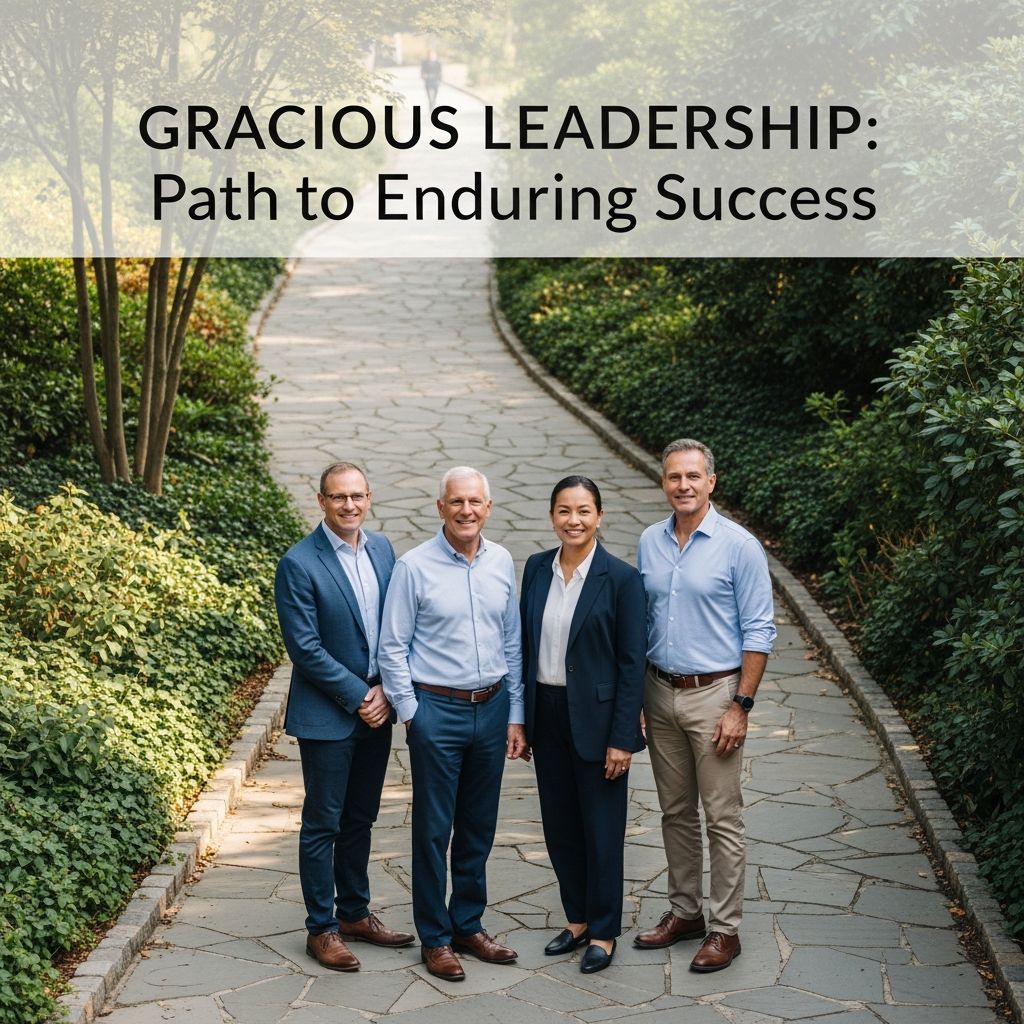
Gracious leadership represents a powerful approach that combines empathy, generosity, and intentional action to inspire teams and achieve sustainable results. Unlike traditional authoritative styles, it prioritizes human connections, fostering environments where individuals thrive and organizations excel.
Defining Gracious Leadership in Modern Contexts
At its core, gracious leadership involves deliberate behaviors rooted in empathy and compassion, enabling leaders to create psychological safety and encourage discretionary effort from their teams. This style transcends mere politeness, embodying a deeper commitment to service, humility, and mutual growth. Leaders who embody grace view success not as a solo endeavor but as a collective achievement, bridging divides and amplifying collective strengths.
Research highlights that such leaders promote civility and clarity of purpose, leading to innovative workplaces where ideas flourish. In volatile environments, gracious leaders stimulate collaboration, recognizing that complex challenges demand shared creativity and intuition. This approach aligns with findings that gratitude and appreciation directly correlate with enhanced business performance and employee motivation.
Core Pillars of Gracious Leadership
Gracious leadership rests on interconnected pillars that guide daily interactions and strategic decisions. These elements, drawn from leadership frameworks, provide a roadmap for cultivating grace.
- Generosity: Gracious leaders share resources like time, knowledge, and recognition generously, adopting a ‘giver’ mindset that benefits teams and society. This fosters loyalty and innovation by empowering others.
- Respect and Humility: Self-awareness fuels respect for diverse perspectives, replacing hubris with humility to build inclusive teams.
- Compassion and Gratitude: Drawing from daily gratitude practices, leaders extend forgiveness and empathy, enhancing well-being and resilience.
- Action-Oriented Civility: Grace manifests through purposeful, civil actions that promote safe spaces for expression and prosperity.
- Energy and Positivity: Infusing interactions with positive energy cultivates trust, loyalty, and reduced conflict.
Building Psychological Safety and Team Loyalty
One hallmark of gracious leadership is the creation of psychological safety, where team members feel valued and free to contribute authentically. Leaders achieve this by emphasizing principles over rigid rules, transforming hearts rather than enforcing temporary compliance. This principle-focused approach teaches wisdom applicable across scenarios, deepening team commitment.
Valuing individuals beyond their output—listening actively and serving their growth—secures hearts and loyalty. Gracious leaders push for excellence while accommodating failure, recognizing personal shortcomings to extend understanding. This balance prevents perfectionism, encouraging risk-taking essential for innovation.
| Traditional Leadership | Gracious Leadership |
|---|---|
| Rigid rules and control | Principles guiding wisdom |
| Views people as means to ends | Values people for who they are |
| Demands perfection | Allows growth through failure |
| Micromanages differences | Embraces diverse opinions |
Enhancing Performance Through Appreciation
Expressing sincere gratitude profoundly impacts performance. Leaders who regularly acknowledge contributions see boosted morale, sustained work ethic, and higher output. In high-pressure periods, such as post-pandemic recovery, appreciation counters burnout, making efforts feel worthwhile.
A culture of gratitude ripples outward, improving customer experiences via happier, more collaborative teams. Prioritizing people yields business success, as fulfilled employees deliver exceptional service. Moreover, gratitude prompts leaders to adopt holistic views, integrating employee insights for rounded decision-making.
Fostering Collaboration and Innovation
Gracious leaders excel at uniting diverse talents, valuing differing strengths to spur creativity. By confronting issues personally and respectfully—avoiding public shaming—they maintain unity while addressing problems. This allows commonalities to prevail over differences, essential in complex, VUCA (volatile, uncertain, complex, ambiguous) worlds.
Allowing natural consequences teaches accountability without ‘sloppy agape,’ training teams through experience. Believing the best in people eliminates micromanagement, enabling true delegation and trust. Even when facing misuse, gracious leaders persist, modeling resilience. Positive leadership complements this by nurturing inclusive climates of compassion and forgiveness.
Practical Strategies for Developing Gracious Habits
Cultivating gracious leadership requires intentional practices. Start with daily gratitude journaling—listing three appreciations—to build compassion capacity. Practice active listening to demonstrate respect, and delegate with autonomy to empower teams.
- Share kudos publicly to reinforce generosity.
- Confront privately with empathy, focusing on growth.
- Embrace failure as learning, sharing personal stories.
- Foster inclusivity by seeking diverse input.
- Infuse positivity through optimistic communication.
Integrate self-awareness via feedback loops, ensuring humility guides actions. Resilience and learning agility further amplify grace, allowing adaptation without losing core values.
Measuring the Impact on Organizational Success
Organizations led graciously report higher engagement, lower turnover, and superior performance. Gratitude correlates with self-esteem, reduced anxiety, and better sleep, indirectly boosting productivity. Character traits like compassion and service orientation predict sustained success beyond ethics.
Positive climates reduce conflict, enhancing cooperation. In studies, gracious styles drive innovation via organizational learning. Ultimately, grace bridges divides, promoting mutual success in interconnected ecosystems.
Frequently Asked Questions (FAQs)
What distinguishes gracious leadership from other styles?
Gracious leadership uniquely blends empathy, generosity, and action, prioritizing psychological safety and collective growth over command-and-control.
Can gracious leaders handle tough decisions?
Yes, they confront personally with respect, allow consequences, and believe the best while maintaining civility.
How does gratitude improve business outcomes?
It boosts morale, fosters positive cultures, enhances customer experiences, and provides holistic business insights.
Is gracious leadership suitable for all industries?
Absolutely, its focus on collaboration and resilience thrives in any VUCA environment, from tech to healthcare.
How can I start practicing gracious leadership today?
Begin with daily gratitude, active listening, and sharing recognition to build momentum.
References
- Grace – the elusive leadership trait — Alexander Hughes. 2023. https://www.alexanderhughes.com/grace-the-elusive-leadership-trait/
- How Gracious Leadership Can Boost Business Performance — Entrepreneur. 2021-11-24. https://www.entrepreneur.com/leadership/how-gracious-leadership-can-boost-business-performance/386102
- 8 Traits of Grace Filled Leadership — Catalyst Leader. N/A. https://insider.catalystleader.com/read/8-traits-of-grace-filled-leadership
- One of the Most Important Leadership Qualities That’s Often… — NLCTB. N/A. https://nlctb.org/featured/the-power-of-positive-leadership/
- 12 Essential Qualities of Effective Leadership — Center for Creative Leadership (CCL.org). 2023. https://www.ccl.org/articles/leading-effectively-articles/characteristics-good-leader/
- The Case for Leadership Character — Harvard Business Publishing. N/A. https://www.harvardbusiness.org/insight/the-case-for-leadership-character/

Medha Deb is an editor with a master's degree in Applied Linguistics from the University of Hyderabad. She believes that her qualification has helped her develop a deep understanding of language and its application in various contexts. Medha specializes in the areas of beauty, health, sports, and wellness and is committed to ensuring that the content on the website is…