
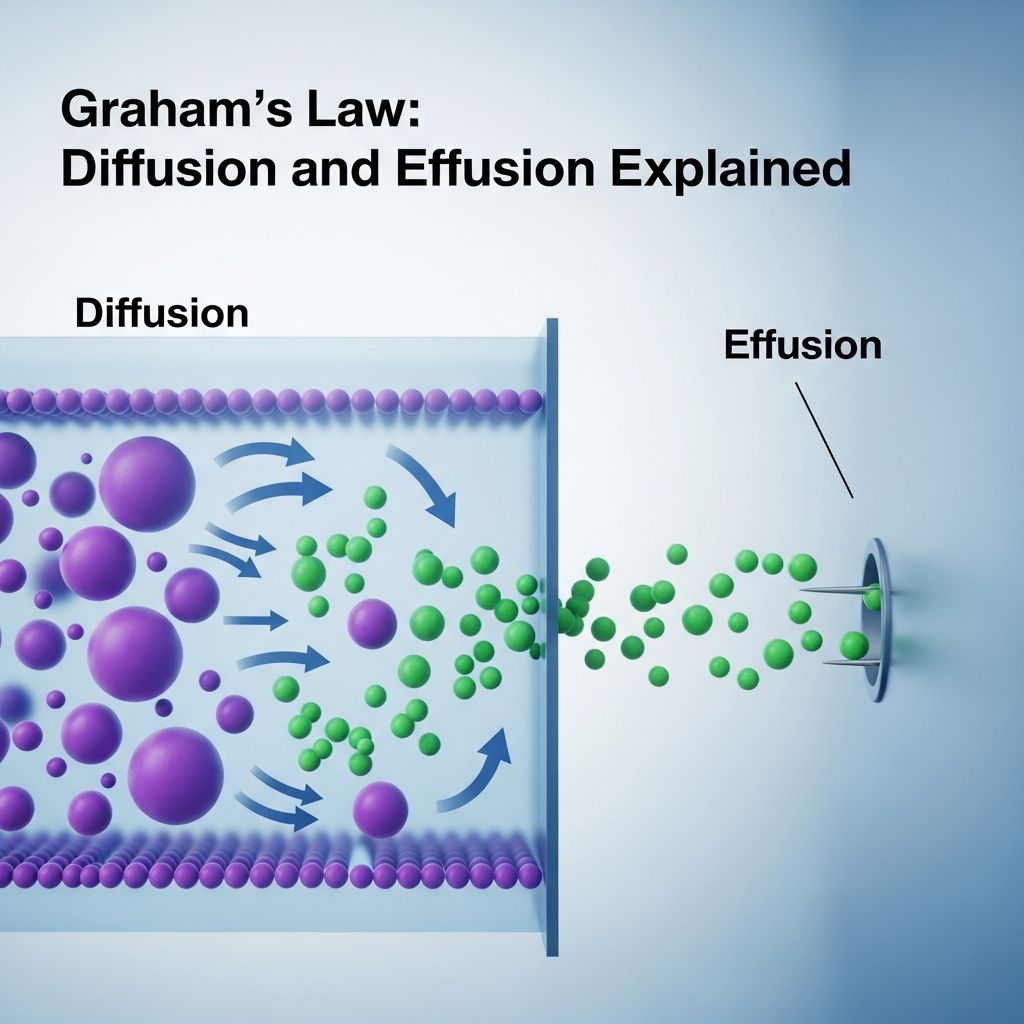
Graham’s Law reveals why lighter gases spread faster than heavier ones, a fundamental principle in gas behavior under constant temperature and pressure.
Foundations of Gas Movement in Chemistry
Gases exhibit constant random motion due to their kinetic energy, leading to two key processes: diffusion and effusion. Diffusion occurs when gas molecules intermingle spontaneously, creating a uniform mixture without external force. Effusion, by contrast, involves gas molecules escaping through a tiny opening into a vacuum. These phenomena underpin many natural and industrial processes, from atmospheric mixing to isotope separation.
Understanding these movements requires grasping the kinetic molecular theory, which posits that gas particles are in perpetual motion, with average kinetic energy proportional to temperature. Lighter molecules, possessing higher velocities at the same energy, traverse spaces more rapidly.
Defining Diffusion and Effusion Precisely
- Diffusion: The spontaneous spreading of gas molecules from high to low concentration regions, driven by random collisions until equilibrium is reached.
- Effusion: The flow of gas through a pinhole or porous barrier into an evacuated area, where molecular speed determines the escape rate.
While diffusion involves multiple gases interacting, effusion typically features a single gas streaming out, making it ideal for precise rate measurements. Everyday examples include the scent of perfume wafting across a room (diffusion) or helium leaking from a balloon (effusion).
The Core Principle: Graham’s Law Statement
Formulated by Thomas Graham in 1848, the law asserts that the rate of diffusion or effusion of a gas is inversely proportional to the square root of its molar mass. Mathematically, for two gases A and B:
rate_A / rate_B = √(M_B / M_A)
Here, rate denotes effusion or diffusion speed, and M is molar mass in g/mol. Lighter gases (smaller M) effuse faster.
| Gas | Molar Mass (g/mol) | Relative Rate (vs. O₂) |
|---|---|---|
| Hydrogen (H₂) | 2.02 | 3.16 |
| Helium (He) | 4.00 | 2.24 |
| Nitrogen (N₂) | 28.01 | 1.68 |
| Oxygen (O₂) | 32.00 | 1.00 |
| Carbon Dioxide (CO₂) | 44.01 | 0.85 |
This table illustrates relative effusion rates compared to oxygen, calculated via Graham’s formula.
Deriving Graham’s Law from Kinetic Theory
Graham’s empirical observation finds theoretical backing in kinetic theory. The root-mean-square speed (v_rms) of gas molecules is:
v_rms = √(3RT / M)
Where R is the gas constant and T is temperature in Kelvin. Since effusion rate ties directly to molecular speed, the ratio becomes:
rate_A / rate_B = v_A / v_B = √(M_B / M_A)
This derivation confirms the law’s foundation in equal kinetic energies (½mv²) at identical temperatures, where velocity inversely scales with √M.
Practical Calculations Using the Formula
To apply Graham’s Law, compare two gases under identical conditions. Suppose we calculate how much faster hydrogen effuses than oxygen:
rate_H₂ / rate_O₂ = √(32 / 2) = √16 = 4
Hydrogen effuses four times faster. For time taken, invert the rate: time ∝ √M.
Worked Example 1: If 1 mole of nitrogen effuses in 10 minutes, how long for 1 mole of methane (CH₄, M=16 g/mol)?
rate_N₂ / rate_CH₄ = √(16/28) ≈ 0.755
time_CH₄ = 10 × (1/0.755) ≈ 13.25 minutes.
Worked Example 2: A balloon deflates with unknown gas. It loses half volume in 30 seconds; pure helium does so in 18 seconds. Identify the gas.
rate_unknown / rate_He = 18/30 = 0.6 = √(4 / M_unknown)
M_unknown = 4 / (0.6)² ≈ 11.11 g/mol (likely neon, close to 20 but adjusted for ideal case).
These problems highlight the law’s utility in quantitative analysis.
Real-World Applications Across Industries
Graham’s Law extends beyond labs. In uranium enrichment for nuclear fuel (or historically, bombs), UF₆ isotopes (235U and 238U) are separated via gaseous diffusion. Lighter 235UF₆ effuses ~1.004 times faster, amplified over thousands of stages.
Medical respirators exploit diffusion rates for efficient gas exchange. In analytical chemistry, gas chromatography leverages effusion principles for separation. Even planetary atmospheres reflect this: hydrogen escapes Earth’s but lingers on heavier-gas dominated Venus.
Limitations and Conditions for Accuracy
The law holds best for ideal gases at low pressure and high temperature, where molecular collisions are minimal. Deviations arise in mixtures (diffusion less precise) or non-ideal behaviors. It’s approximate for densities but exact for molar masses under equal T and P.
- Assumes point-like molecules with elastic collisions.
- Ignores gas solubility in barriers for pure effusion.
- Less accurate for very light or polyatomic gases due to rotational energies.
Experimental Methods to Verify Graham’s Law
Graham used porous pots to measure effusion times. Modern setups employ capillary tubes or mass spectrometers. Students often compare balloon deflation rates or use soap bubble timers for hydrogen vs. air. Precision experiments confirm the √M relationship within 1-2% error.
Frequently Asked Questions (FAQs)
What distinguishes diffusion from effusion?
Diffusion mixes gases in a shared space via random motion; effusion is unidirectional escape through a small hole into vacuum.
Why do lighter gases effuse faster?
At equal temperatures, all gases have the same kinetic energy, so lighter molecules achieve higher speeds.
Can Graham’s Law apply to liquids or solids?
Primarily for gases; analogous diffusion exists but lacks the same inverse square root dependence.
How is Graham’s Law used in isotope separation?
Gaseous diffusion cascades exploit tiny molar mass differences for enriching isotopes like uranium-235.
Does temperature affect the law?
The ratio remains constant at fixed T; absolute rates increase with temperature via kinetic energy.
Advanced Extensions and Modern Relevance
In nanotechnology, effusion governs graphene membrane gas sieving. Climate models use diffusion rates for pollutant spread. Graham’s insights persist in microfluidics and space exploration, predicting gas retention on exoplanets. Future applications may include efficient hydrogen storage and purification.
This principle not only explains observable phenomena but empowers precise predictions in chemical engineering and beyond.
References
- Graham’s law – Wikipedia — Wikipedia contributors. 2023-10-15. https://en.wikipedia.org/wiki/Graham%27s_law
- Graham’s Law: Diffusion And Effusion — BYJU’S. 2024-01-01. https://byjus.com/chemistry/grahams-law/
- Graham’s Law of Diffusion vs. Effusion | Formula & Differences — Study.com. 2023-11-20. https://study.com/learn/lesson/diffusion-effusion-formula-differences-grahams-law.html
- 2.9: Graham’s Laws of Diffusion and Effusion — Chemistry LibreTexts (University of Arkansas Little Rock). 2023-08-05. https://chem.libretexts.org/Courses/University_of_Arkansas_Little_Rock/Chem_3572:_Physical_Chemistry_for_Life_Sciences_(Siraj)/02:_Properties_of_Gases/2.09:_Graham%27s_Laws_of_Diffusion_and_Effusion
- Graham’s law of diffusion — Khan Academy. 2022-09-12. https://www.khanacademy.org/science/health-and-medicine/respiratory-system/gas-exchange-jv/v/graham-s-law-of-diffusion

Medha Deb is an editor with a master's degree in Applied Linguistics from the University of Hyderabad. She believes that her qualification has helped her develop a deep understanding of language and its application in various contexts. Medha specializes in the areas of beauty, health, sports, and wellness and is committed to ensuring that the content on the website is…