
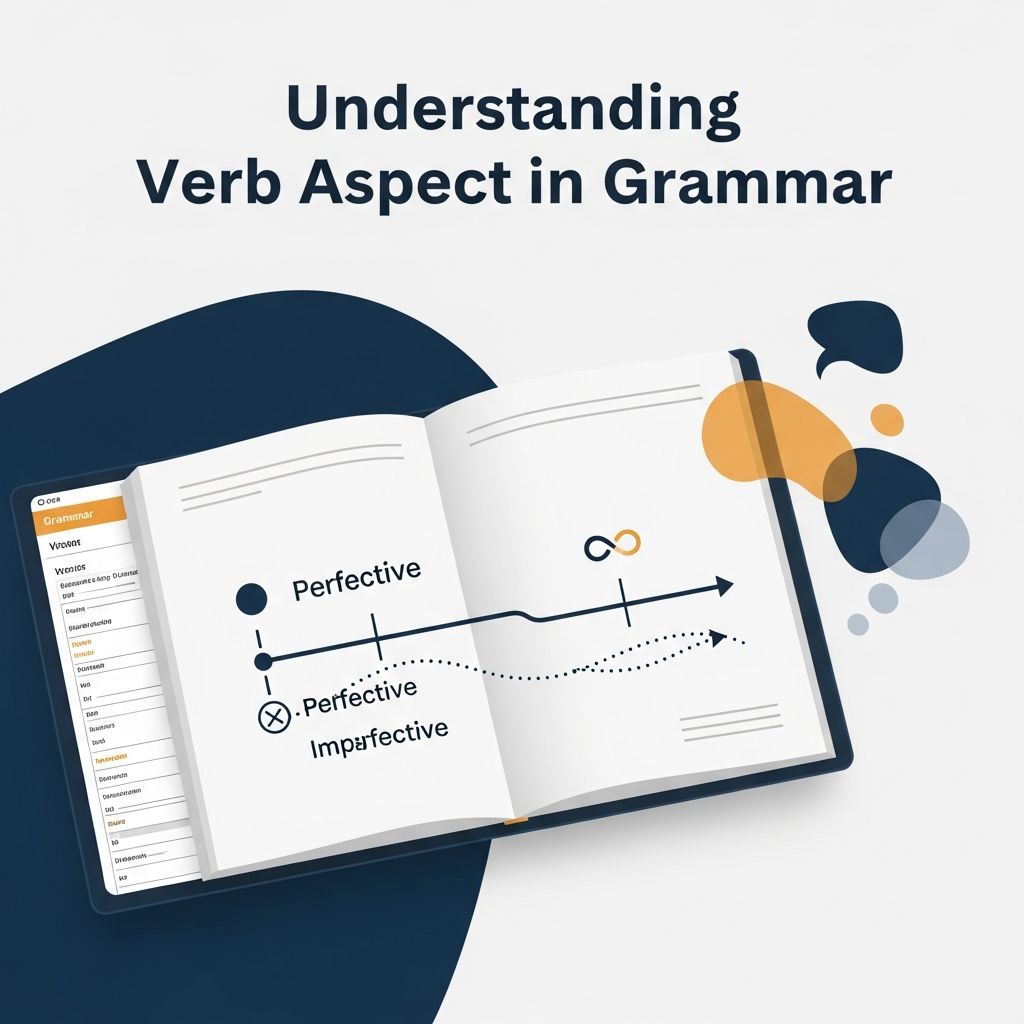
Grammatical aspect provides a window into the internal structure of actions and states expressed by verbs, revealing whether they are ongoing, completed, or viewed in specific temporal perspectives. Unlike tense, which anchors events to external time points like now or yesterday, aspect focuses on the ‘how’ of the action’s unfolding.
Defining Aspect: Internal Time vs. External Reference
Aspect examines the temporal makeup within a situation, such as an event, process, or state, without tying it to the speaker’s current moment. It contrasts with tense by being non-deictic—aspect does not point to ‘now’ or ‘then’ but describes the situation’s inherent temporal qualities.
Linguists divide aspect into viewpoint and situation type. Viewpoint determines if the action is seen as a complete whole (perfective) or with focus on its ongoing parts (imperfective). Situation types classify verbs by properties like duration, change, and endpoint, influencing how aspect is applied.
- Perfective viewpoint: Presents the situation as bounded and whole, ignoring internal phases. Example: ‘She ate the apple’ views the eating as complete.
- Imperfective viewpoint: Zooms into the action’s duration or repetition, like ‘She was eating the apple,’ highlighting the process.
This distinction allows the same event to shift meaning based on aspect, enriching narrative nuance.
Core Components of Aspectual Meaning
Aspectual viewpoint shapes presentation: perfective spans the entire situation externally, while imperfective delves inside, exposing phases like beginning, middle, or repetition. Situation types, per Vendlerian categories adapted by linguists, include:
| Situation Type | Key Traits | Examples |
|---|---|---|
| States | Static, durative, atelic (no endpoint) | know, exist, love |
| Activities | Dynamic, durative, atelic | run, dance, think |
| Accomplishments | Dynamic, durative, telic (has endpoint) | build a house, write a letter |
| Achievements | Dynamic, punctual, telic | win a race, notice |
| Semelfactives | Dynamic, punctual, atelic | cough, sneeze |
These types interact with viewpoint; for instance, an imperfective activity like ‘running’ emphasizes continuity.
English Verb Aspects: A Practical Framework
English employs four primary aspects—simple, progressive, perfect, and perfect progressive—combined with tenses to convey precise temporal textures.
Simple Aspect: Facts and Completes
Simple aspect states actions without duration emphasis, suitable for habits, facts, or completed events. It pairs with present (‘She walks’), past (‘She walked’), or future (‘She will walk’). This form assumes wholeness, akin to perfective viewpoint.
- Present simple: General truths, e.g., ‘Water boils at 100°C.’
- Past simple: Completed past actions, e.g., ‘They visited Paris.’
Progressive Aspect: Ongoing Actions
Progressive (continuous) aspect highlights actions in progress, using ‘be’ + -ing. It conveys imperfective views: ‘She is walking’ (now), ‘She was walking’ (past in progress), ‘She will be walking’ (future ongoing).
This aspect suits temporary situations or parallel actions, adding dynamism: ‘While I was cooking, the phone rang.’
Perfect Aspect: Connections Across Time
Perfect aspect links earlier actions to a later reference point, using ‘have’ + past participle. It signals completion with relevance: ‘She has walked’ (present perfect, recent past affects now), ‘She had walked’ (past perfect, before another past event).
Not focused on ongoing flow, it establishes precedence: ‘By noon, they had finished the project.’
Perfect Progressive: Duration to Completion
Combining perfect and progressive, this uses ‘have been’ + -ing to show prolonged actions leading to a later point: ‘She has been walking for hours’ (duration up to now).
It emphasizes effort or temporary states: ‘They had been studying all night before the exam.’
Aspect in Cross-Linguistic Perspective
While English relies on auxiliaries, other languages mark aspect morphologically. Slavic languages like Russian use perfective prefixes for completion (‘pročitat” read completely) vs. imperfective (‘čitat” read ongoing).
Romance languages blend tense-aspect: French imparfait (‘je mangeais’ ongoing past) vs. passé composé (‘j’ai mangé’ completed). Asian languages like Chinese use aspect particles: ‘le’ for completion (‘tā chī-le fàn’ he ate food, done).
Even aspect-less languages convey it via adverbs or context, showing aspect’s universality.
Common Pitfalls: Aspect vs. Tense Confusion
Tense locates events externally (‘when’), aspect internally (‘how’). ‘I walked’ (simple past: completed) vs. ‘I was walking’ (past progressive: ongoing).
| Tense | Simple | Progressive | Perfect | Perfect Progressive |
|---|---|---|---|---|
| Present | I eat. | I am eating. | I have eaten. | I have been eating. |
| Past | I ate. | I was eating. | I had eaten. | I had been eating. |
| Future | I will eat. | I will be eating. | I will have eaten. | I will have been eating. |
Misusing aspect alters meaning: ‘I have seen it’ implies recent relevance; ‘I saw it’ is neutral past.
Practical Applications in Writing and Speech
Mastering aspect enhances clarity. Narratives use progressive for suspense (‘The door creaked open…’), perfect for backstory (‘She had always dreamed of this’).
In academic writing, precise aspect avoids ambiguity: ‘Researchers have been investigating’ signals ongoing work vs. ‘researched’ (completed study).
Business reports benefit: ‘Sales have increased’ shows current trend; ‘Sales increased’ is historical fact.
Advanced Topics: Iterativity and Habituality
Beyond basics, aspect handles repetition. Habitual uses simple (‘I exercise daily’) or modals (‘I would exercise’). Frequentative forms, rarer in English, intensify repetition (e.g., ‘He coughed repeatedly’).
Prospective aspect looks forward (‘be about to’). These expand expression.
Frequently Asked Questions (FAQs)
What is the main difference between tense and aspect?
Tense indicates when an action occurs relative to now; aspect describes its internal duration, completion, or viewpoint.
How many aspects does English have?
English has four: simple, progressive, perfect, and perfect progressive, combinable with tenses.
Can the same event have different aspects?
Yes, e.g., ‘I read the book’ (simple, complete) vs. ‘I was reading the book’ (progressive, ongoing).
Do all languages have grammatical aspect?
No, but most convey it somehow; some use particles or context instead of inflections.
Why does aspect matter in communication?
It adds precision to timing, preventing misunderstandings about action states.
This exploration equips learners to wield aspect effectively, elevating language precision.
References
- Aspect – Grammatical Features — GrammaticalFeatures.net. Accessed 2026. http://www.grammaticalfeatures.net/features/aspect.html
- Grammatical aspect – Wikipedia — Wikipedia. Accessed 2026. https://en.wikipedia.org/wiki/Grammatical_aspect
- What Is Aspect in Grammar? — GrammarBook.com (The Blue Book of Grammar and Punctuation). Accessed 2026. https://www.grammarbook.com/blog/verbs/aspect-in-grammar/
- Aspect of a Verb: Explanation and Examples — Grammar Monster. Accessed 2026. https://www.grammar-monster.com/glossary/aspect.htm
- Introduction to verb aspect — Khan Academy. Accessed 2026. https://www.khanacademy.org/humanities/grammar/parts-of-speech-the-verb/verb-aspect-simple-progressive-and-perfect/v/intro-to-aspect
- Tense and Aspect — Stanford Encyclopedia of Philosophy. 2015-08-31. https://plato.stanford.edu/entries/tense-aspect/

- Integrated M.A. in Applied Linguistics, University of Hyderabad
- 5+ years in editorial, instructional, SEO, and research-based writing
Sneha is a relationships and lifestyle writer with a strong foundation in applied linguistics and certified training in relationship coaching. She brings over five years of writing experience to theskillvault, crafting thoughtful, research-driven content that empowers readers to build healthier relationships, boost emotional well-being, and embrace holistic living. Her writing and insights reflect the belief that beauty, happiness, and wellness…