
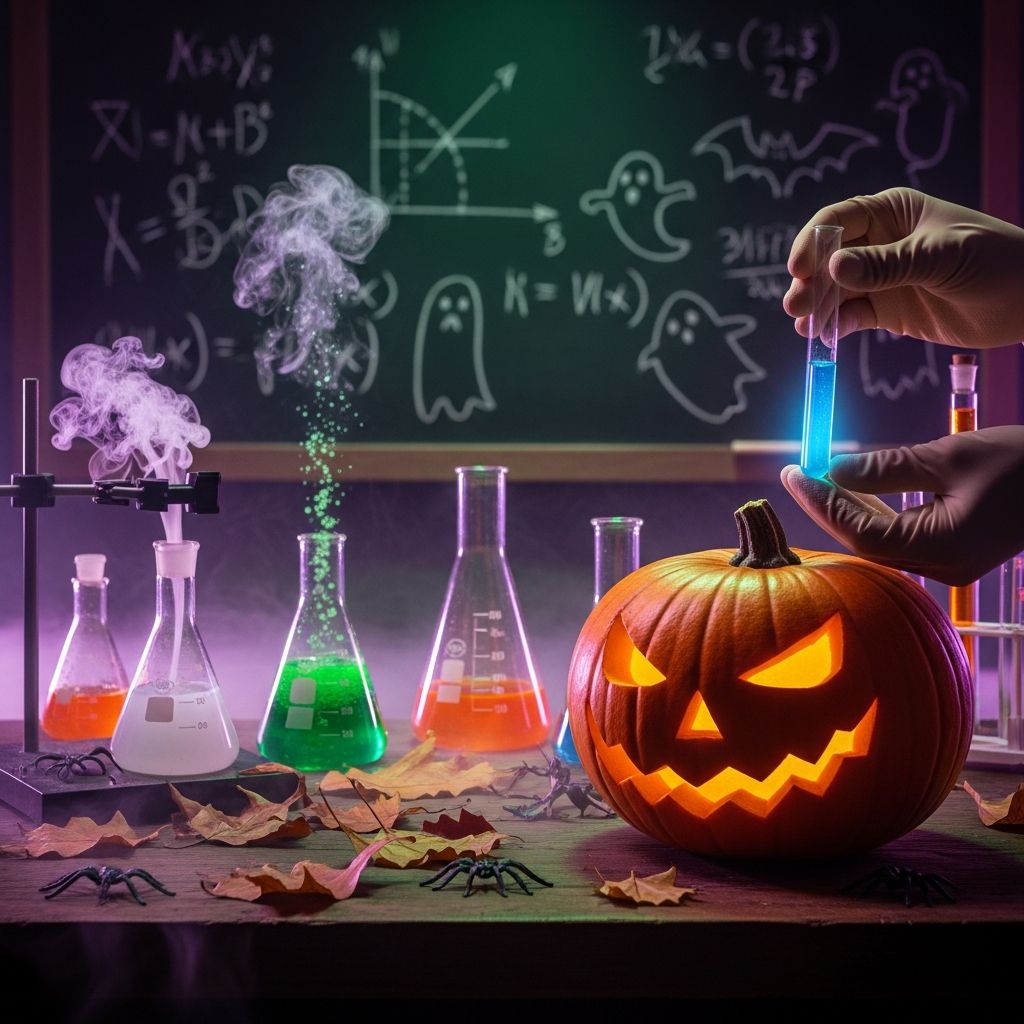
Halloween offers a unique opportunity to merge festive excitement with scientific discovery. These experiments transform ordinary celebrations into educational experiences, helping children grasp fundamental principles in chemistry, physics, and biology through playful, thematic activities. Designed for various age groups, they require minimal materials and promote critical thinking, observation, and hypothesis testing.
Chemical Reactions That Go Bump in the Night
Chemical reactions provide dramatic visuals perfect for Halloween themes. These activities demonstrate acid-base interactions and gas production in captivating ways.
Cauldron Overflow Experiment
Create a bubbling witch’s cauldron using a clear container, baking soda, and vinegar tinted with food coloring. Add dish soap for extra foam. The reaction produces carbon dioxide gas, causing rapid expansion. Children can predict the overflow time by varying ingredient amounts, learning about exothermic reactions.
- Materials: Plastic bowl, baking soda (1/2 cup), vinegar (1 cup), green food coloring, dish soap.
- Steps: Layer baking soda at bottom, pour in colored vinegar mixed with soap, observe foam eruption.
- Science Concept: Acid (vinegar) neutralizes base (baking soda), releasing CO2 gas.
Foaming Phantom Heads
Carve small pumpkins or use plastic skulls filled with the same mixture. The foam mimics ectoplasm, illustrating gas volume changes under pressure.
Physics of Phantoms and Floating Specters
Physics experiments reveal forces, states of matter, and energy transfer through ghostly demonstrations.
Ascending Tea Bag Spirits
Cut a tea bag open, empty contents, and stand it upright on a plate. Ignite the top; convection currents from hot air lift the lightweight paper like a ghost. This showcases heat-induced density changes and buoyancy.
| Age Group | Key Learning | Safety Note |
|---|---|---|
| Preschool | Observation of motion | Adult supervision for fire |
| Elementary | Convection explanation | Use heatproof surface |
| Middle School | Calculate air volume rise | Extinguisher nearby |
Electrostatic Spirit Levitation
Rub a balloon on hair to charge it, then use static to lift tissue paper ghosts or make marker drawings float on water. Demonstrates electrostatic forces and surface tension.
Biological Mysteries Unearthed
Explore life sciences with decaying produce and candy osmosis, connecting Halloween treats to natural processes.
Decomposing Gourd Observation
Section a pumpkin and monitor changes over days: mold growth, weight loss, odor development. Track with journals, discussing microbial decomposition and environmental factors.
- Weigh daily to quantify mass loss.
- Compare sealed vs. exposed samples.
- Concept: Bacteria and fungi break down organic matter.
Candy Osmosis Lab
Soak gummy worms or bears in water, saltwater, and vinegar overnight. Measure size changes to understand osmosis—water movement across membranes.
Gummies swell in hypotonic solutions (pure water) and shrink in hypertonic ones (saltwater), mimicking cell behavior.
Engineering Challenges with a Spooky Twist
STEM engineering encourages design, testing, and iteration using Halloween motifs.
Spectral Tower Construction
Build the tallest stable ghost tower from marshmallows and toothpicks. Test against wind (fan) or shakes, optimizing for strength-to-height ratio.
- Brainstorm designs.
- Prototype and measure.
- Redesign after failure.
Candy Launcher Physics
Construct catapults from popsicle sticks, rubber bands, and spoons to launch candy corn. Measure distance, adjusting angles for maximum range, applying projectile motion principles.
Sensory Explorations and Non-Newtonian Wonders
Tactile activities engage senses while teaching material properties.
Ectoplasmic Slime Synthesis
Mix glue, borax, water, and neon paint for glowing slime. Add glow-in-dark powder for Halloween flair. Explores polymers and shear-thickening fluids.
Arachnid Ice Excavation
Freeze plastic spiders in ice blocks; melt with warm water, salt, or tools. Compares melting rates, introducing heat transfer.
Advanced Spooktacular Demonstrations
For older kids, incorporate dry ice and light effects.
Sublimating Dry Ice Potions
Drop dry ice in warm soapy water for fog clouds and bubbles. Explains sublimation (solid to gas) and nucleation sites. Caution: Handle with gloves.
Glowing Bioluminescent Brew
Use tonic water (quinine glows under blacklight) and highlighters (fluorescein extract) for radiant potions, teaching fluorescence.
Age-Appropriate Activity Guide
| Age | Recommended Experiments | Extensions |
|---|---|---|
| 3-5 Years | Slime, ice melt, simple fizz | Sensory descriptions |
| 6-8 Years | Pumpkin reactions, candy osmosis | Data recording |
| 9-12 Years | Tea bag ghosts, catapults | Hypothesis testing |
| 13+ Years | Dry ice, density towers | Quantitative analysis |
Frequently Asked Questions (FAQs)
What safety precautions should I take?
Supervise all activities involving heat, chemicals, or small parts. Use protective gear for dry ice and ensure good ventilation.
Are these experiments budget-friendly?
Yes, most use household items like vinegar, baking soda, and candy, costing under $10 total.
Can they align with school curricula?
Absolutely—many tie to NGSS standards in physical sciences, life sciences, and engineering design.
How do I adapt for large groups?
Prepare stations with pre-measured supplies; rotate groups for hands-on time.
What if a child has allergies?
Substitute food items with plastic alternatives; check for sensitivities to dyes or adhesives.
Enhancing Learning Through Reflection
Post-experiment discussions solidify concepts. Ask: What happened? Why? What if we change X? This fosters scientific inquiry.
Document with photos or videos for portfolios, extending engagement beyond the holiday.
References
- Next Generation Science Standards: Physical Sciences — National Research Council. 2013-06-15. https://www.nextgenscience.org/
- Acid-Base Reactions in Everyday Chemistry — American Chemical Society. 2023-10-01. https://www.acs.org/
- States of Matter: A Guide for Teachers — U.S. Department of Education. 2024-01-20. https://www.ed.gov/
- Osmosis and Diffusion Experiments — National Science Teaching Association. 2022-09-12. https://www.nsta.org/
- Engineering Design Process for K-12 — National Academy of Engineering. 2021-05-10. http://www.nae.edu/

Medha Deb is an editor with a master's degree in Applied Linguistics from the University of Hyderabad. She believes that her qualification has helped her develop a deep understanding of language and its application in various contexts. Medha specializes in the areas of beauty, health, sports, and wellness and is committed to ensuring that the content on the website is…