
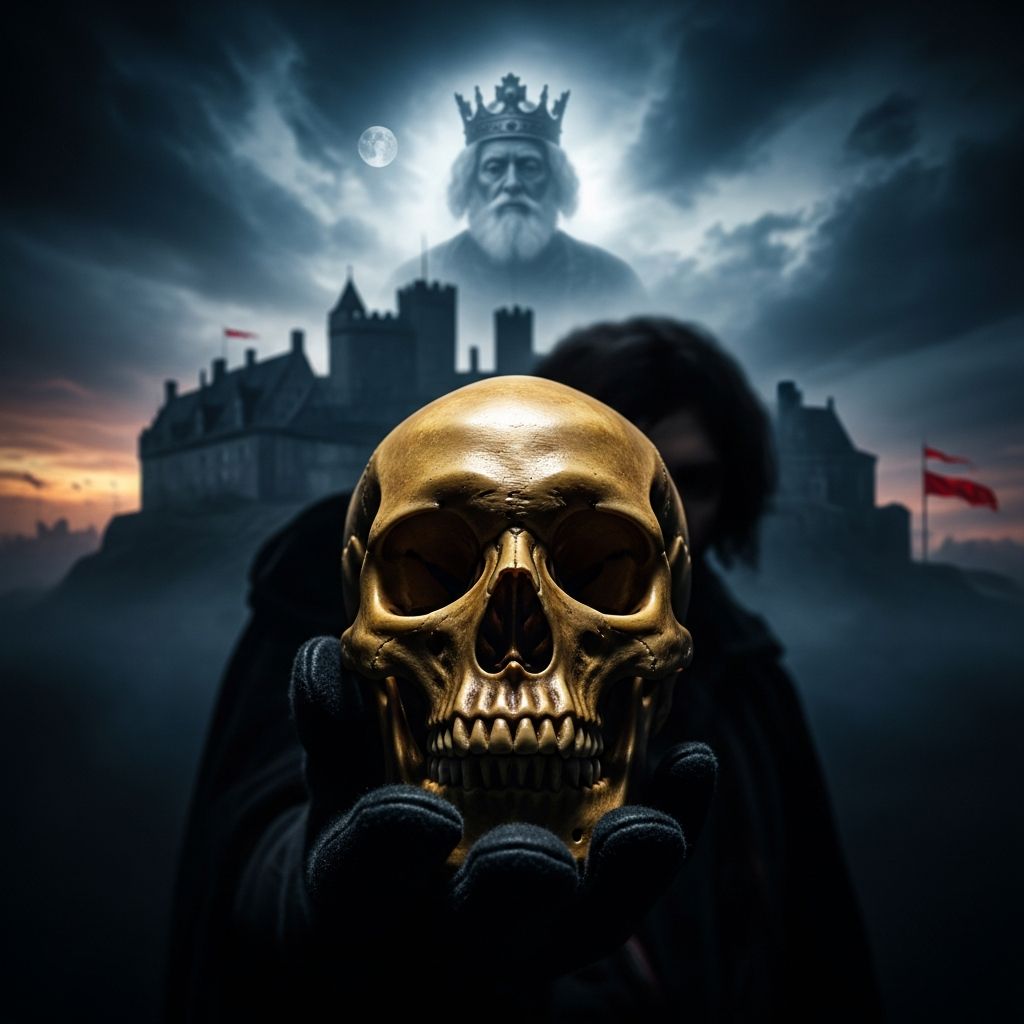
William Shakespeare’s Hamlet stands as one of the most profound tragedies in English literature, weaving a tapestry of revenge, madness, betrayal, and mortality. Set in the cold halls of Elsinore Castle in Denmark, the play follows Prince Hamlet as he grapples with his father’s murder, his mother’s hasty remarriage, and a spectral command for vengeance. This guide offers an original exploration of the story’s progression, delving into character motivations, pivotal moments, and thematic depths without spoiling the emotional impact for newcomers. We’ll trace the narrative arc act by act, highlight crucial soliloquies, and examine how personal vendettas spiral into national catastrophe.
The Shadow of Death: Denmark’s Fractured Court
The drama opens amid political tension and personal grief. Denmark braces for potential invasion from Norway’s Prince Fortinbras, whose father was defeated by the late King Hamlet. Guards on the battlements spot a ghostly figure resembling the recently deceased king, first dismissed as imagination but confirmed by scholar Horatio. This apparition sets a supernatural tone, hinting at unrest beyond the grave.
At court, King Claudius—Hamlet’s uncle—has swiftly married Queen Gertrude and claimed the throne, bypassing young Hamlet. The prince, returned from university, mourns deeply, clad in black and questioning the haste of the wedding in his first soliloquy: a raw outpouring of disillusionment with human frailty. Claudius urges Hamlet to move on, but the prince’s wit masks profound sorrow. Meanwhile, Polonius, the verbose lord chamberlain, advises his son Laertes to depart for France with platitudes like self-truth, while forbidding daughter Ophelia from pursuing her affection for Hamlet.
- Key Tension: Hamlet’s isolation grows as family and friends prioritize stability over his grief.
- Foreshadowing: Norway’s threat mirrors internal decay, symbolizing how unchecked ambition erodes order.
Ghostly Revelations and Vows of Revenge
Hamlet’s world shatters when Horatio reveals the ghost’s appearances. Venturing out at midnight, he confronts the specter, which identifies as his father, poisoned in the orchard by Claudius via ear-drops during sleep. The ghost demands revenge but urges sparing Gertrude, leaving her conscience to heaven. This encounter ignites Hamlet’s quest but plants seeds of doubt—is the ghost truthful or demonic?
Swearing Horatio and the guards to secrecy, Hamlet vows to feign madness (‘antic disposition’) to probe the truth. Ophelia’s reports of his erratic behavior reach Polonius, who attributes it to lovesickness. Claudius summons old friends Rosencrantz and Guildenstern to spy on Hamlet, revealing the court’s paranoia.
In a powerful aside, Hamlet laments inaction in his ‘O, what a rogue and peasant slave am I’ speech, contrasting his paralysis with fictional avengers. This internal conflict—duty versus doubt—defines his tragic heroism.
Deception, Performance, and Uncovering Lies
A troupe of players arrives, prompting Hamlet to test Claudius with ‘The Mousetrap,’ a play mirroring the ghost’s tale. The king’s guilty reaction confirms the murder, thrilling Hamlet but alerting Claudius, who retreats in turmoil.
Polonius arranges a meeting between Hamlet and Gertrude. Alone with his mother, Hamlet rails against her remarriage, mistaking rustling behind an arras for Claudius and stabbing Polonius dead. The ghost reappears to Hamlet (invisible to Gertrude), refocusing him. He drags the body away, declaring Polonius fodder for worms—a grim meditation on mortality.
| Event | Hamlet’s Action | Outcome |
|---|---|---|
| The Play Within a Play | Stages murder reenactment | Confirms Claudius’s guilt |
| Closet Scene | Confronts Gertrude; kills Polonius | Exile to England; Ophelia’s madness accelerates |
| Spy Network Exposed | Dismisses Rosencrantz and Guildenstern | They carry forged execution orders |
Exile, Madness, and Spiraling Tragedies
Claudius, fearing Hamlet, dispatches him to England with Rosencrantz and Guildenstern bearing secret execution orders. At sea, pirates capture Hamlet, who forges new letters dooming his escorts. Returning to Denmark, he encounters Ophelia’s funeral, her drowning—ambiguous suicide or accident—shattering Laertes, who blames Hamlet.
Ophelia’s madness manifests in haunting songs of loss, underscoring collateral damage from Hamlet’s revenge. Claudius manipulates Laertes into a rigged fencing match: poisoned rapier, backup tainted wine. Gertrude’s unwitting toast seals her fate.
- Laertes’ Rage: Mirrors Hamlet’s but unburdened by doubt, highlighting revenge’s blind fury.
- Fortinbras Parallel: His decisive march contrasts Hamlet’s hesitation, framing the Dane’s flaws.
The Fatal Duel: Climax of Blood and Betrayal
The court assembles for the duel. Hamlet apologizes to Laertes, but treachery unfolds: Gertrude drinks poison meant for Hamlet, collapsing. Laertes wounds Hamlet with the envenomed blade; in the scuffle, blades switch, poisoning Laertes too. Dying, Laertes reveals Claudius’s plot. Hamlet forces the king to drink the lethal wine, achieving vengeance as all principals perish.
Hamlet, expiring, bids Horatio live to chronicle events and names Fortinbras successor. The Norwegian prince enters, claiming Denmark amid the carnage, ordering Hamlet military honors. ‘The rest is silence’ encapsulates existential finality.
Central Themes: Revenge’s Corrosive Path
Hamlet interrogates revenge’s morality. Hamlet’s delay stems not from cowardice but philosophical depth—’To be or not to be’ probes suicide, action, and suffering’s value. Madness blurs real and feigned: Hamlet’s calculated, Ophelia’s genuine.
Power corrupts: Claudius’s usurpation invites chaos. Women like Gertrude and Ophelia suffer patriarchal machinations. Corruption metaphors—rotten state, poisoned ear—permeate, linking personal sins to societal rot.
Existential queries dominate: ‘What a piece of work is a man’ decries humanity’s contradictions. The play-within-a-play underscores art’s truth-revealing power.
Character Dynamics: Heroes, Villains, and Fools
- Hamlet: Intellectual prince torn by duty, feigning insanity while battling melancholy.
- Claudius: Cunning king, tormented by guilt yet unrepentant.
- Gertrude: Ambiguous queen, loving yet flawed in loyalty.
- Ophelia: Tragic pawn, destroyed by male conflicts.
- Horatio: Loyal foil, embodiment of reason.
Polonius’s meddling folly contrasts Hamlet’s profundity; Laertes’ hot-blooded revenge antithesizes thoughtful delay.
Frequently Asked Questions (FAQs)
Why does Hamlet delay his revenge?
Hamlet’s hesitation arises from moral qualms, doubt about the ghost, fear of afterlife consequences, and over-intellectualizing, as explored in his soliloquies.
Is Ophelia’s death suicide?
The text ambiguously describes her drowning while garlanding flowers; Gertrude’s poetic report suggests accident amid madness, but interpretations vary.
What happens to Rosencrantz and Guildenstern?
Hamlet alters their execution orders; they die offstage in England, unwitting tools of Claudius.
Who becomes king at the end?
Fortinbras seizes the throne, endorsed by Hamlet’s dying wish, symbolizing renewal through foreign resolve.
Is Hamlet truly mad?
He claims to feign it for cover, but grief and pressure blur lines, making his psyche a scholarly debate.
Legacy and Modern Relevance
Since 1603, Hamlet has captivated with psychological realism, influencing Freudian analysis to films like Kenneth Branagh’s epic. Its exploration of inaction amid crisis resonates in political paralysis today. The prince’s introspection—’There are more things in heaven and earth’—invites endless reinterpretation.
Productions vary: David Tennant’s manic energy, or Zeffirelli’s introspective Mel Gibson. Themes of surveillance echo modern spying; mental health struggles feel contemporary.
In classrooms, it teaches rhetoric, from iambic pentameter to soliloquies’ intimacy. Staging challenges abound: ghost effects, duel choreography, Ophelia’s flowers. Yet its core—humanity’s tragic flaws—endures universally.
This plot guide illuminates Hamlet‘s labyrinthine intrigue, rewarding rereads with fresh insights into ambition’s cost and vengeance’s void.
References
- Hamlet Act-by-Act Plot Synopsis — Royal Shakespeare Company. 2023. https://www.rsc.org.uk/shakespeare-learning-zone/hamlet/story/scene-by-scene
- The Plot: Hamlet — Royal Shakespeare Company. 2023. https://www.rsc.org.uk/hamlet/the-plot
- Hamlet — Wikipedia (sourced from primary texts). 2026-04-01. https://en.wikipedia.org/wiki/Hamlet
- Hamlet Plot Summary — LitCharts. 2024. https://www.litcharts.com/lit/hamlet/summary
- Synopsis of Hamlet — Hartford Stage. 2023. https://www.hartfordstage.org/stagenotes/hamlet/synopsis
- Hamlet: Full Play Summary — SparkNotes. 2024. https://www.sparknotes.com/shakespeare/hamlet/summary/
- Summary of Hamlet — Shakespeare Birthplace Trust. 2023. https://www.shakespeare.org.uk/explore-shakespeare/shakespedia/shakespeares-plays/hamlet/

Medha Deb is an editor with a master's degree in Applied Linguistics from the University of Hyderabad. She believes that her qualification has helped her develop a deep understanding of language and its application in various contexts. Medha specializes in the areas of beauty, health, sports, and wellness and is committed to ensuring that the content on the website is…