
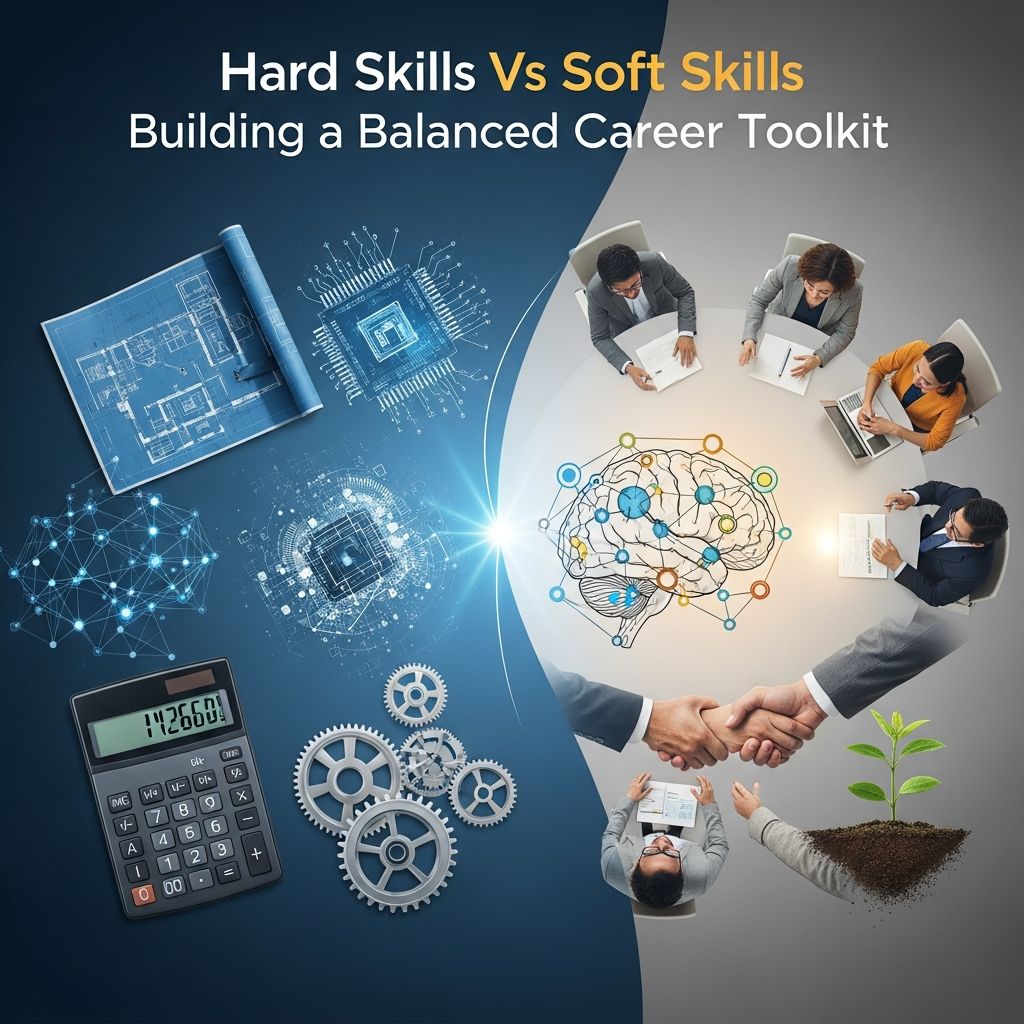
To thrive in today’s workplace, you need more than technical expertise or a good personality alone. You need a **blend** of hard and soft skills that work together like a complete toolkit, helping you perform your job and collaborate effectively with others.
What Are Hard Skills?
Hard skills are the concrete, teachable abilities you use to perform specific tasks at work. They are often tied to particular tools, technologies, or professional practices and are usually gained through formal education, training, or structured practice.
Common examples include:
- Writing code in a particular programming language
- Preparing financial statements or forecasts
- Operating specialized machinery or equipment
- Running statistical analyses with tools like R or SPSS
- Speaking a second language fluently
Because hard skills are specific and task-focused, they are comparatively easy to test and measure—through exams, certifications, work samples, or technical interviews.
What Are Soft Skills?
Soft skills are the interpersonal, social, and cognitive abilities that influence how you work, communicate, and solve problems. They shape how you interact with colleagues, manage yourself, adapt to change, and contribute to a team.
Typical soft skills include:
- Communication (written and verbal)
- Teamwork and collaboration
- Adaptability and resilience
- Empathy and emotional intelligence
- Time management and organization
- Critical thinking and problem-solving
- Conflict resolution and negotiation
- Leadership and influence
Unlike hard skills, soft skills are harder to quantify and usually develop gradually through life and work experiences.
Key Differences at a Glance
| Aspect | Hard Skills | Soft Skills |
|---|---|---|
| Definition | Technical, role-specific abilities and knowledge | Interpersonal, social, and self-management abilities |
| How they are learned | Courses, certifications, on-the-job technical training | Everyday interactions, feedback, coaching, experience |
| How they are measured | Tests, portfolios, licenses, practical assessments | Observation, behavioral interviews, peer reviews |
| Transferability | Often tied to specific tools or professions | Highly transferable across roles and industries |
| Primary focus | What you do | How you do it and how you work with others |
Why Both Types of Skills Matter to Employers
Hard skills ensure you can perform the technical aspects of a job, while soft skills determine how effectively you apply that knowledge in real situations.
From an employer’s point of view:
- Hard skills enable a company to produce products or deliver services at a professional standard.
- Soft skills influence collaboration, innovation, customer relationships, and workplace culture.
Surveys of employers regularly show that communication, teamwork, problem-solving, and professionalism rank among the most desired skills in new hires, often alongside technical abilities.
How Hard and Soft Skills Work Together
In practice, most roles require a combination of both skill types. Consider these simplified examples:
- Software developer
- Hard skills: Programming languages, version control, testing methods
- Soft skills: Collaborating in agile teams, giving and receiving code review feedback, managing time across sprints
- Healthcare professional
- Hard skills: Clinical procedures, diagnostic tools, medical record systems
- Soft skills: Empathy, clear communication with patients, staying calm under pressure
- Sales representative
- Hard skills: Product knowledge, CRM software, pricing structures
- Soft skills: Active listening, persuasion, handling objections respectfully
Without solid hard skills, performance suffers because core duties are not executed correctly. Without strong soft skills, projects stall, conflicts escalate, and customers or colleagues lose trust.
Developing Hard Skills: Structured Learning and Practice
Because hard skills are technical and specific, they respond well to planned training and formal study. You can build or upgrade your hard skills through:
- Formal education – Degrees, diplomas, or vocational programs that teach discipline-specific knowledge.
- Certifications and courses – Shorter, targeted programs that validate competence in tools, methods, or standards.
- On-the-job training – Learning systems, procedures, and industry tools under supervision.
- Self-directed learning – Books, reputable online courses, and hands-on projects that deepen technical understanding.
- Deliberate practice – Repeating specific tasks with feedback until you reach a higher level of proficiency.
When planning your hard skill development, focus on:
- What your current role requires now
- What adjacent roles or future promotions are likely to demand
- Industry trends, such as automation or new technologies, that may change skill requirements
Developing Soft Skills: Experience, Reflection, and Feedback
Soft skills are built gradually and often require self-awareness. Universities and employers increasingly offer programs to strengthen them, but everyday experiences are equally important.
Practical ways to grow your soft skills include:
- Requesting feedback – Ask managers and colleagues for specific examples of when you communicated well or poorly, collaborated effectively, or struggled.
- Observing role models – Notice how respected colleagues handle conflicts, give feedback, or lead meetings, and adopt useful behaviors.
- Volunteering for cross-functional work – Projects with people from other teams expose you to different perspectives and test your communication and adaptability.
- Practicing reflection – After challenging interactions, note what went well, what did not, and what you might try next time.
- Using training or coaching – Workshops on communication, leadership, or emotional intelligence can accelerate progress when combined with practice.
Because soft skills affect how others experience working with you, improvements in this area can significantly influence your reputation, career growth, and leadership potential.
Showcasing Hard and Soft Skills on Your Resume
To make your skills visible to hiring managers, you need to go beyond listing buzzwords. Focus on evidence and outcomes.
Highlighting Hard Skills
- Include relevant tools, technologies, and methods in a dedicated skills or technical section.
- Mention certifications, licenses, and formal training with dates and issuing organizations.
- Use bullet points in your experience section to show how you applied hard skills to achieve measurable results (e.g., “developed an application that reduced processing time by 20%”).
Highlighting Soft Skills
- Demonstrate soft skills indirectly through achievements (e.g., “coordinated a cross-team initiative that delivered the project two weeks early”).
- Weave indicators of teamwork, leadership, or communication into accomplishment bullets instead of listing them without context.
- Use your cover letter to illustrate how you handled a challenge, showing judgment, empathy, or resilience.
Assessing Your Own Skills: A Simple Checklist
Use the questions below to identify strengths and gaps. Answer honestly and look for patterns.
Self-Check: Hard Skills
- Do I meet or exceed the technical requirements listed in job descriptions similar to my role?
- Which tools or methods do colleagues regularly rely on me to handle?
- Where do I frequently ask for help because I lack knowledge or confidence?
- Have I updated my technical skills in the last 12–18 months to stay current?
Self-Check: Soft Skills
- How often do conflicts around me escalate instead of being resolved constructively?
- Do teammates and stakeholders describe me as reliable and easy to work with?
- When plans change, do I adapt smoothly or get stuck in frustration?
- Do I listen carefully before responding, or do I often interrupt?
- Have I sought feedback on my leadership, communication, or collaboration style in the past year?
Planning Your Next Steps
Once you understand your current strengths, you can plan your development in a balanced way.
- Identify 1–2 high-impact hard skills that directly support your current or desired role.
- Choose 1–2 soft skills that would most improve your effectiveness (for example, communication or time management).
- Set specific goals, such as completing a course, leading a small project, or practicing a new meeting habit.
- Track progress by noting concrete changes: fewer misunderstandings, more efficient workflows, or new responsibilities.
Over time, this combination of targeted technical learning and deliberate behavior change builds a resilient, adaptable career profile that can withstand shifts in technology and job markets.
Frequently Asked Questions (FAQs)
Q: Are hard skills more important than soft skills?
A: Employers increasingly look for a balance. Hard skills qualify you for a role, but soft skills often determine who gets hired, promoted, and trusted with leadership responsibilities.
Q: Can soft skills really be taught?
A: Soft skills can be improved through training, coaching, feedback, and intentional practice, even if they are not taught in the same way as technical subjects.
Q: How do I prove my soft skills in an interview?
A: Use concrete examples. When asked behavioral questions (for example, “Tell me about a time you handled a conflict”), describe the situation, what you did, and the outcome to show your communication, problem-solving, or teamwork.
Q: Do different careers require different mixes of hard and soft skills?
A: Yes. Highly technical roles may place heavier emphasis on specialized hard skills, while management or client-facing roles demand especially strong soft skills. Still, almost all modern jobs require some level of both.
Q: How often should I update my skills?
A: It is wise to review your skill set at least annually, checking job postings, industry news, and employer expectations to see which hard and soft skills are becoming more important.
References
- Hard skills vs. Soft skills — Workable Recruiting Resources. 2023-05-01. https://resources.workable.com/hr-terms/hard-skills-vs-soft-skills
- Hard Skills vs. Soft Skills: What’s the Difference? — Indeed Career Guide. 2022-08-18. https://www.indeed.com/career-advice/resumes-cover-letters/hard-skills-vs-soft-skills
- Soft Skills vs Hard Skills: Definitions, Differences and Examples — Personio HR Lexicon. 2023-02-10. https://www.personio.com/hr-lexicon/soft-skills-hard-skills/
- Soft Skills vs Hard Skills — University of Salford, Staff Development. 2022-09-15. https://www.salford.ac.uk/spd/soft-skills-vs-hard-skills
- Hard Skills vs. Soft Skills: What’s the Difference? — Coursera Career Academy. 2023-06-21. https://www.coursera.org/articles/hard-skills-vs-soft-skills
- Understanding Soft vs. Hard Skills — Washington State University Human Resource Services. 2021-11-05. https://hrs.wsu.edu/understanding-soft-vs-hard-skills/
- Skills: Hard (Technical) vs Soft (Professional) — Next Steps Idaho. 2022-04-12. https://nextsteps.idaho.gov/resources/skills-hard-technical-vs-soft-professional

Medha Deb is an editor with a master's degree in Applied Linguistics from the University of Hyderabad. She believes that her qualification has helped her develop a deep understanding of language and its application in various contexts. Medha specializes in the areas of beauty, health, sports, and wellness and is committed to ensuring that the content on the website is…