
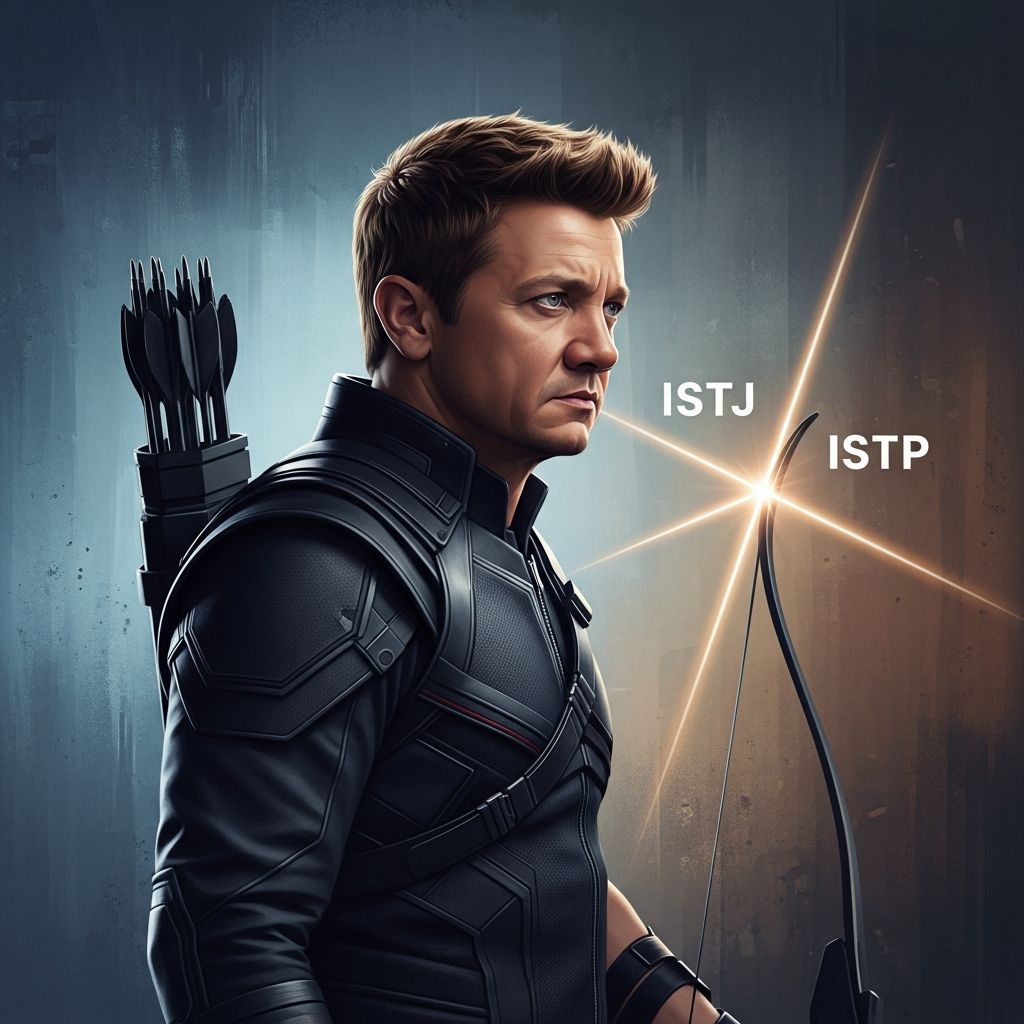
Among the Avengers, Hawkeye is the one most people underestimate. No armor, no magic, no gamma radiation – just a bow, a quiver of trick arrows, and an unnerving ability to stay calm when everything is on fire around him. That makes him ideal for a personality analysis: his power is almost entirely psychological and skill-based, not supernatural.
This article uses popular trait models like the 16-personality framework as an interpretive lens to explore how Clint Barton’s behavior often lands between ISTJ-A (Assertive Logistician) and ISTP-A (Assertive Virtuoso). It is not a clinical assessment, but a way to understand why this “ordinary” human feels so compelling in a world of gods and geniuses.
From Carnival Archer to Avenger: Why Personality Matters Here
Clint Barton’s story begins with trauma and apprenticeship: a difficult childhood, time in a traveling circus, and training under morally ambiguous mentors before he ever pointed an arrow at a supervillain. Those early experiences created a particular combination of traits:
- Extreme skill built through repetition – years of practice, not a sudden origin accident.
- Embedded distrust of authority – born from abuse and betrayal in youth.
- Comfort with risk and improvisation – circus work and vigilante choices required both.
When applied to personality typing, these elements explain why Hawkeye is:
- Structured and reliable like an ISTJ when he’s on the job.
- Unpredictable, hands-on, and occasionally reckless like an ISTP when left to his own devices.
Core Trait Cluster: Introverted, Observant, Thinking, Assertive
Across most of his portrayals, Hawkeye consistently displays four major traits that align with the 16-personality axes:
| Dimension | Likely Side | How Hawkeye Shows It |
|---|---|---|
| Energy | Introverted (I) | Prefers small circles, quiet family time, and working in the background rather than public attention. |
| Information | Observant (S) | Focuses on real-world data: angles, distance, movement, terrain, and immediate threats. |
| Decision-making | Thinking (T) | Makes choices based on tactics and outcomes, even when emotionally costly. |
| Identity | Assertive (-A) | Rarely ruminates out loud, doesn’t show anxiety, and performs under pressure. |
Introversion: The Quiet Center of a Chaotic Team
Despite the one-liners, Clint is fundamentally private. He hides an entire family life from the team for years, keeps his worries to himself, and prefers decompressing away from the spotlight. When the mission ends, he tends to retreat, not celebrate.
- He often stands at the edge of group conversations, observing rather than dominating.
- He lets others (like Stark or Thor) draw the attention while he focuses on angles and exits.
Observant Sensing: The Archer’s Awareness
Hawkeye’s fighting style is built on concrete perception: he reads wind, distance, speed, and cover in fractions of a second. His archery feats rely on:
- Outstanding visual acuity and spatial judgment.
- Body awareness from acrobatics and circus-style agility.
- Detailed memory of layouts, vantage points, and equipment.
That eye for detail also shows up in his gear: he often helps design or adjust his own bows and trick arrows, reflecting hands-on, sensors-first problem-solving.
Thinking: Tactical First, Feelings Later
Even when his choices are emotional underneath, Hawkeye frames them in pragmatic terms. He tends to:
- Ask what will work, not what will feel fair.
- Accept personal risk if it increases mission success.
- Communicate in direct, sometimes blunt, statements.
In both the comics and films, he frequently makes hard calls that prioritize overall survival or objective completion over his own safety. That is very much in line with Thinking types who value outcomes, systems, and strategy.
Assertive: Calm Under Fire
Hawkeye’s confidence is quiet but unmistakable. On the battlefield he treats impossible shots as routine, even when facing aliens, robots, or cosmic threats. An Assertive identity is reflected in:
- Low visible anxiety, even when massively outgunned.
- Fast decisions without obvious second-guessing.
- Self-deprecating humor instead of verbalizing fear.
Logistician vs. Virtuoso: The Line Hawkeye Walks
The real debate is less about the four main letters and more about whether Hawkeye is more Judging (J) or Prospecting (P). In other words:
- Is he primarily a structured duty-doer (ISTJ-A)?
- Or a tactical improviser (ISTP-A)?
Hawkeye as ISTJ-A: The Grounded Professional
When working under formal organizations like S.H.I.E.L.D. or structured Avengers teams, Hawkeye strongly resembles an Assertive Logistician:
- He shows intense reliability: if he accepts a mission, he sees it through.
- He follows agreed plans and coordinates precisely with teammates.
- He treats hero work like a job: prepare, execute, go home.
ISTJs are often described as the backbone of institutions: practical, patient, and loyal. Hawkeye’s long service on multiple Avengers rosters and his history as a team leader in the comics fit that pattern well.
Hawkeye as ISTP-A: The Rogue Engineer of Mayhem
Outside a rigid chain of command, Hawkeye looks far more like an Assertive Virtuoso:
- He tinkers with gear, modifies weapons, and adapts tools on the fly.
- He shows a streak of rule-breaking independence, walking away from institutions he believes are wrong.
- He thrives in chaos, making split-second decisions that no plan could fully anticipate.
Virtuosos are known for hands-on problem-solving and comfort with risk. Hawkeye’s acrobatic archery, habit of charging into lopsided fights, and willingness to operate in gray areas (like the Thunderbolts era) match that description strongly.
Why He Might Sit Near the Middle
Personality research supports the idea that people rarely fit neatly into one side of a binary trait spectrum; most traits are distributed continuously rather than categorically. Hawkeye is a good fictional demonstration of this:
- On missions, he uses structure like a Judging type.
- Off missions, he drifts, tinkers, and follows impulse like a Prospecting type.
Rather than trying to force a final label, it is more accurate to see him as an ISTJ–ISTP hybrid, leaning one way or the other depending on context and medium.
The Mind-Control Lens: Amplifying His Logistician Side
At one point, Hawkeye is placed under external control via a powerful artifact that twists existing traits rather than inventing new ones. In that state, he becomes a model of cold, task-focused execution: emotionless, relentlessly efficient, and utterly locked onto objectives.
That representation is a useful thought experiment: if you cranked his ISTJ-like qualities to the maximum and stripped away his conscience and improvisational warmth, you would get exactly that hyper-focused operative. It suggests that underneath his dry humor and rogue edge lies a deeply ordered, methodical mind.
Duty, Loyalty, and the Moral Compass
Official Marvel materials repeatedly emphasize that Clint Barton possesses a strong moral compass that sometimes pushes him to defy orders or abandon organizations he no longer trusts.
- He leaves or challenges teams whose leadership he believes has lost its way.
- He continues fighting even after catastrophic personal losses, driven by a sense of responsibility rather than glory.
- He routinely sides with individuals and small communities, not faceless systems.
This combination – duty-bound yet skeptical of authority – is where his ISTJ and ISTP tendencies intersect. His loyalty is to principles and people, not to institutions for their own sake.
Precision and Practice: Skill as a Personality Expression
Psychologically, Hawkeye’s legendary archery is not just a plot device; it is an expression of how he relates to the world. Various character profiles and official descriptions note that:
- His archery borders on the superhuman, involving trick shots, ricochets, and near-impossible angles.
- He maintains rigorous daily training that builds speed, strength, and coordination.
- He carefully analyzes his own battles and adjusts tactics over time.
For Observant, Thinking types, mastery often becomes a stabilizing anchor. The bow is not just a weapon; it is the system he controls in a world full of cosmic chaos.
Relationships and Team Dynamics
Clint is often surrounded by people with louder personalities, yet he repeatedly ends up in mentorship and leadership roles.
- He has led multiple Avengers lineups and other teams, leveraging experience and practicality.
- He trains younger heroes, passing along both tactics and hard-won lessons from his own failures.
- He forms bonds with peers who understand compromise and gray areas rather than strict idealism.
His interpersonal style fits an Introverted thinker who cares deeply but communicates sparsely: loyalty is shown through presence, backup, and shared danger more than through emotional speeches.
What Hawkeye Reveals About “Ordinary” Heroes
From a personality perspective, Hawkeye is a reminder that:
- You do not need fantastical powers to be compelling; psychological realism is enough.
- Duty and independence can coexist in the same person.
- People often sit between neat personality labels, shifting with context.
His blend of discipline, technical skill, roguish independence, and quiet compassion is exactly what makes him relatable. In a world of superhumans, he stays stubbornly human and keeps showing up anyway.
Frequently Asked Questions (FAQs)
Q: Is Hawkeye more of an ISTJ or an ISTP?
He shows strong elements of both. In structured settings and long-term commitments he looks like an ISTJ (Logistician), while his improvisation, gear tinkering, and occasional rule-breaking resemble an ISTP (Virtuoso). Different storylines and media lean him slightly in one direction or the other.
Q: Why is Hawkeye often described as relatable compared to other Avengers?
Because he has no inherent superpowers and relies on training, discipline, and judgment, his struggles and limits feel closer to real human experience. His injuries, doubts, and failures are part of the story, yet he continues to show up and take risks, which fits the archetype of a grounded, flawed hero.
Q: How do his archery skills connect to his personality type?
His precision reflects an Observant, Thinking style: he notices physical details most people miss and uses logical calculations about trajectory, timing, and position. Years of methodical practice also mirror the organized, persistent side often seen in ISTJ/ISTP combinations.
Q: Does Hawkeye’s distrust of authority make him less of a team player?
Not necessarily. He is deeply committed to his teammates but willing to challenge institutions or leaders when they violate his internal code. That tension – loyal to people, cautious with systems – is one of his defining characteristics and explains his shifting roles across different teams.
Q: Can fictional characters be meaningfully typed with real personality models?
They can be interpreted through those models, which is useful for discussion and insight, but the results are not clinical diagnoses. Writers may change direction over time, and multiple authors can emphasize different traits, so any type assignment is best treated as a flexible lens rather than a final verdict.
References
- Hawkeye (Clint Barton) — Marvel Entertainment, LLC. 2023-10-01. https://www.marvel.com/characters/hawkeye-clint-barton
- Who is Hawkeye? Complete Marvel Character History & Powers Guide — SuperHeroToyStore Blog. 2023-06-15. https://www.superherotoystore.com/blogs/news/who-is-hawkeye-complete-marvel-character-history-powers-guide
- Hawkeye – Marvel Comics – Avengers – Thunderbolts — Writeups.org. 2022-11-20. https://www.writeups.org/hawkeye-avengers-marvel-comics-thunderbolts/
- Hawkeye | Marvel Cinematic Universe Wiki — Fandom. 2022-05-10. https://marvelcinematicuniverse.fandom.com/wiki/Hawkeye
- Personality Traits and the Five-Factor Model — American Psychological Association (APA Dictionary of Psychology). 2021-09-01. https://dictionary.apa.org/five-factor-model
- Personality Traits Across Cultures: A Systematic Review — Allik, J., & McCrae, R. R., Journal of Personality, Wiley. 2004-06-01. https://doi.org/10.1111/j.1467-6494.2004.00298.x
- Hawkeye: The Rogue Archer (Avengers Personality Series) — 16Personalities. 2018-04-12. https://www.16personalities.com/articles/hawkeye-the-rogue-archer-avengers-personality-series

Medha Deb is an editor with a master's degree in Applied Linguistics from the University of Hyderabad. She believes that her qualification has helped her develop a deep understanding of language and its application in various contexts. Medha specializes in the areas of beauty, health, sports, and wellness and is committed to ensuring that the content on the website is…