
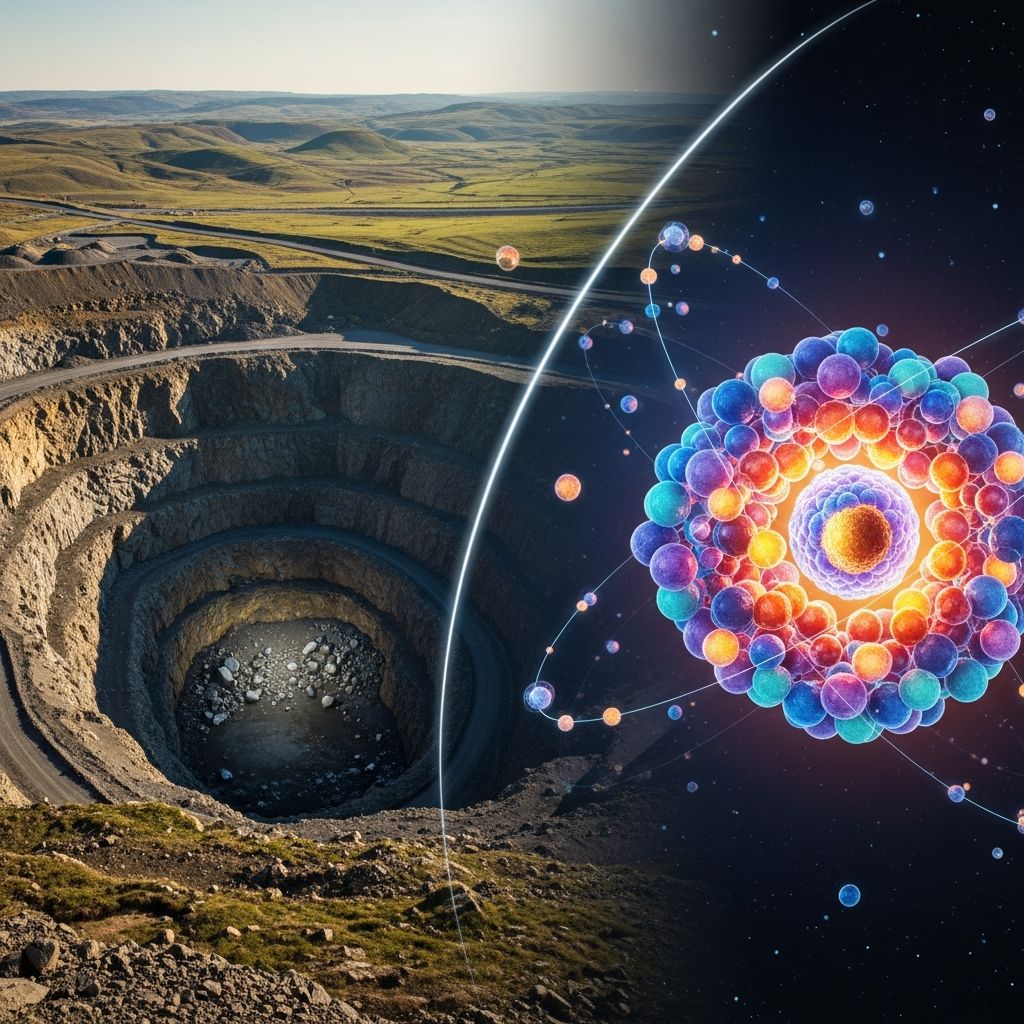
The quest to identify the heaviest elements hinges on precise definitions: atomic mass for superheavy synthetic atoms, density for compact natural materials, and natural abundance for Earth’s primordial inventory. This exploration bridges everyday density champions like osmium with lab-born giants like oganesson, revealing a periodic table frontier shaped by nuclear physics and cosmic events.
Defining Heaviness in the Chemical World
Elements earn the ‘heaviest’ label through multiple lenses. By **atomic number** (protons in the nucleus), oganesson (Og, 118) reigns supreme as the final confirmed entry on the periodic table. Its atomic mass nears 300 u, dwarfing hydrogen’s 1 u. Density measures mass per volume, crowning osmium at 22.59 g/cm³—imagine a 1 cm³ cube tipping scales at over 22 grams, heavier than a comparable platinum piece (21.45 g/cm³).
Natural occurrence adds nuance: uranium (atomic number 92, mass ~238 u) dominates Earth’s deposits, mineable like gold, while trace superheavies like plutonium emerge from rare decay chains. Synthetic elements beyond 92 demand particle accelerators, pushing boundaries where stability crumbles in milliseconds.
Osmium: The Density King of Natural Elements
Osmium (Os, 76) claims the density throne among stable, naturally sourced elements. Its 22.59 g/cm³ arises from tightly packed atoms in a body-centered cubic lattice, enhanced by strong electron-nucleus bonds. Rarer than gold, osmium lurks in platinum ores, extracting at €2,219 per gram due to scarcity and toxicity—its osmium tetroxide (OsO₄) vapors blister lungs.
Contrast osmium with low-density hydrogen gas (0.09 g/cm³ at STP), underscoring density’s role in material heft. A 1 m³ osmium block weighs ~22,590 kg, outmassing 20 adults. Iridium rivals at 22.56 g/cm³, but osmium edges ahead, vital in alloys for fountain pen tips and electrical contacts resisting wear.
| Element | Density (g/cm³) | Key Use/Property |
|---|---|---|
| Osmium | 22.59 | Hardest natural metal alloy base |
| Iridium | 22.56 | Catalyst, spark plugs |
| Platinum | 21.45 | Jewelry, catalysis |
| Gold | 19.32 | Electronics, bullion |
| Uranium | 19.05 | Nuclear fuel |
This table highlights transition metals’ density peak, driven by d-block electron filling.
Superheavy Synthetics: Oganesson and Beyond
Element 118, oganesson, synthesized in 2002 by Russian and American teams, boasts the highest atomic number and mass (~294-300 u). Named for physicist Yuri Oganessian, its sole isotope (Og-294) halves in 0.7 ms, defying chemical analysis. Yet theory unveils oddities: relativistic effects warp inner electrons to 80% light speed, blurring shells into a ‘nebulous blob’ unlike noble gas kin like xenon.
Protons form shells, but neutrons mingle chaotically, contrasting lighter superheavies. Predicted solid at room temperature (vs. gaseous radon), oganesson may react, challenging group 18 inertness due to destabilized 7p orbitals. Synthesis fuses californium-249 with calcium-48 beams in cyclotrons, yielding fleeting atoms detected by decay signatures.
- Creation Method: Heavy-ion collisions (e.g., ⁴⁸Ca + ²⁴⁹Cf → ²⁹⁴Og + 3n)
- Half-Life: ~0.7 ms, shortest among named elements
- Relativistic Shift: Electrons delocalized, potentially metallic
- Island of Stability: Hopes for longer-lived isotopes near Z=114-126 unfulfilled here
Natural Heavyweights: Uranium to Trace Californium
Uranium-238, at 19.05 g/cm³ and mass 238 u, heads naturally abundant heavies, comprising 99% of mined ore. Formed in supernovae, it decays alpha, seeding daughters like thorium. Trace neptunium (93) and plutonium (94) arise in uranium deposits via neutron capture, proven in Oklo’s 2-billion-year-old Gabon reactor.
Californium (98) edges as Earth’s heaviest natural trace, from uranium ore neutron fluxes yielding micrograms via beta decay. Heavier einsteinium/fermium flickered at Oklo but vanished, half-lives too brief (~years). Plutonium-244 persists nature’s trace at 80 million-year half-life.
- Uranium: Abundant, nuclear fuel.
- Neptunium/Plutonium: Trace from decay chains.
- Californium: Minute natural yields, mostly synthetic.
Synthesis Frontiers: Building Beyond Nature
Post-uranium elements demand accelerators. Early actinides like curium (96) used helium ions on plutonium: ⁴He + ²³⁹Pu → ²⁴²Cm + n. Modern superheavies employ calcium-48 on actinide targets, e.g., ⁴⁸Ca + ²⁴³Am → ²⁸⁸Mc (115). Over 117 elements confirmed, with 118’s 2016 naming.
Challenges: Low yields (1 atom/week), beam times costing millions. The ‘island of stability’ posits closed neutron shells (N=184) stabilizing Z=114+ isotopes for seconds—hunt continues.
Bizarre Properties of Superheavies
Relativity dominates: heavy nuclei boost electron speeds, contracting s/p orbitals, expanding d/f—disrupting trends. Oganesson: gaseous? No, solid; inert? Reactive. Hassium (108) forms volatile OsO₄-like oxide; flerovium (114) hydrophobic. Adsorption energies (e.g., OsO₄ -39 kJ/mol) guide gas-phase studies.
Nuclear ‘magic numbers’ (2,8,20,28,50,82,126) stabilize shells; superheavies test driplines where neutrons/protons unbind.
Cosmic Origins and Extremes
Heavy elements forge in neutron star mergers or supernovae r-process, peaking at third r-process peak (A~195: gold, platinum). Earth retains uranium/californium traces; space harbors black hole TON 618 (66 billion solar masses), but elements cap at ~120 naturally.
Frequently Asked Questions (FAQs)
What is the densest natural element?
Osmium, at 22.59 g/cm³, outdensifies all stable natural elements.
Which element has the highest atomic number?
Oganesson (118), synthetic with ~300 u mass.
Is there a heaviest naturally occurring element?
Californium (98) in uranium ores, though trace; uranium dominates abundance.
Why are superheavy elements unstable?
Coulomb repulsion overwhelms strong force; fleeting half-lives under 1 second.
Could oganesson be useful?
Theoretical only; no bulk due to instability, but probes nuclear theory.
Future Horizons for Heavy Element Research
Facilities like GSI/FAIR, Dubna’s JINR eye element 119+ via titanium-50 beams, stability hunts intensify. Quantum computing aids relativistic predictions; astrophysics links r-process to abundances. These pursuits redefine matter’s limits, from lab flecks to stellar forges.
References
- The Heaviest Object in The World — YouTube (Vsauce2 channel transcript). 2023. https://www.youtube.com/watch?v=QeS9P-mOE7k
- 5 ways the heaviest element on the periodic table is really bizarre — Science News. 2017-01-21. https://www.sciencenews.org/article/5-ways-heaviest-element-periodic-table-really-bizarre
- Oganesson — Wikipedia (drawing from IUPAC confirmation). 2016-11-28 (naming). https://en.wikipedia.org/wiki/Oganesson
- The Heaviest Elements in the Universe — Texas A&M Cyclotron Institute. 2009 (updated context). https://cyclotron.tamu.edu/smp/The%20Heaviest%20Elements%20in%20the%20Universe.pdf
- The heaviest naturally occurring element on Earth? — Stuart Cantrill (Chemical Blog). 2014-05-15. https://stuartcantrill.com/2014/05/15/the-heaviest-naturally-occurring-element-on-earth/

- Integrated M.A. in Applied Linguistics, University of Hyderabad
- 5+ years in editorial, instructional, SEO, and research-based writing
Sneha is a relationships and lifestyle writer with a strong foundation in applied linguistics and certified training in relationship coaching. She brings over five years of writing experience to theskillvault, crafting thoughtful, research-driven content that empowers readers to build healthier relationships, boost emotional well-being, and embrace holistic living. Her writing and insights reflect the belief that beauty, happiness, and wellness…