
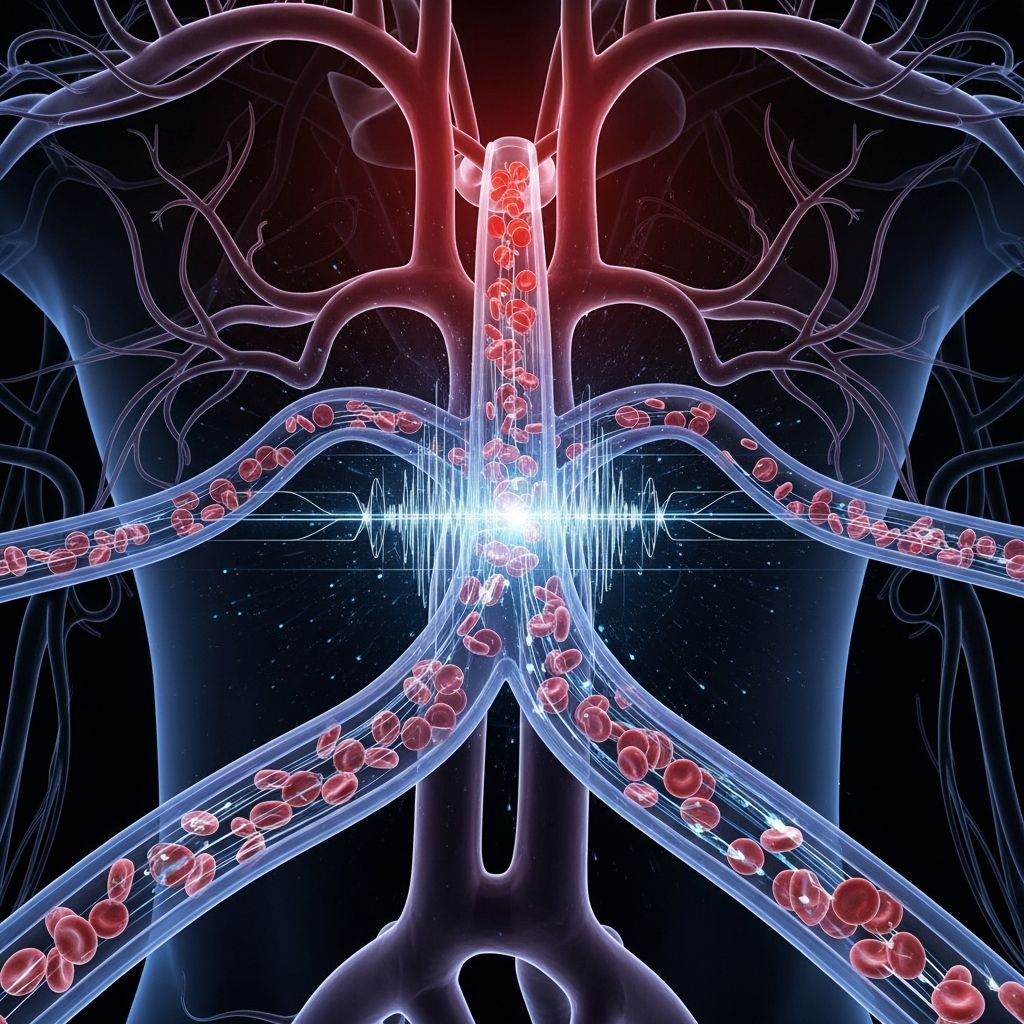
The human circulatory system is a marvel of engineering, tirelessly delivering oxygen, nutrients, and removing waste to sustain life. At its core lies hemodynamics, the scientific study of blood flow and the forces that drive it through arteries, veins, and capillaries. This discipline blends physics, biology, and chemistry to explain how the heart generates pressure and how vessels respond to maintain efficient circulation.
Foundational Principles of Blood Movement
Hemodynamics draws from fundamental physical laws, much like fluid dynamics in engineering. Blood, though a complex non-Newtonian fluid, follows principles akin to Ohm’s Law: flow equals pressure difference divided by resistance. Here, pressure gradient is the driving force from the heart, flow is blood volume per unit time, and resistance arises from vessel properties.
The circulatory system operates as a closed loop, with the heart as the pump creating hydrostatic pressure to propel blood. This pressure is isotropic compressive stress, measured in force per unit area, ensuring even distribution to tissues. Homeostatic mechanisms, including autoregulation, continuously adjust flow to match metabolic demands, preventing turbulence and optimizing laminar flow in most vessels.
Core Components Driving Circulation
Several interconnected parameters define hemodynamic performance:
- Cardiac Output (CO): Total blood volume pumped by the heart per minute, calculated as stroke volume (SV) times heart rate (HR). Normal CO is about 5-6 liters/min at rest.
- Stroke Volume (SV): Blood ejected per heartbeat, influenced by preload, contractility, and afterload.
- Heart Rate (HR): Beats per minute, modulated by the autonomic nervous system.
- Blood Pressure (BP): Force exerted by blood on vessel walls, with systolic/diastolic averages of 120/80 mmHg.
- Vascular Resistance: Opposition to flow, primarily from arterioles; systemic vascular resistance (SVR) balances cardiac output.
These elements interact dynamically. For instance, during exercise, HR and SV increase to boost CO, while vessels dilate to reduce resistance and enhance flow.
The Heart’s Pivotal Role in Hemodynamics
The heart initiates all blood movement through concentric contraction of cardiac myocytes, generating ventricular ejection. Right and left ventricles handle pulmonary and systemic circulations, respectively, with the left pumping against higher resistance.
Key phases include:
| Phase | Description | Hemodynamic Impact |
|---|---|---|
| Diastole | Ventricular filling | Increases preload, optimizing SV via Frank-Starling mechanism |
| Systole | Ventricular contraction | Generates peak pressure, propels blood into aorta/pulmonary artery |
| Ejection | Blood expulsion | Determines SV; turbulence occurs in ventricles |
Laminar flow predominates in arteries for efficiency, slowing near walls due to friction, while turbulent flow happens at branches or stenoses, demanding more energy.
Vascular Factors Influencing Flow Efficiency
Blood vessels are not passive tubes; they actively regulate hemodynamics. Diameter is critical: flow varies inversely with resistance (Poiseuille’s Law: resistance proportional to 1/radius^4), so small changes profoundly affect perfusion.
- Arterioles: Primary resistance sites, constricting/dilating via smooth muscle to control local flow.
- Capillaries: Exchange sites with low pressure for nutrient diffusion.
- Veins: Low-pressure reservoirs, using valves and skeletal muscle pumps for venous return.
Friction (viscosity) from blood components like red cells and plasma proteins influences speed; central blood moves fastest. Elasticity allows arteries to dampen pressure waves (Windkessel effect), maintaining steady flow.
Regulatory Mechanisms for Balance
The body employs multilayered controls:
- Autonomic Nervous System: Sympathetic stimulation raises HR and vasoconstricts; parasympathetic slows HR.
- Hormonal: Renin-angiotensin-aldosterone system elevates BP; atrial natriuretic peptide promotes vasodilation.
- Local Factors: Metabolites like adenosine and nitric oxide cause vasodilation in active tissues.
- Autoregulation: Intrinsic myogenic response stabilizes capillary pressure.
These ensure organs like the brain and kidneys receive consistent supply despite postural changes or activity.
Mathematical Foundations of Hemodynamics
Quantitative analysis uses:
- Ohm’s Law Analog:
Flow = ΔP / R, where ΔP is pressure drop, R resistance. - Poiseuille’s Law:
R = (8ηL) / (πr⁴), η=viscosity, L=length, r=radius. - Continuity Equation:
A₁v₁ = A₂v₂, conserving volume flow.
Blood’s rheology complicates models, as it shears variably.
Clinical Relevance and Pathophysiology
Disruptions cause disease:
- Hypertension: Elevated SVR overworks heart, risking hypertrophy.
- Shock: Low CO impairs perfusion; types include cardiogenic, hypovolemic.
- Atherosclerosis: Plaques narrow vessels, increasing turbulence and thrombosis risk.
Monitoring via echocardiography, Swan-Ganz catheters assesses parameters like pulmonary capillary wedge pressure.
Advanced Applications in Modern Medicine
Hemodynamics informs treatments:
| Condition | Hemodynamic Goal | Intervention |
|---|---|---|
| Heart Failure | Optimize CO, reduce preload | Diuretics, ACE inhibitors |
| Sepsis | Restore perfusion | Vasopressors, fluids |
| Pulmonary Hypertension | Lower pulmonary resistance | Prostacyclins |
Research advances computational modeling for personalized therapies.
Frequently Asked Questions (FAQs)
What exactly is hemodynamics?
Hemodynamics studies blood flow dynamics, focusing on pressures, flows, and resistances in the cardiovascular system.
How does vessel diameter affect blood flow?
Smaller diameters exponentially increase resistance, slowing flow per Poiseuille’s Law.
What causes turbulent blood flow?
High velocity, branches, or stenoses disrupt laminar patterns, common in ventricles.
Why is cardiac output crucial?
It determines systemic oxygen delivery, adapting to needs via HR and SV.
How do we measure hemodynamic parameters clinically?
Non-invasively via ultrasound/Doppler; invasively with catheters for pressures.
References
- Hemodynamics | Anatomy and Physiology | Research Starters — EBSCO. Accessed 2026. https://www.ebsco.com/research-starters/anatomy-and-physiology/hemodynamics
- Haemodynamics physiology — Schwarzer Cardiotek GmbH. Accessed 2026. https://www.schwarzercardiotek.com/haemodynamics-physiology/
- Hemodynamics — Wikipedia (background). Accessed 2026. https://en.wikipedia.org/wiki/Hemodynamics
- Hemodynamics — PMC (NCBI). 2016-07-20. https://pmc.ncbi.nlm.nih.gov/articles/PMC4958049/
- What Is Hemodynamics? — Cleveland Clinic. 2022-09-08. https://my.clevelandclinic.org/health/body/24013-hemodynamics
- Physiology, Cardiovascular Hemodynamics — StatPearls (NCBI). Accessed 2026. https://www.ncbi.nlm.nih.gov/books/NBK470310/
- Hemodynamics (Pressure, Flow, and Resistance) — CV Physiology. Accessed 2026. https://cvphysiology.com/hemodynamics/h001

- Integrated M.A. in Applied Linguistics, University of Hyderabad
- 5+ years in editorial, instructional, SEO, and research-based writing
Sneha is a relationships and lifestyle writer with a strong foundation in applied linguistics and certified training in relationship coaching. She brings over five years of writing experience to theskillvault, crafting thoughtful, research-driven content that empowers readers to build healthier relationships, boost emotional well-being, and embrace holistic living. Her writing and insights reflect the belief that beauty, happiness, and wellness…