
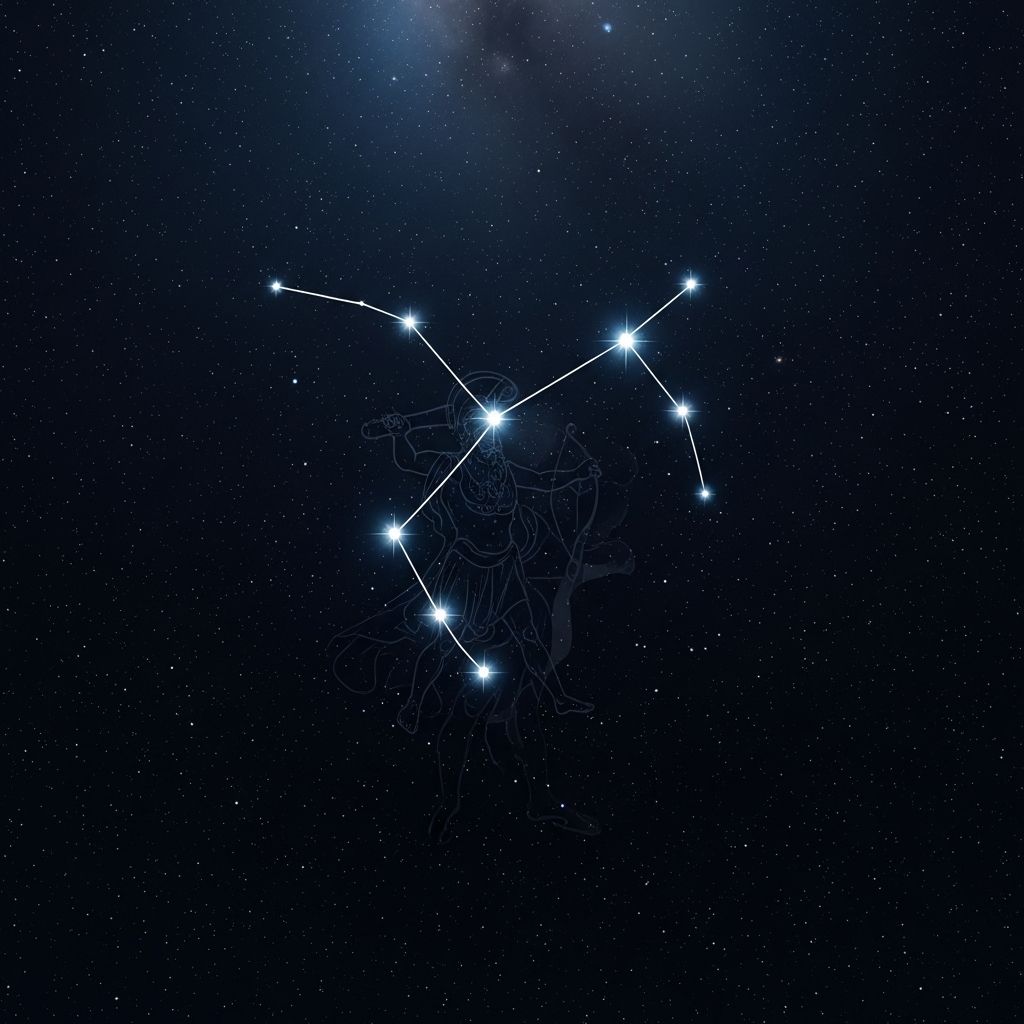
The **Hercules constellation** stands as one of the largest and most storied patterns in the northern celestial hemisphere, representing the legendary hero known for his incredible strength and twelve labors. Spanning 1225 square degrees, it ranks as the fifth largest constellation, visible from latitudes +90° to -50°.
Understanding the Historical Roots of Hercules
Hercules draws its name from the Roman adaptation of the Greek hero Heracles, a figure of immense power who completed epic feats like slaying the Nemean Lion and capturing the Golden Apples of the Hesperides. Ancient Sumerians may have linked it to Gilgamesh, with records tracing back millennia. Ptolemy cataloged it among the 48 original constellations in the 2nd century, and today the International Astronomical Union recognizes it as one of 88 modern ones.
In sky lore, Hercules is depicted kneeling triumphantly over the dragon Draco, with his club raised. This imagery captures the hero’s victory in mythology, where he battled serpents and monsters. The constellation’s position in the third quadrant (NQ3) places it amid a rich neighborhood of stars and galaxies.
Prime Viewing Seasons and Optimal Conditions
For the best views, target **summer evenings** from June to September, peaking around July when Hercules transits the meridian at midnight. Northern observers enjoy it highest from March through September, but light pollution can obscure its faint stars—no first-magnitude beacons here.
- Ideal Time: After sunset in summer; use a dark-sky site away from city lights.
- Tools Needed: Naked eye for asterisms, binoculars for clusters, telescope for details.
- Weather Tip: Clear, moonless nights enhance visibility of dim objects.
Step-by-Step Directions to Spot Hercules
Finding Hercules requires navigating via brighter neighbors since its stars top out at magnitude 2.78. Start with the **Summer Triangle**: locate brilliant Vega in Lyra and Arcturus in Boötes.
- Draw an imaginary line from Vega (magnitude 0.03 in Lyra) through to Arcturus (magnitude -0.05 in Boötes).
- The midpoint along this line reveals the **Keystone asterism**—a quadrilateral of four stars forming Hercules’ torso: Eta (η), Pi (π), Zeta (ζ), and Epsilon (ε) Herculis.
- Confirm by noting borders with Draco (north), Corona Borealis (south), Ophiuchus (southwest), Aquila (south), and Lyra (east).
Under dark skies, the Keystone resembles a trapezoid tilted on its side, with Eta Herculis marking the “head” corner. Practice on clear nights to train your sky eye.
Key Stars Illuminating the Hero’s Form
Hercules boasts 14 IAU-approved named stars, none overwhelmingly bright but collectively distinctive. Here’s a breakdown:
| Star Name | Bayer Designation | Magnitude | Distance (ly) | Notable Trait |
|---|---|---|---|---|
| Kornephoros | β Herculis | 2.78-2.81 | 139 | Brightest; binary system, “club bearer” |
| Rasalgethi | α Herculis | ~3.0 (variable) | ~360 | Red supergiant; hero’s head |
| Sarin | δ Herculis | 3.14 | ~137 | Multiple star system |
| Maasym | λ Herculis | 4.3 | ~370 | Orange giant |
**Kornephoros (Beta Herculis)** shines as the crown jewel at magnitude 2.81, a binary with a 410-day orbit, lying southwest of the Keystone. **Rasalgethi (Alpha Herculis)**, a variable red giant, glows with an orange hue, evoking the hero’s fiery trials. These, plus the Keystone stars (all ~3rd-4th magnitude), sketch Hercules’ kneeling figure.
Deep-Sky Treasures Within Hercules’ Borders
Hercules overflows with celestial gems, including globular clusters, nebulae, and galaxy groups—prime targets for amateur scopes.
- Messier 13 (M13, NGC 6205): The Great Globular Cluster, brightest in the northern sky at magnitude 5.8, spans 24 arcminutes with over 8000 stars. Locate two-thirds from ζ to η Herculis; naked-eye visible in dark skies, resolves into sparkle through binoculars.
- Messier 92 (M92, NGC 6341): Slightly fainter (mag 6.5) but denser, near the Keystone’s northwest edge—nearly as grand as M13.
- NGC 6210 (Turtle Nebula): A planetary nebula, magnitude 9.4, compact and responsive to small telescopes.
- Hercules A: Radio galaxy with massive lobes, plus clusters like Abell 2199 (290+ galaxies, featuring NGC 6166).
These objects highlight Hercules as a deep-sky hotspot, especially M13, observable even in 8-inch telescopes revealing hundreds of stars.
Meteor Showers Radiating from Hercules
The **Tau Herculids (Herculids)** meteor shower peaks in early June, with radiant in Hercules. ZHR up to 5-10 meteors/hour under ideal conditions, known for slow, bright fireballs from Comet 73P/Schwassmann-Wachmann 3. Observe post-midnight in dark sites.
Advanced Observing Tips and Equipment
To maximize Hercules sessions:
- Star Hopping: Use apps like Stellarium or charts for precision.
- Binoculars (10×50): Reveal M13’s glow; scan Keystone for doubles.
- Telescopes: 6-8 inch for cluster resolution; UHC filters for nebulae.
- Challenges: Faint stars demand averted vision; log observations for patterns.
Hercules rewards patience, blending myth with modern astronomy—home to 12 stars with confirmed exoplanets.
Frequently Asked Questions (FAQs)
What is the best time to see the Hercules constellation?
Summer evenings from June to September, especially July, when it’s highest at midnight in the northern hemisphere.
How do I find the Keystone asterism?
Connect Vega (Lyra) and Arcturus (Boötes); the middle hosts the four-star Keystone: η, π, ζ, ε Herculis.
What is Messier 13?
The Great Globular Cluster, a magnitude 5.8 ball of 8000+ stars, easiest deep-sky object in Hercules, visible to naked eye in dark skies.
Does Hercules have bright stars?
No first-magnitude stars; brightest is Kornephoros (β Her) at 2.78 magnitude.
Can I see Hercules from the southern hemisphere?
Partially, down to -50° latitude, but lower on horizon and harder due to faintness.
Why Hercules Captivates Stargazers Everywhere
From ancient myths to Messier marvels, Hercules bridges human stories with cosmic wonders. Its sprawling form challenges beginners yet delights experts with clusters like M13 and M92. Venture out, connect the Keystone, and witness the hero’s eternal vigil.
References
- Hercules Constellation — Constellation Guide. 2023. https://www.constellation-guide.com/constellation-list/hercules-constellation/
- Hercules Constellation: The Ultimate Guide — Label Stars. 2023. https://labelstars.com/en/constellations-list/hercules-constellation
- Constellation Hercules | Information & Images — Star Registration. 2023. https://www.star-registration.com/blogs/constellations-and-zodiac-signs/constellation-hercules
- Hercules Constellation | Star Map & Facts — Go Astronomy. 2023. https://www.go-astronomy.com/constellations.php?Name=Hercules
- How to spot Hercules in the night sky — BBC Sky at Night Magazine. 2023. https://www.skyatnightmagazine.com/advice/hercules-constellation

- Integrated M.A. in Applied Linguistics, University of Hyderabad
- 5+ years in editorial, instructional, SEO, and research-based writing
Sneha is a relationships and lifestyle writer with a strong foundation in applied linguistics and certified training in relationship coaching. She brings over five years of writing experience to theskillvault, crafting thoughtful, research-driven content that empowers readers to build healthier relationships, boost emotional well-being, and embrace holistic living. Her writing and insights reflect the belief that beauty, happiness, and wellness…