
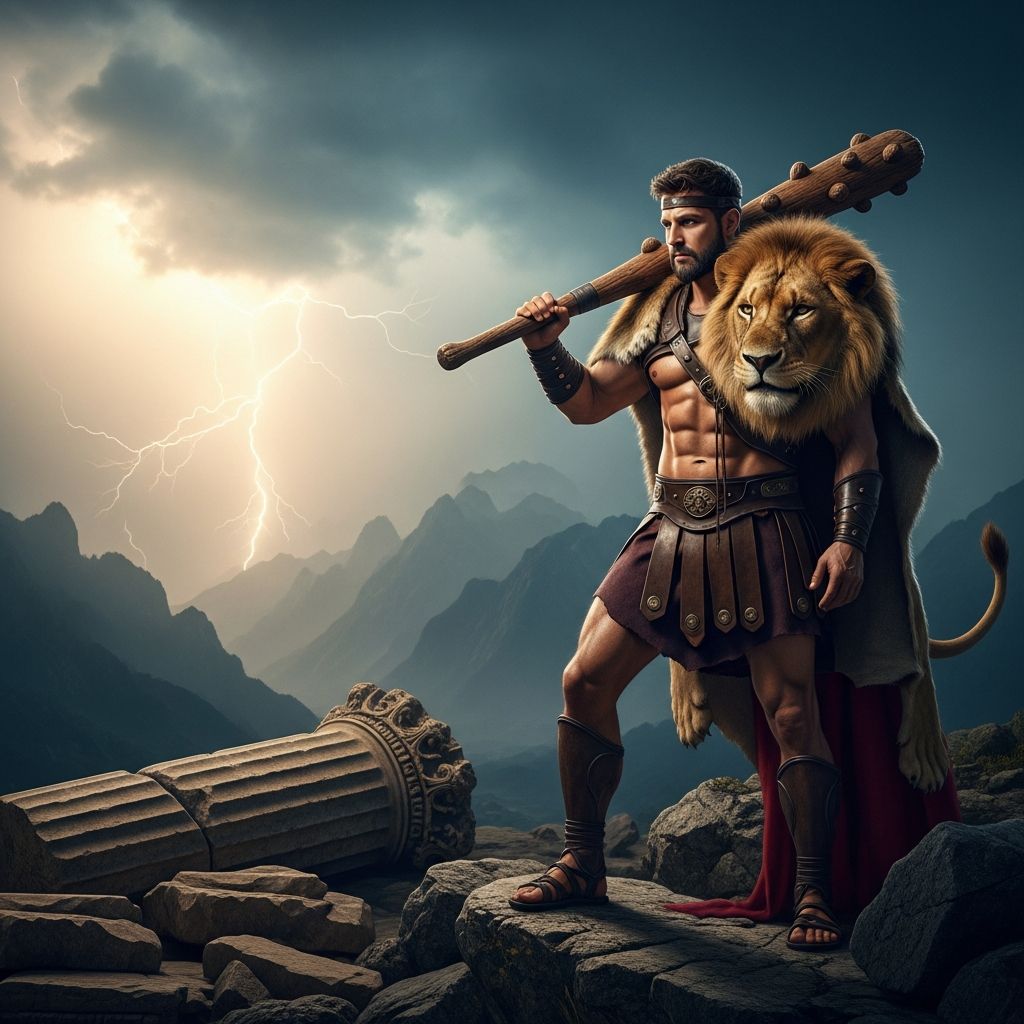
Hercules, known as Heracles in Greek tradition, stands as one of the most iconic figures in classical mythology, celebrated for his unparalleled strength, courage, and perseverance through unimaginable trials. Born of divine and mortal parentage, his life embodies the clash between heroism and tragedy, redemption and glory.
Divine Origins and Turbulent Beginnings
The story of Hercules begins with Zeus, king of the gods, who disguised himself as the warrior Amphitryon to seduce Alcmene, a mortal princess. On the same night Amphitryon consummated his marriage, Zeus fathered Hercules, making him a demigod with extraordinary potential. Alcmene bore twins: Hercules, sired by Zeus, and Iphicles, the son of her human husband. This illicit union enraged Hera, Zeus’s jealous wife, who vowed eternal enmity against the child.
From infancy, Hercules faced Hera’s wrath. She dispatched two venomous serpents into his cradle to slay him, but the infant demigod seized them, strangling both with his tiny hands. This feat revealed his superhuman might and marked him as no ordinary child. As he grew, Hercules honed his skills in archery, wrestling, and combat, becoming a formidable warrior. Yet, Hera’s malice shadowed him, driving him to fits of rage that would define his path to atonement.
The Shadow of Madness and the Path to Penance
In Thebes, Hercules married Megara, daughter of King Creon, and fathered several children. Hera, unrelenting, inflicted him with madness, causing him to slaughter his own family in a horrific frenzy. Overcome with guilt upon regaining sanity, he sought purification at the Oracle of Delphi. The oracle, influenced by Hera, commanded him to serve King Eurystheus of Tiryns for twelve years, performing any tasks assigned—a sentence that birthed the legendary Twelve Labors.
Eurystheus, cowardly and resentful of Hercules’s power, devised increasingly impossible challenges to ensure his failure. These labors transformed Hercules from a flawed warrior into a mythic archetype of endurance. They also showcased his ingenuity, as brute strength alone often proved insufficient.
Conquering the Twelve Labors
The Twelve Labors form the cornerstone of Hercules’s legend, each a testament to his valor. Here’s a detailed overview:
- Nemean Lion: Invulnerable to weapons, this beast terrorized Nemea. Hercules strangled it bare-handed and wore its skin as armor.
- Lernaean Hydra: A multi-headed serpent whose heads regrew when severed. With aid from his nephew Iolaus, Hercules cauterized the stumps, finally slaying it.
- Golden Hind of Artemis: A sacred deer swift as the wind. Hercules captured it alive after a year-long pursuit, respecting the goddess’s property.
- Erymanthian Boar: A massive, destructive pig. Hercules drove it into snowdrifts and carried it back alive to Tiryns.
- Augean Stables: Filthy for decades, cleaned in a single day by diverting rivers—a labor of wit over might.
- Stymphalian Birds: Man-eating flocks with metallic feathers. Hercules flushed them out with a rattle and shot them with arrows.
- Cretan Bull: A raging beast from Crete. Wrestled and captured, it later roamed Greece as the Marathonian Bull.
- Mares of Diomedes: Flesh-eating horses of the Thracian king. Hercules fed Diomedes to them to subdue the beasts.
- Belt of Hippolyta: From the Amazon queen. After a fierce battle, he claimed her girdle.
- Cattle of Geryon: Guarded by a three-bodied giant on Erytheia. Hercules slew Geryon and herded the cattle home.
- Apples of the Hesperides: Golden fruits in a distant garden. He tricked Atlas into fetching them while holding up the heavens.
- Cerberus: The three-headed Underworld hound. Hercules wrestled it from Hades’s realm without weapons.
These feats not only absolved Hercules but elevated him to legendary status, symbolizing humanity’s triumph over chaos.
Beyond the Labors: Epic Quests and Adventures
Hercules’s exploits extended far beyond his penance. He joined the Argonauts on Jason’s quest for the Golden Fleece, contributing his might against formidable foes. He liberated Prometheus by slaying the eagle that tormented him daily, earning prophecies of his future glory. As protector of city-states, cults dedicated to him sprang up across Greece, honoring his role in battling giants for Olympus’s defense.
His romantic life was tumultuous, marked by multiple marriages and lovers. After Megara, he wed Omphale, queen of Lydia, in servitude. His final union with Deianira ended tragically when she unwittingly used a poisoned centaur’s blood on a tunic, causing unbearable agony.
| Adventure | Key Challenge | Outcome |
|---|---|---|
| Argonauts’ Voyage | Clashing with giants and sea monsters | Aided in securing the Golden Fleece |
| Prometheus Liberation | Killing the tormenting eagle | Freed the Titan; received foresight |
| Gigantomachy | Battle against earth-born giants | Secured Olympus for the gods |
| Amazon Expedition | War with warrior women | Obtained Hippolyta’s belt |
This table highlights select non-labor adventures, illustrating Hercules’s breadth of heroism.
Tragic End and Divine Ascension
Deianira’s gift of the poisoned tunic led Hercules to Mount Oeta, where he built a pyre and immolated himself to end his suffering. The mortal part burned away, and Zeus elevated his divine essence to Olympus. There, he reconciled with Hera, marrying her daughter Hebe, goddess of youth, and became the god of strength and protectors of mankind.
Ancient lore even credits him with creating the Milky Way: as an infant, his vigorous nursing from Hera caused her milk to spray across the heavens.
Lasting Legacy in Culture and Symbolism
Hercules’s influence permeates art, literature, and modern media. From ancient statues depicting his labors to Renaissance paintings and Disney films, he symbolizes resilience. His story teaches redemption through trials, the fusion of strength and intellect, and mortality’s potential for divinity. Cults in his name underscored his role as a civic hero, with festivals celebrating his protective spirit.
In Roman tradition, as Hercules, he embodied virtus—manly excellence—patronizing athletes and soldiers. Today, phrases like “Herculean task” evoke his enduring impact on language.
Frequently Asked Questions (FAQs)
What made Hercules so strong?
Hercules’s strength stemmed from his divine heritage as Zeus’s son, amplified by mythic feats like strangling serpents as a baby.
Why did Hera hate Hercules?
Hera despised him as living proof of Zeus’s infidelity, tormenting him from birth to death.
How did Hercules die?
Poisoned by a centaur’s blood-laced tunic from Deianira, he self-immolated, ascending as a god.
Were the Twelve Labors real tasks?
Mythic in nature, they represented cosmic battles against chaos, achieved through strength and cunning.
Did Hercules have children?
Yes, numerous offspring from various unions, many founding heroic lineages like the Heracleidae.
References
- Hercules (classical mythology) — EBSCO Research Starters. Accessed 2026. https://www.ebsco.com/research-starters/religion-and-philosophy/hercules-classical-mythology
- Hercules :: The Life of the Greek Hero — GreekMythology.com. Accessed 2026. https://www.greekmythology.com/Myths/Heroes/Heracles/heracles.html
- Facts and Information on the Greek Hero Heracles (Hercules) — GreekGodsAndGoddesses.net. Accessed 2026. https://greekgodsandgoddesses.net/heroes/heracles/
- H is for Hercules: 5 Facts about the Hero — Forte Academy. 2023-04-24. https://www.forte-academy.co.uk/post/h-is-for-hercules-5-facts-about-the-hero-for-museumweek
- 14 Intriguing Hercules Facts — KickassFacts.com. Accessed 2026. https://www.kickassfacts.com/hercules-facts/
- Heracles | Myth, Significance, Labors, Meaning, & Facts — Encyclopædia Britannica. 2026-04-04. https://www.britannica.com/topic/Heracles
- Hercules Facts – Twelve Labours of Hercules — Twinkl. Accessed 2026. https://www.twinkl.com/teaching-wiki/hercules

Medha Deb is an editor with a master's degree in Applied Linguistics from the University of Hyderabad. She believes that her qualification has helped her develop a deep understanding of language and its application in various contexts. Medha specializes in the areas of beauty, health, sports, and wellness and is committed to ensuring that the content on the website is…