
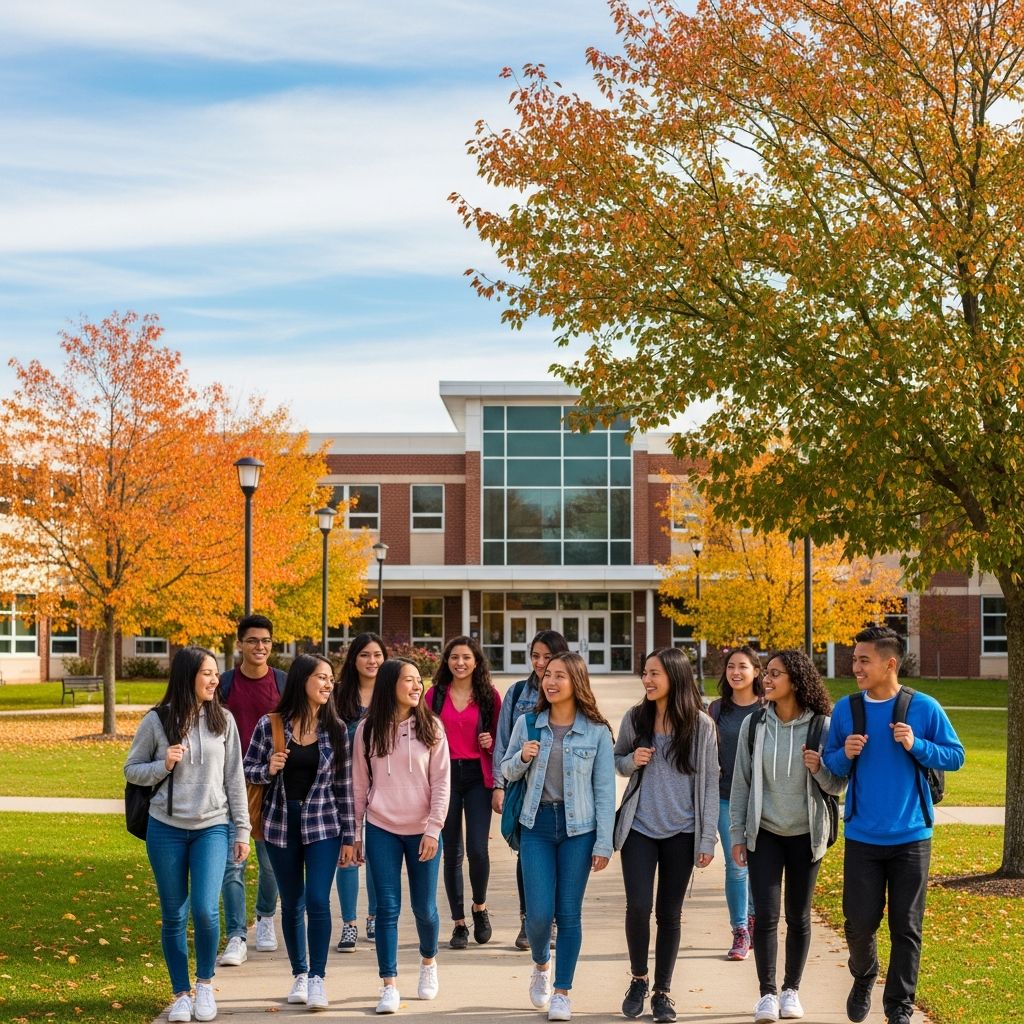
High school marks a pivotal stage in a student’s educational journey, typically spanning grades 9 through 12 for students aged 14 to 18. This period focuses on building foundational skills in core subjects while offering pathways to college, careers, or both. With diverse options like traditional public schools, private institutions, charter programs, and online platforms, families can select environments that best match their needs, from flexible schedules to personalized learning.
Understanding the U.S. High School Landscape
The structure of secondary education in the United States is decentralized, managed primarily by local school districts under state guidelines. Most high schools are comprehensive, accepting students from designated areas regardless of academic track. Core requirements generally include four years of English and math, three years of science and social studies, and electives like foreign languages or arts. This setup allows students to tailor their education, with options for honors, Advanced Placement (AP), or International Baccalaureate (IB) courses that can earn college credit.
Public high schools, funded by taxes, provide tuition-free access but vary in resources by district budget. Private schools offer smaller classes and specialized programs at a cost, while charter schools blend public funding with innovative approaches. Increasingly, online high schools deliver the same rigorous curriculum virtually, appealing to families seeking flexibility without location constraints.
Key Features of Modern High Schools
- Core Curriculum: Emphasizes English (literature and writing), mathematics (algebra through calculus), sciences (biology, chemistry), and social studies (U.S. and world history). These build critical thinking and problem-solving skills essential for postsecondary success.
- Advanced Opportunities: AP and dual-enrollment programs allow high-achievers to take college-level courses. For instance, AP exams can yield credits transferable to universities, reducing future costs.
- Electives and Extracurriculars: Choices in arts, technology, health, or vocational training complement academics. Activities like sports, clubs, and internships foster well-rounded development.
- Graduation Requirements: States set minimum credits, often including end-of-course exams. Reforms like Common Core aim to standardize rigor across regions.
Online High Schools: A Flexible Alternative
Virtual high schools have surged in popularity, offering accredited diplomas identical to those from brick-and-mortar schools. These programs suit homeschoolers, athletes, performers, or those in remote areas, providing 24/7 access to lessons, certified teachers, and state-aligned curricula. Tuition-free options exist for eligible residents, blending live sessions with self-paced modules.
Benefits include customizable pacing, no commuting, and support for unique schedules. Students engage via interactive platforms, submitting work online and participating in virtual clubs or proctored exams. Research shows comparable outcomes in graduation rates and college readiness when paired with parental involvement.
Finding High Schools in Your Area
Locating suitable high schools starts with zip code searches on state education department sites or platforms listing public, private, and online options. Consider factors like accreditation, student-teacher ratios, graduation rates, and college placement stats. Tools from the National Center for Education Statistics help compare nearby schools.
| School Type | Cost | Flexibility | Best For |
|---|---|---|---|
| Public | Free | Fixed schedule | Local residents seeking community |
| Private | Tuition-based | Varies | Specialized programs |
| Charter | Free (lottery) | Innovative models | Alternative learning styles |
| Online | Often free | High (self-paced) | Flexible lifestyles |
Enrollment Processes Across High School Types
Public school enrollment requires proof of residency and prior records, often handled mid-year. Private and charter admissions involve applications, interviews, or lotteries. Online programs simplify with online forms, transcripts, and placement tests, enabling quick starts—even mid-semester for transfers.
Key steps: Verify accreditation (e.g., Cognia or regional bodies), review course catalogs, attend info sessions, and check transfer credit policies. Many offer free trials or counseling to ease transitions.
Curriculum Innovations and Student Support
High schools evolve with standards like No Child Left Behind (legacy influence) and career clusters, integrating real-world skills such as STEM, financial literacy, and digital citizenship. Support services include counseling for college apps, mental health resources, and remediation for at-risk students.
Dual enrollment with community colleges accelerates progress, while career-technical education (CTE) pathways prepare for trades. Dropout prevention focuses on personalized plans, boosting completion rates.
Comparing Traditional vs. Virtual High Schools
| Aspect | Traditional | Virtual |
|---|---|---|
| Social Interaction | Daily in-person | Online clubs, video calls |
| Schedule | Fixed hours | Flexible, anytime |
| Resources | Labs, gyms | Digital tools, home setup |
| Outcomes | Standard diploma | Equivalent accredited diploma |
Preparing for Life After High School
High school equips students for postsecondary paths: 4-year universities, 2-year colleges, vocational training, or workforce entry. Diplomas open doors, with AP/IB enhancing applications. Guidance counselors assist with resumes, FAFSA, and scholarships.
Success metrics include 80-90% graduation rates nationally, though gaps persist for underserved groups. Programs targeting equity, like expanded AP access, narrow disparities.
FAQs
What grades are covered in high school?
Typically grades 9-12, for ages 14-18, culminating in a diploma.
Are online high schools legitimate?
Yes, accredited ones issue state-recognized diplomas equivalent to traditional ones.
How do I enroll in a high school near me?
Search by zip code on state DOE sites; provide residency proof for public, apply for others.
What if my child needs a flexible schedule?
Online or homeschool-hybrid options offer pacing that fits travel, work, or health needs.
Can high school credits transfer?
Yes, between accredited schools, ensuring seamless moves.
Next Steps for Your Family
Research local options today: Enter your zip code, compare programs, and contact admissions. Many provide free consultations to align education with goals. Whether seeking rigor, flexibility, or community, the right high school sets the foundation for thriving futures.
References
- Secondary education in the United States — EBSCO Research Starters. Accessed 2026. https://www.ebsco.com/research-starters/education/secondary-education-united-states
- Secondary education in the United States — Wikipedia. Accessed 2026. https://en.wikipedia.org/wiki/Secondary_education_in_the_United_States
- High School Education Curriculum — EBSCO Research Starters. Accessed 2026. https://www.ebsco.com/research-starters/education/high-school-education-curriculum
- What the High School Curriculum Covers — All Education Schools. Accessed 2026. https://www.alleducationschools.com/blog/what-the-high-school-curriculum-covers/
- The Structure of American Education — National Center for Education Statistics (NCES). 2010. https://nces.ed.gov/pubs2010/2010014/structure.asp
- A Guide to U.S. Education Levels — USAHello. Accessed 2026. https://usahello.org/education/children/grade-levels/
- The Secondary School System in the US — IJAB. Accessed 2026. https://ijab.de/en/information-and-services/information-on-countries/youth-in-the-usa/education/the-secondary-school-system

Medha Deb is an editor with a master's degree in Applied Linguistics from the University of Hyderabad. She believes that her qualification has helped her develop a deep understanding of language and its application in various contexts. Medha specializes in the areas of beauty, health, sports, and wellness and is committed to ensuring that the content on the website is…