
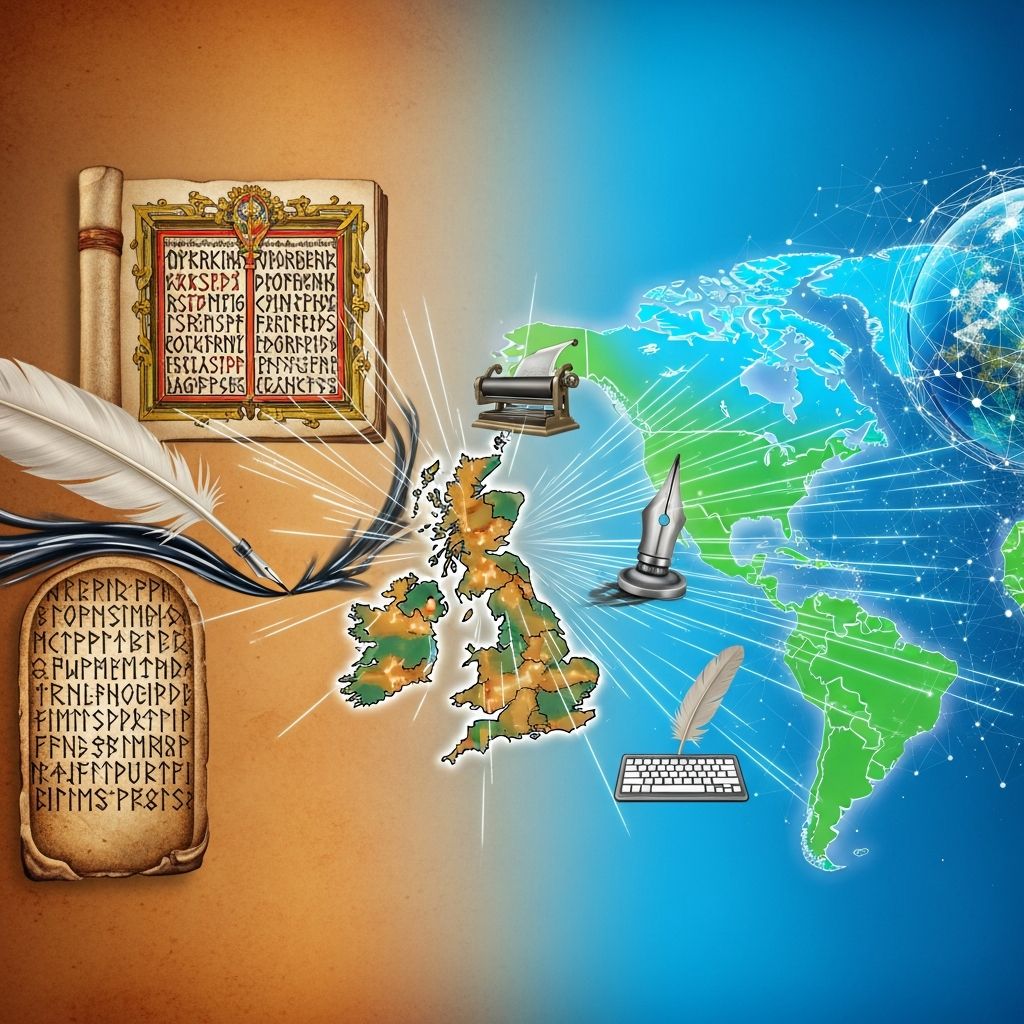
The English language stands as one of the most influential modes of communication today, spoken by over 1.4 billion people worldwide and serving as the primary lingua franca in international diplomacy, science, technology, and commerce.
Roots in Ancient Migrations
English traces its beginnings to the fifth century when Germanic tribes—the Angles, Saxons, and Jutes—migrated from northern Europe to the British Isles following the Roman withdrawal.[10] These groups spoke early forms of West Germanic dialects, which laid the foundation for what we now call Old English. Unlike the Celtic languages of the native Britons or the Latin of Roman settlers, these invaders’ tongue quickly dominated the region, evolving into the language of Engla-land, or England.
The closest living relative to English today is Frisian, spoken in parts of the Netherlands and Germany, sharing phonetic and grammatical similarities that highlight their shared Proto-Germanic ancestry. This Proto-Germanic language itself stemmed from the broader Indo-European family, spoken by nomads on the Eurasian steppes around 6,500 years ago.
Evolution Through Historical Eras
The transformation of English spans several distinct periods, each marked by invasions, cultural shifts, and linguistic borrowings.
Old English: The Germanic Foundation (c. 450–1150)
During the Anglo-Saxon era, Old English featured complex inflections, gendered nouns, and a vocabulary rooted in daily life—words like “be,” “strong,” and “water” persist today. It was heavily synthetic, relying on word endings to convey meaning rather than strict word order. Viking invasions introduced Norse influences, adding words such as “sky,” “egg,” and “knife.”
Middle English: Norman Transformation (1150–1500)
The Norman Conquest of 1066 flooded English with French vocabulary, particularly in law, government, and cuisine—think “justice,” “government,” and “beef.” Syntax began simplifying, with flexible word order emerging, and grammar started shifting toward analytic structures. By the 14th century, post-Hundred Years’ War, English reclaimed prominence over French in official use.
Early Modern English: Renaissance and Standardization (1500–1800)
The printing press, invented by Gutenberg around 1440 and brought to England by William Caxton in 1476, standardized spelling and grammar. The Great Vowel Shift altered pronunciations dramatically, making Chaucer’s Middle English sound foreign to modern ears. Shakespeare’s era blended innovative coinages with classical borrowings, enriching the lexicon during the English Renaissance.
Modern English: Global Expansion (1800–Present)
British colonialism and American innovation propelled English worldwide. Today, it evolves rapidly through technology, internet slang, and globalization, incorporating terms from Hindi, Arabic, and beyond.
Core Linguistic Features
English’s structure combines Germanic simplicity with extensive Romance influences, creating a flexible yet irregular system.
| Feature | Description | Examples |
|---|---|---|
| Grammar | Analytic with minimal inflections; relies on word order and auxiliaries. | Subject-Verb-Object (SVO); modal verbs like “can,” “will.” |
| Vocabulary | Hybrid: 60% Latin/French, 25% Germanic; vast synonyms for nuance. | “Ask” (Germanic) vs. “inquire” (Latin). |
| Pronunciation | Non-phonetic; 44 sounds but only 26 letters; stress-timed rhythm. | “Through” rhymes with “threw” but spelled differently. |
| Tenses | 12 primary tenses using auxiliaries; continuous aspects unique. | “I am eating” (present continuous). |
Unlike synthetic languages like Latin, English uses prepositions and helper verbs, making it accessible but prone to irregularities like strong verbs (sing-sang-sung).
Dialects and Varieties Across the Globe
English manifests in diverse forms, reflecting regional histories.
- British English: Preferred in Europe, Africa, South Asia; features spellings like “colour,” “centre.”
- American English: Dominant in the US, influences global media; uses “color,” “center,” and unique idioms.
- Australian, Canadian, Indian English: Blend local substrates; e.g., Australian slang like “barbie” for barbecue.
- Singaporean/World Englishes: Incorporate multilingual elements, functioning as pidgins or creoles in some contexts.
These varieties share mutual intelligibility but differ in pronunciation (rhotic vs. non-rhotic), vocabulary, and spelling.
English as the World’s Lingua Franca
With 400 million native speakers and over 1 billion total, English is official in 57 countries and a UN working language. It dominates aviation (ICAO standard), internet (over 50% of content), and academia (80% of journals). The British Empire’s legacy, amplified by US cultural exports, cemented its status.
Influence on and from Other Languages
English has borrowed extensively: 29% from French, 29% Latin, yet retains Germanic core grammar. Conversely, it has shaped Spanish (via colonialism), Japanese (loanwords like “computer”), and programming languages.
Challenges in Learning and Usage
Irregular spelling (e.g., “cough,” “though”) and phrasal verbs (“give up”) pose hurdles for non-natives. Yet, its simplicity in plurals (add -s) and lack of cases aids learners.
Frequently Asked Questions (FAQs)
What is the origin of the English language?
English originated from West Germanic dialects brought by Anglo-Saxon settlers to Britain in the 5th century AD.
How many people speak English worldwide?
Over 1.4 billion speakers, including 400 million native, per recent estimates.
Is English a Romance or Germanic language?
English is Germanic but borrows heavily from Romance languages like French.
What makes English spelling so irregular?
The Great Vowel Shift and influx of words from various languages without phonetic standardization.
Will English remain the global lingua franca?
Likely yes, due to its entrenchment in tech, business, and media, though multilingualism grows.
References
- English language – Wikipedia — Wikimedia Foundation. 2026 (continuously updated). https://en.wikipedia.org/wiki/English_language
- English language | Origin, History, Development, Characteristics — Encyclopædia Britannica. 2026 (continuously updated). https://www.britannica.com/topic/English-language
- English – Emory College Language Center — Emory University (.edu). Accessed 2026. https://languagecenter.emory.edu/languages/english.html
- What is English Language? – YouTube Transcript — YouTube Educational Content. 2026. https://www.youtube.com/watch?v=gr21w_4uejE
- British, American, International: Different Types of English — Acolad (official company page). 2025. https://www.acolad.com/en/services/translation/types-english-language
- A brief history of the English language — Oxford International English Schools. Accessed 2026. https://www.oxfordinternationalenglish.com/a-brief-history-of-the-english-language/

- Integrated M.A. in Applied Linguistics, University of Hyderabad
- 5+ years in editorial, instructional, SEO, and research-based writing
Sneha is a relationships and lifestyle writer with a strong foundation in applied linguistics and certified training in relationship coaching. She brings over five years of writing experience to theskillvault, crafting thoughtful, research-driven content that empowers readers to build healthier relationships, boost emotional well-being, and embrace holistic living. Her writing and insights reflect the belief that beauty, happiness, and wellness…