
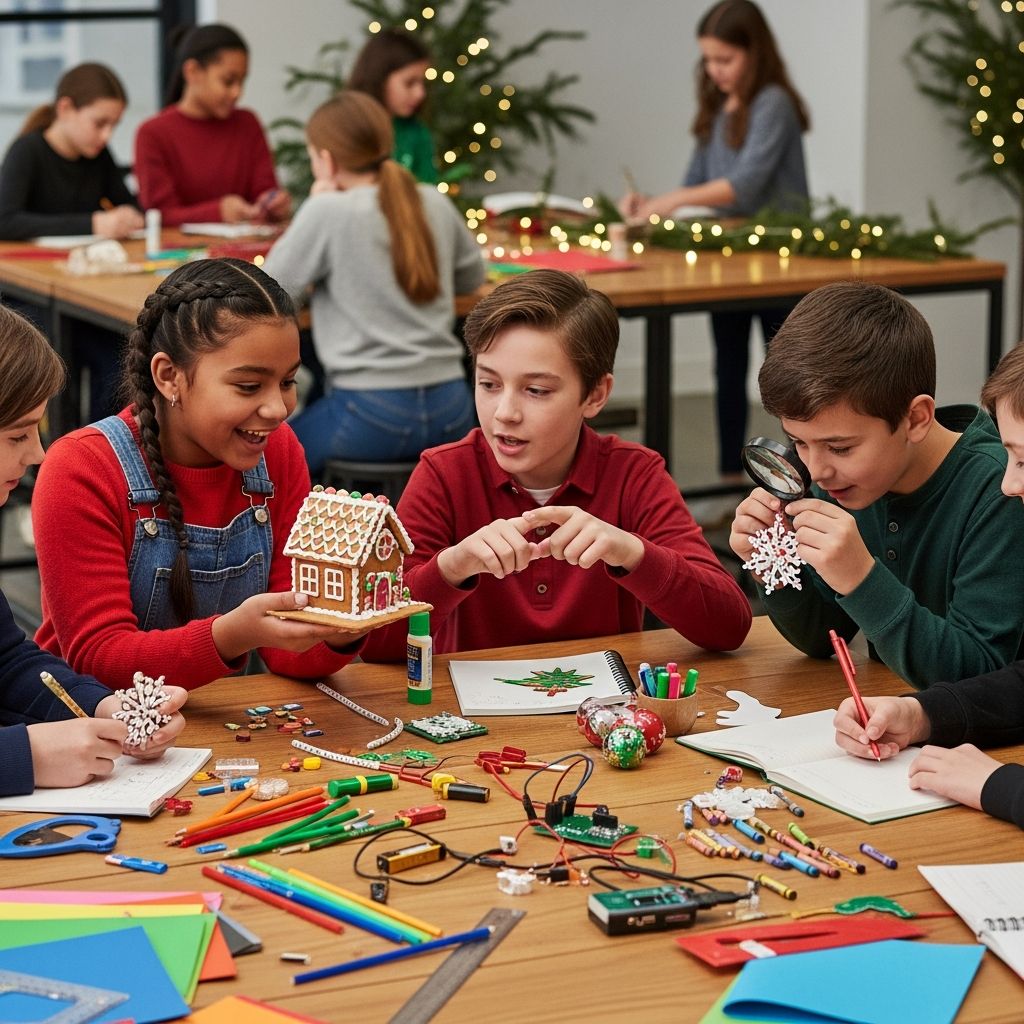
The weeks leading to winter break present both a challenge and an opportunity for educators. While shortened schedules and student excitement can disrupt routine instruction, this period also offers a unique window to implement thematic learning that captures student enthusiasm and reinforces core academic skills. Strategic integration of holiday-themed content into existing curricula allows teachers to maintain engagement while covering essential standards-based competencies across multiple disciplines.
Language Arts Explorations Through Holiday Literature
Literature-based instruction gains particular resonance when connected to seasonal narratives. Middle school students benefit from close reading exercises that explore timeless holiday stories, particularly those examining themes of generosity, sacrifice, and personal transformation. Classic texts such as O. Henry’s “The Gift of the Magi” provide rich opportunities for students to examine character motivation, conflict resolution, and the author’s intended message about materialistic values versus meaningful human connection.
Beyond traditional reading comprehension, these literary explorations enable teachers to weave in sophisticated language analysis. Students can examine how authors employ specific literary devices—metaphor, symbolism, and narrative perspective—to convey deeper meaning within familiar holiday settings. This approach simultaneously reinforces analytical reading skills while maintaining thematic consistency throughout the unit.
Creative Writing Frameworks Using Seasonal Prompts
Structured writing activities become more engaging when framed through holiday contexts. One effective approach involves using randomization tools—such as die rolls—to generate story components including characters, settings, and central conflicts. This technique democratizes the creative process by removing blank-page anxiety while still requiring students to synthesize elements into coherent narratives. Students might generate scenarios ranging from resourceful characters solving unexpected problems to humorous situations arising from unexpected circumstances during holiday celebrations.
The flexibility of these writing activities accommodates diverse learning preferences and output formats. Rather than requiring traditional written submissions exclusively, teachers can encourage alternative presentation methods including oral storytelling, dramatic performance, puppet theater, or multimedia presentations combining text with visual elements. This multimodal approach acknowledges that middle school students possess varied strengths and communication preferences.
Vocabulary Development and Grammar Skills Through Holiday Contexts
Linguistic instruction seamlessly integrates into seasonal activities through strategic exercises targeting specific language conventions. Analogy-based activities, for instance, combine vocabulary development with critical thinking as students complete visual puzzles using holiday imagery. Similarly, structured exercises exploring homophones and homonyms—presented through familiar seasonal texts—reinforce grammatical concepts while maintaining thematic coherence.
Word study activities benefit from the motivational boost provided by festive framing. Whether through color-by-number grammar exercises or specialized grammar worksheets incorporating holiday vocabulary, students maintain engagement with foundational language skills during a season when motivation typically fluctuates.
Science-Integrated Hands-On Explorations
The natural sciences offer exceptional opportunities for experiential learning when approached through seasonal perspectives. Holiday-themed STEM stations transform abstract scientific concepts into tangible, memorable learning experiences while maintaining rigor and standards alignment.
Chemistry and Physical Science Through Observable Phenomena
Temperature effects on material properties become immediately relatable when students investigate candy cane dissolution rates across varying water temperatures. This investigation directly illustrates fundamental principles of thermal energy while using materials that connect meaningfully to seasonal contexts. Students formulate predictions, design controlled experiments, collect quantitative data, and draw conclusions—engaging in authentic scientific practices.
Electrical circuits gain fresh appeal when students construct series and parallel configurations using miniature holiday lights to illuminate paper decorations. This hands-on approach to circuit design reinforces conceptual understanding of electrical flow while producing visually satisfying results that enhance classroom environment aesthetics.
Earth Science and Ecological Systems
Investigations into how seasonal changes affect ecosystems connect abstract ecological concepts to observable reality. Students might examine how evergreen trees contribute to environmental systems throughout their life cycles, or construct food webs featuring tundra organisms, explicitly connecting holiday imagery to broader biological principles. These activities bridge students’ existing holiday schema with new scientific knowledge, facilitating deeper conceptual understanding.
Physics Concepts Through Engineering Challenges
Engineering design challenges incorporating marshmallows as projectiles engage students in exploring potential and kinetic energy while requiring creative problem-solving. Similarly, parachute design tasks using coffee filters and string incorporate physics principles while maintaining appropriate complexity for middle school cognition. These activities naturally foster discussions about force, motion, and energy transfer within contexts that feel playful rather than tedious.
Building and Construction-Based Learning Activities
Three-dimensional construction projects simultaneously develop spatial reasoning, structural engineering concepts, and fine motor skills while producing artifacts that decorate classroom environments or serve as gifts.
Periodic Table Ornament Customization
Assigning each student responsibility for researching a specific periodic table element and creating a decorated ornament representation accomplishes multiple educational objectives simultaneously. Students engage in information literacy skills by researching element properties, conduct creative design processes, and develop ownership of their learning through personalized artifact creation. The collaborative classroom display—termed a “Chemistree”—reinforces periodic table familiarity while creating a visually striking environment that celebrates student work.
This activity scales flexibly depending on available materials and time. Lamination extends ornament durability, while alternative display methods (such as bulletin board arrangements) accommodate varying physical space constraints.
Structural Engineering Through Edible Materials
Tower-building competitions using marshmallows, candy, and toothpicks introduce engineering principles including load-bearing capacity, structural stability, and center-of-gravity concepts. These tactile experiences transform abstract physics into concrete, observable phenomena while accommodating students’ developmental need for kinesthetic engagement. The inherent competition and immediate visual feedback sustain motivation throughout the building process.
Comparative Literary Analysis and Modern Interpretation
Advanced middle school students benefit from comparative text analysis that positions classic holiday literature within contemporary contexts. Reading traditional poems such as “‘Twas the Night Before Christmas” alongside modern adaptations, parodies, or contemporary retellings develops analytical skills while validating students’ existing cultural knowledge.
Activities requiring students to identify language, imagery, or cultural references no longer current to contemporary audiences facilitate discussion about historical context and language evolution. Students might revise classic texts to reflect modern settings, transportation methods, or consumer goods, explicitly engaging in authorial decision-making processes as they make intentional word choices that preserve original meaning while updating surface details.
Character Development Through Debate and Discussion
Structured debates addressing holiday-themed premises develop argumentative reasoning, evidence evaluation, and perspective-taking skills. Rather than traditional competitive formats, collaborative discussion structures encourage students to explore multiple viewpoints regarding scenarios such as resource redistribution or ethical consumer practices within holiday gift-giving contexts. These discussions leverage students’ growing abstract reasoning capabilities while addressing authentic moral questions.
Creative Expression and Visual Arts Integration
Card-making projects incorporating written messages, visual design, and personal reflection accomplish affective objectives alongside skill development. The combination of intentional written composition describing admired qualities or wishes for recipients requires sophisticated emotional expression while maintaining age-appropriate accessibility. Creating cards for community members, classroom guests, or peers builds social-emotional competencies including perspective-taking and appreciation expression.
Movement-Based Learning Activities
The developmental reality that middle school students require increased physical movement and kinesthetic engagement can inform activity design. Games incorporating movement—from snowball races (using paper or cloth projectiles) to target-toss activities—provide essential physical outlets while maintaining curricular connection through physics discussions about trajectory, force application, and target prediction.
Differentiation Strategies for Heterogeneous Learners
Holiday activities offer natural opportunities for differentiation addressing varied student readiness levels, learning preferences, and access needs. Strategic scaffolding such as sentence frames for written responses, visual organizers for comprehension tasks, or simplified experiment procedures ensures that modified learning experiences maintain cognitive demand appropriate to individual students’ developmental levels. Extension activities for advanced learners—including experimental variations, enhanced research requirements, or peer teaching opportunities—sustain challenge for students demonstrating accelerated understanding.
Alternative presentation formats, material choices, and performance settings accommodate diverse learner profiles while maintaining consistent learning objectives across differentiated implementations.
Assessment Approaches for Seasonal Learning
Authentic assessment methods prove particularly valuable when evaluating holiday-themed learning activities. Rather than exclusively relying on traditional tests, teachers can employ performance tasks, artifact analysis, peer feedback, and student self-reflection to gauge conceptual understanding and skill development. Rubrics explicitly valuing creativity, collaboration, and problem-solving alongside content mastery acknowledge the multifaceted nature of student learning during interdisciplinary units.
Creating Inclusive Holiday Experiences
Thoughtful implementation of seasonal activities demonstrates cultural responsiveness by acknowledging that not all students celebrate Christmas or value similar holiday traditions. Incorporating diverse cultural celebrations, emphasizing secular scientific and literary themes, and allowing student choice regarding participation levels ensures that activities feel welcoming and accessible rather than exclusionary. Activities framed around universal themes such as gift-giving, family connection, or seasonal change transcend specific religious or cultural contexts while maintaining festive engagement.
Classroom Environment Enhancement Through Seasonal Decoration
Strategic environmental modifications—including holiday lighting, seasonal displays of student work, and thematic classroom reorganization—influence student mood, engagement, and psychological comfort. These environmental elements, when combined with meaningful curricular activities, create cohesive learning experiences that students perceive as qualitatively different from routine instruction while remaining fundamentally connected to established learning objectives.
Frequently Asked Questions
Q: How can I implement holiday activities while maintaining academic rigor?
A: Design activities that explicitly align to specific content standards and learning objectives. Use thematic framing as a vehicle for teaching core concepts rather than substituting entertainment for instruction. Include intentional assessment methods that measure progress toward identified learning targets. This approach maintains cognitive demand while increasing motivational engagement through seasonal contexts.
Q: What accommodations ensure holiday activities remain inclusive?
A: Offer choice regarding participation in specifically religious activities, emphasize secular scientific and literary content, incorporate diverse cultural celebrations, and allow students to modify assignments to reflect their own family traditions. Frame activities around universal themes rather than specific holidays when possible, and communicate with families about planned activities to address concerns or suggest modifications.
Q: How should I manage classroom behavior during increased seasonal excitement?
A: Channel student energy through structured, movement-based activities rather than attempting to suppress enthusiasm. Clear expectations, consistent routines, and consistent consequences maintain classroom management effectiveness. Incorporate choice, collaborative structures, and hands-on engagement to sustain focus on academic tasks rather than off-task social behavior.
Q: Can holiday activities work for advanced or below-grade-level learners?
A: Yes, through intentional differentiation. Provide varied entry points (simplified or enriched variations), flexible grouping structures, scaffolded supports or extension challenges, and multiple means of demonstrating learning. The thematic framework remains consistent while cognitive demands adjust to individual learner needs.
Q: What materials or resources do these activities require?
A: Most activities utilize readily available materials including craft supplies, household items, or low-cost consumables. Many can be adapted using substitute materials based on school budget or supply availability. Digital resources and free downloadable materials address resource constraints for under-resourced schools.
References
- Christmas Science Activities for Your Middle School Class — Secondary Sparks. 2024. https://secondarysparks.com/christmas-science-activities/
- Fun Christmas Activities for School — Houghton Mifflin Harcourt. 2024. https://www.hmhco.com/blog/fun-christmas-classroom-activities-for-school
- 8 Holly Jolly Christmas Activities for Middle School ELA — Hey Natayle. 2024. https://heynatayle.com/christmas-activities-for-middle-school-ela/
- Engaging Christmas STEM Activities for Middle School — I’m the Chef Too. 2024. https://www.imthecheftoo.com/blogs/stem-for-kids/festive-fun-engaging-christmas-stem-activities-for-middle-school
- 55 Low-Prep Christmas & Holiday Activities for Middle School — Twinkl. 2024. https://www.twinkl.com/blog/55-christmas-and-holiday-activities-for-6th-7th-and-8th-grade

Medha Deb is an editor with a master's degree in Applied Linguistics from the University of Hyderabad. She believes that her qualification has helped her develop a deep understanding of language and its application in various contexts. Medha specializes in the areas of beauty, health, sports, and wellness and is committed to ensuring that the content on the website is…