
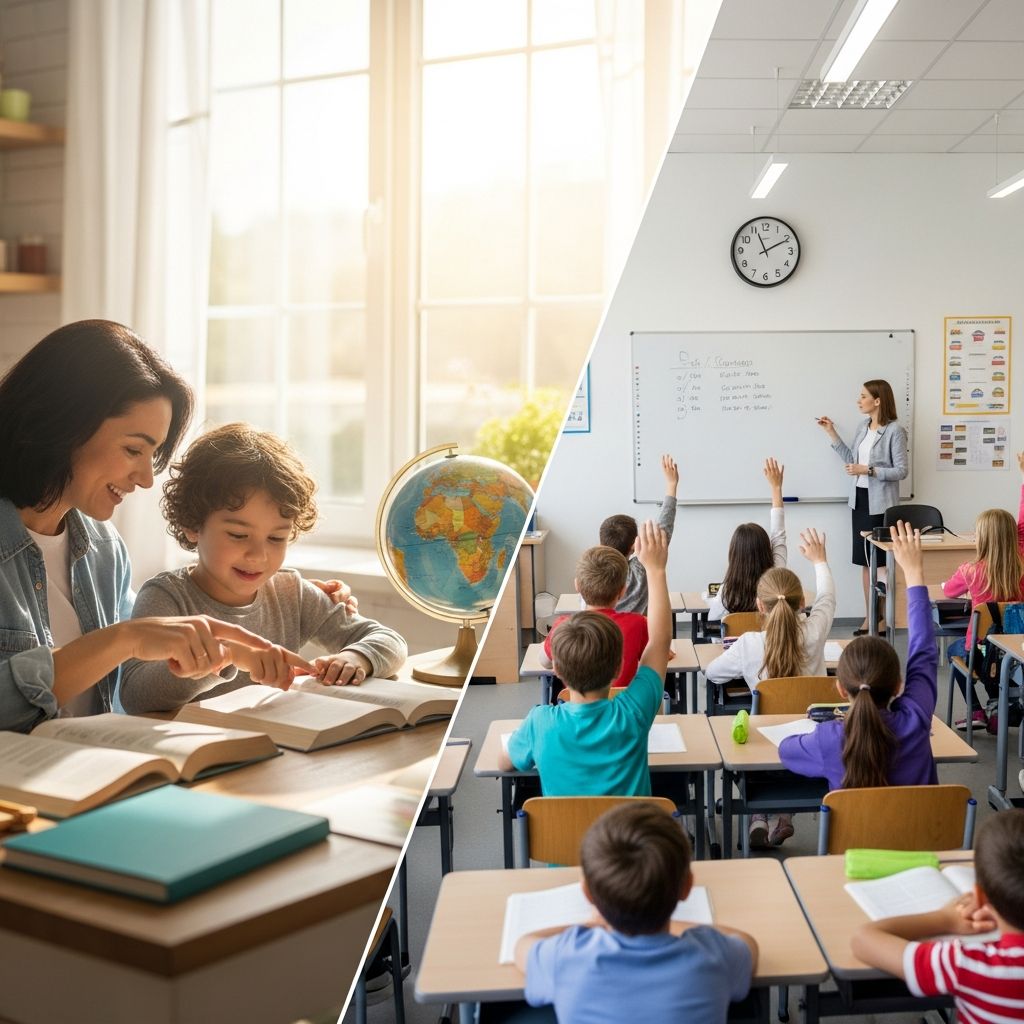
Parents today face a pivotal decision in their child’s education: whether to opt for homeschooling or public schooling. This choice shapes academic growth, social development, and family dynamics. Homeschooling provides tailored learning experiences at home, while public schools deliver structured education with professional oversight. Understanding the strengths and challenges of each helps families align education with their values and child’s needs.
Defining the Two Educational Paths
Homeschooling involves parents or guardians teaching children directly, often using customized curricula that adapt to individual paces and interests. This method emphasizes flexibility, allowing integration of real-world experiences into daily lessons. In contrast, public schooling enrolls students in government-funded institutions where certified teachers follow standardized programs designed to meet state benchmarks. These schools serve millions, fostering a communal learning environment with diverse resources.
Public schools educate approximately 49.4 million students across the U.S., according to the National Center for Education Statistics. Meanwhile, about 3.7 million children, or 6.73% of school-age kids, are homeschooled as of 2024. These numbers highlight the scale of public education alongside the rising popularity of home-based alternatives.
Academic Outcomes and Performance Metrics
Academic results vary between the approaches, with data showing distinct advantages. Homeschooled students often excel on standardized tests, scoring 15-25 percentile points higher than public school peers. Their average SAT score reaches 1190, compared to 1060 for public school students. College graduation rates also favor homeschoolers at 67%, versus 59% for public graduates. However, public school high school graduation stands at 91%, higher than the 66.7% for homeschooled students.
These statistics suggest homeschooling supports accelerated learning for motivated students, while public schools ensure broader completion rates through structured progression. Homeschoolers benefit from personalized pacing, enabling advanced learners to progress quickly or struggling ones to build foundations without peer pressure. Public schools align with state standards, preparing students for standardized assessments and future benchmarks.
| Metric | Homeschool | Public School |
|---|---|---|
| Standardized Test Percentiles | 15-25 points higher | Baseline |
| Average SAT Score | 1190 | 1060 |
| College Graduation Rate | 67% | 59% |
| High School Graduation Rate | 66.7% | 91% |
Flexibility and Customization in Learning
Homeschooling shines in its adaptability. Parents craft schedules around family life, incorporating travel, hobbies, or seasonal activities into education. Lessons match a child’s learning style—visual, kinesthetic, or auditory—fostering deeper engagement. This suits gifted students accelerating through math or those needing extra time in reading.
Public schools operate on fixed calendars with set hours, limiting personalization. While electives and advanced placement classes offer some choice, the core curriculum follows uniform pacing for entire classes. This structure builds discipline and time management but may frustrate students who learn at different speeds.
- Homeschool Flexibility: Custom schedules, integrated field trips, pace adjustment.
- Public School Structure: Predictable routines, group pacing, standardized progression.
Socialization and Peer Interactions
A common concern for homeschooling is socialization, yet evidence counters this myth. Homeschooled children engage through co-ops, sports leagues, church groups, and community classes, often interacting across age groups for mature social skills. Studies indicate high psychological well-being and socialization levels among them.
Public schools provide daily immersion with diverse peers, teaching conflict resolution, teamwork, and cultural awareness via group projects and events. This mirrors workplace dynamics but can include challenges like bullying in larger settings.
Both environments build essential skills; homeschooling requires proactive planning, while public schools offer organic opportunities.
Support for Diverse Learners
Children with special needs receive varied support. Public schools mandate Individualized Education Programs (IEPs), speech therapy, and specialized staff, ensuring legal compliance and professional intervention. These resources prove vital for disabilities or language barriers.
Homeschooling allows bespoke strategies, like sensory breaks or therapy-integrated lessons, ideal for neurodiverse kids. Parents access some public services in certain states, but success hinges on family initiative and external experts.
Access to Resources and Facilities
Public schools boast labs, gyms, libraries, and arts studios, funded publicly at no direct cost to families. Extracurriculars like band or robotics enhance resumes and skills.
Homeschoolers leverage home setups, online tools, museums, and co-ops. Costs vary, but creativity expands options beyond traditional facilities. Public education eases financial burdens, freeing budgets for tutoring or activities.
Parental Role and Time Commitment
Homeschooling demands parents as primary educators, requiring planning, teaching, and record-keeping. This deep involvement correlates with strong outcomes but suits stay-at-home or flexible schedules. Public schooling shifts teaching to professionals, with parents focusing on support like homework or volunteering. This appeals to working families.
Financial Considerations
Public schools are tuition-free, though taxes fund them. Additional expenses include supplies and fees. Homeschooling incurs curriculum costs ($500-$2500 yearly), though cheaper than private options. Savings come from no commuting or uniforms.
| Aspect | Homeschool Costs | Public School Costs |
|---|---|---|
| Tuition | $500-$2500/year | $0 |
| Supplies/Activities | Variable (co-ops, online) | Fees for sports/clubs |
| Overall | Potentially lower long-term | Tax-funded, accessible |
Family Lifestyle and Values Alignment
Choose based on lifestyle. Active families value homeschool travel flexibility; structured ones prefer school routines. Align with values—homeschooling integrates faith or ethics seamlessly, while public schools expose diverse viewpoints. Assess local school quality; strong districts favor public enrollment.
Hybrid Options and Transitions
Blends exist: homeschool part-time with public classes or sports. Switching is feasible—many states allow easy enrollment changes. Trial periods help test fit.
Frequently Asked Questions
What are the main benefits of homeschooling?
Homeschooling offers personalized pacing, flexible schedules, and alignment with family values, leading to higher test scores for many students.
Do homeschooled kids miss out on socialization?
No, they participate in co-ops, sports, and groups, often developing strong social skills across ages.
Are public schools better for special needs?
Yes, they provide IEPs and specialists, though homeschooling allows custom approaches.
How much does homeschooling cost?
Average $500-$2500 annually for materials, less than private schools.
Can I switch from homeschool to public school?
Yes, most states permit transitions with placement testing.
Which is better for college prep?
Homeschoolers often have higher SATs and graduation rates, but public schools offer structured transcripts.
References
- Homeschool vs Public School: Pros, Cons & Key Differences — Outschool. 2024. https://outschool.com/homeschool/vs-public-school
- Exploring Homeschooling vs Public School: Pros and Cons — The School House. 2024. https://www.theschoolhouse.org/post/homeschool-vs-public-school-pros-cons
- Public School vs. Homeschool Statistics: A Comprehensive Analysis — Crown Counseling. 2024. https://crowncounseling.com/statistics/public-school-vs-homeschool/
- Homeschool vs Public School: Key Differences Explained — Common Sense Press. 2024. https://commonsensepress.com/homeschool-vs-public-school-a-complete-comparison/
- Homeschool vs Public School — Classical Conversations. 2024. https://classicalconversations.com/blog/homeschool-vs-public-school/

- Integrated M.A. in Applied Linguistics, University of Hyderabad
- 5+ years in editorial, instructional, SEO, and research-based writing
Sneha is a relationships and lifestyle writer with a strong foundation in applied linguistics and certified training in relationship coaching. She brings over five years of writing experience to theskillvault, crafting thoughtful, research-driven content that empowers readers to build healthier relationships, boost emotional well-being, and embrace holistic living. Her writing and insights reflect the belief that beauty, happiness, and wellness…