
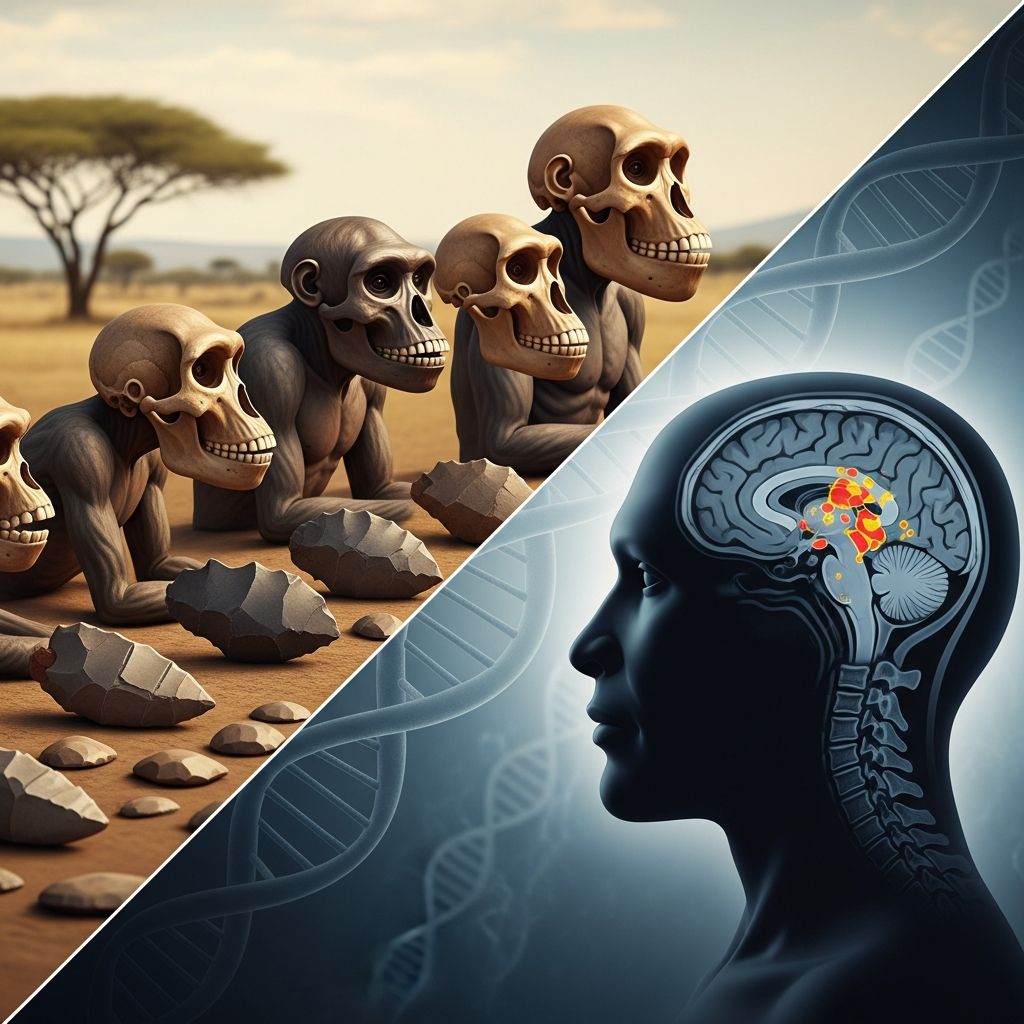
Hominins represent the branch of the primate family tree that includes modern humans and our closest extinct relatives, distinguished primarily by adaptations like bipedal locomotion and shifts in cranial morphology. Recent fossil analyses and phylogenetic studies have prompted a nuanced reassessment of what qualifies a species as a hominin, moving beyond simple bipedality to incorporate life history traits, dental evolution, and inner ear structures.
Distinguishing Hominins from Hominids
The terms hominin and hominid often cause confusion, but they denote distinct taxonomic groups. Hominids encompass the broader family of great apes, including humans, chimpanzees, gorillas, and orangutans, along with their ancestors. In contrast, hominins specifically refer to the lineage leading to modern humans, starting from the divergence with the chimpanzee line approximately 6-7 million years ago (mya).
This split occurred in Africa, where genetic evidence shows humans and chimpanzees sharing about 99% of DNA, underscoring a recent common ancestor. Hominins are characterized by bipedalism—walking upright on two legs—which freed hands for tool use and marked a pivotal evolutionary shift. Early hominins also exhibited dental changes, such as reduced canine size, signaling alterations in diet and social behaviors.
Core Anatomical Hallmarks of Hominins
Bipedalism stands as the defining feature of hominins, evident in skeletal adaptations like a centered foramen magnum (the skull’s base opening for the spinal cord), curved spine, and angled femur. These allow efficient upright posture and energy-saving gait compared to knuckle-walking apes.
Cranial trends further define hominin evolution:
- Increased cranial capacity: From under 400 cc in early forms to over 1,300 cc in modern humans, linked to cognitive advancements.
- Reduced prognathism: Flatter faces with less forward-jutting jaws.
- Diminished brow ridges and sagittal crests: Smoother foreheads and absence of crests for jaw muscle attachment.
- Smaller teeth and molars: Reflecting softer diets and cooking technologies later on.
- Expanded frontal lobes: Associated with planning and social complexity.
These changes appear progressively in the fossil record, painting a trajectory toward modern human anatomy.
Life History Evolution in Hominins
Beyond bones, hominin evolution involves protracted life histories—slower maturation, extended childhoods, and longer lifespans—contrasting great apes. The last common ancestor of humans and chimpanzees likely had a slow life history akin to modern apes, with weaning around 4-5 years and maturity at 12-15 years.
Hominins diverged by delaying maturity and extending post-reproductive life, reducing adult mortality and enabling grandmothering hypotheses for knowledge transfer. Fossil evidence from Homo heidelbergensis and Neanderthals suggests body sizes and dental development aligning with modern human paces, though samples are limited.
| Species/Group | Weaning Age (est.) | Maturity Age (est.) | Lifespan (est.) |
|---|---|---|---|
| Great Apes (LCA) | 4-5 years | 12-15 years | ~40 years |
| Early Hominins | ~5 years | ~15 years | ~45 years |
| Modern Humans | 2-3 years | 18+ years | 70+ years |
This table summarizes inferred shifts, drawn from demographic models and fossil proxies like dental eruption patterns.
Earliest Hominin Candidates
Fossils from 6-7 mya challenge and refine hominin status. Ardipithecus ramidus (4.4 mya) shows partial bipedalism with opposable big toes, yet forest-adapted. Australopithecus afarensis (Lucy, 3.2 mya) confirms full bipedality via knee and pelvis fossils, despite arboreal traits.
Earlier contenders like Sahelanthropus tchadensis (7 mya) have contested foramen magnum positions suggesting upright posture, though debated. These taxa bridge ape-like and human-like features, highlighting mosaic evolution.
Phylogenetic Debates and Inner Ear Evidence
Late Miocene great apes like Hispanopithecus and Rudapithecus prompt reassessments. Inner ear (bony labyrinth) morphology—semicircular canals (SCs)—reveals locomotor clues. African apes share short, bulgy SCs with right angles between anterior and posterior canals, differing from orangutans’ elongated forms.
These dryopithecins resemble African apes more than orangutans, but ancestral reconstructions show plesiomorphic (primitive) states, not conclusively placing them as stem hominins or hominids. Humans uniquely feature large anterior canals and displaced posterior portions.
Principal component analyses separate hominids (positive bgPC1) from gibbons, with humans extreme on bgPC2 due to rounded canals.
Major Hominin Genera and Trends
Australopithecus and Paranthropus
Australopithecus species (4-2 mya) varied ecologically: gracile forms like A. anamensis had mixed diets, while robust Paranthropus boisei specialized in tough vegetation, evident in massive jaws.
Early Homo
Homo habilis (2.3 mya) introduced stone tools (Oldowan), with brain sizes nearing 600 cc. Homo erectus (1.8 mya-100 kya) migrated globally, controlled fire, and achieved 1,000+ cc brains.
Archaic Humans
Neanderthals and H. heidelbergensis show modern-like life histories, with evidence of symbolic behavior and extended care for elderly.
Trends in height, brain volume, and tool complexity escalate dramatically post-2 mya.
Subnasal Morphology and Taxonomic Refinement
Facial regions like the subnasal area—below the nose—vary significantly. Recent developmental studies reassess fossil hominids, revealing patterns tying morphology to growth processes rather than just phylogeny. This aids distinguishing genera like Australopithecus from Homo.
Behavioral Indicators: Foresight and Culture
Archaeology reveals hominin cognition. Tool retention for future use signals planning, emerging by 2 mya in H. erectus. Later, symbolic artifacts indicate abstract thinking.
Frequently Asked Questions (FAQs)
What defines a hominin?
A hominin is any species in the human lineage post-chimpanzee divergence, marked by bipedalism and human-like traits.
When did bipedalism evolve?
Evidence points to 6-7 mya, with clearer signs by 4.4 mya in Ardipithecus.
How has brain size changed in hominins?
From ~350 cc in early australopiths to 1,350 cc in modern humans, driving intelligence.
Are Neanderthals hominins?
Yes, as extinct Homo species closely related to us.
What role does inner ear morphology play?
It informs phylogeny and locomotion, distinguishing hominid groups.
Future Directions in Hominin Research
Genomics, CT scans of petrous bones, and new African finds will further refine the hominin tree. Debates persist on species counts—dozens proposed—and exact divergence timings, but consensus grows on bipedalism’s primacy and gradual encephalization.
Lineage perspectives emphasize diagnosable fossil clusters over lumping, enhancing taxonomic precision.
References
- Hominin life history: reconstruction and evolution — Hawkes K, Smith RL. 2008-05-27. https://pmc.ncbi.nlm.nih.gov/articles/PMC2409099/
- 2. Hominin Evolution — Lemonade-Ed. Accessed 2026. https://www.lemonade-ed.com/level-3/3-6-human-evolution/2-hominin-evolution
- Reassessment of the phylogenetic relationships of the late Miocene… — Alba DM et al. 2021-01-12. https://www.pnas.org/doi/10.1073/pnas.2015215118
- Subnasal morphological variation in fossil hominids — McCollum MA. 2000-05. https://pubmed.ncbi.nlm.nih.gov/10813707/
- Archaeological evidence for thinking about possibilities in hominin… — Royal Society Publishing. 2022. https://royalsocietypublishing.org/rstb/article/377/1866/20210350/109108/Archaeological-evidence-for-thinking-about
- A lineage perspective on hominin taxonomy and evolution — Wiley Online Library. 2019. https://onlinelibrary.wiley.com/doi/full/10.1002/evan.22018

- Integrated M.A. in Applied Linguistics, University of Hyderabad
- 5+ years in editorial, instructional, SEO, and research-based writing
Sneha is a relationships and lifestyle writer with a strong foundation in applied linguistics and certified training in relationship coaching. She brings over five years of writing experience to theskillvault, crafting thoughtful, research-driven content that empowers readers to build healthier relationships, boost emotional well-being, and embrace holistic living. Her writing and insights reflect the belief that beauty, happiness, and wellness…