
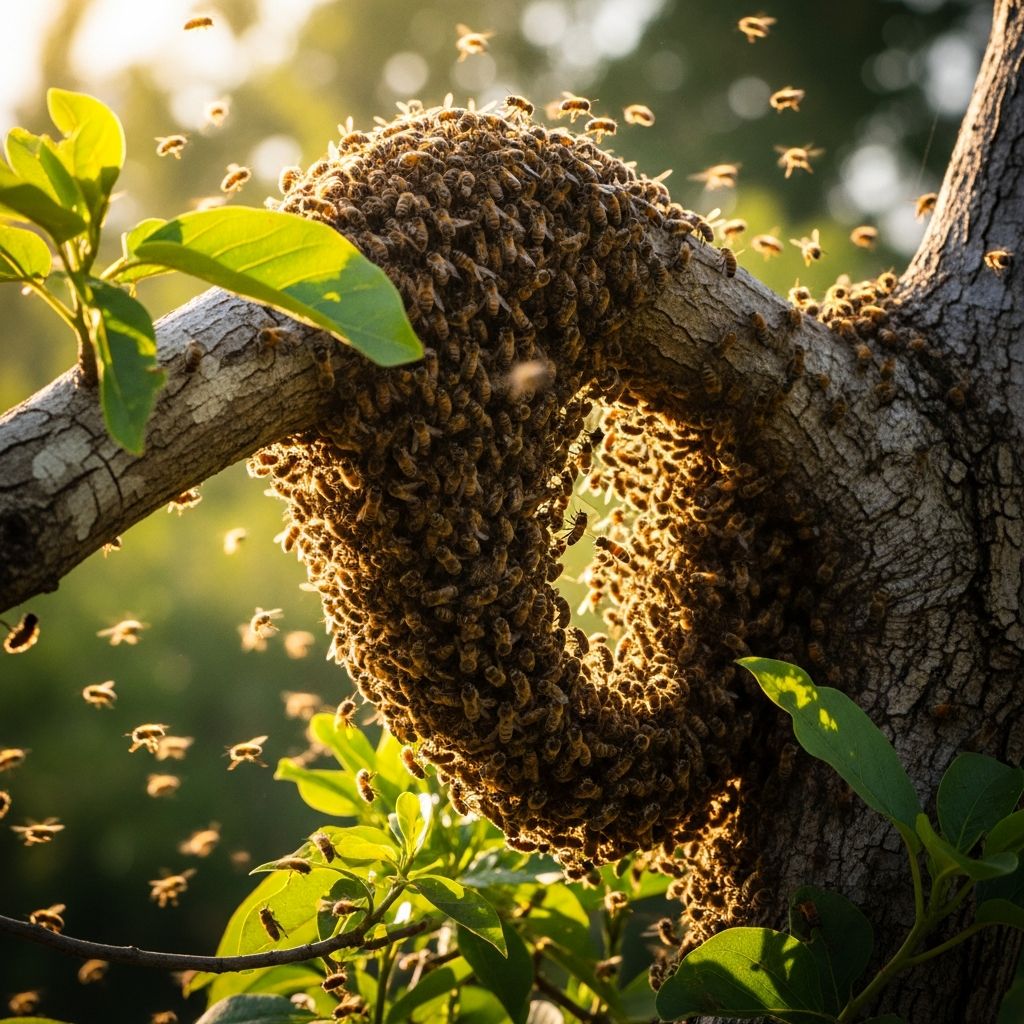
Honey bee swarming represents a fundamental reproductive mechanism where a single colony divides to form new ones, ensuring species propagation. This process typically unfolds in spring when nectar flows abundantly, prompting bees to address overcrowding through organized division.
The Biological Imperative Behind Swarming
At its core, swarming addresses hive congestion as populations surge. Colonies expand rapidly during peak foraging seasons, filling combs with brood, pollen, and honey until space constraints signal workers to initiate queen rearing for division.
Overcrowding triggers workers to construct special queen cells along comb edges, stocked with royal jelly to nurture potential new queens. This preparation allows the existing queen to depart with a substantial worker contingent, typically half to two-thirds of the hive’s population.
- Population Pressure: Rapid spring growth from abundant blooms leads to comb saturation.
- Resource Signals: Full honey stores and brood areas prompt reproductive splitting.
- Environmental Cues: Warm weather and nectar availability align with swarming peaks.
Step-by-Step: How a Swarm Forms and Departs
The sequence begins internally with queen cell construction. Eggs laid in these cups hatch into larvae fed royal jelly, accelerating development into virgin queens. Concurrently, the reigning queen reduces weight by fasting, enabling flight capability.
Workers engorge on nectar, storing it in honey stomachs for wax production post-swarm. As the first new queen nears emergence, the old queen exits amid a buzzing cloud, landing nearby on branches or structures to form a temporary cluster.
| Stage | Description | Key Players |
|---|---|---|
| Preparation | Queen cells built; queen slims down; bees load nectar. | Workers, old queen. |
| Departure | Old queen leads 50-70% of workers out. | All swarm bees. |
| Clustering | Bees form protective ball around queen. | Workers protect queen. |
Scout Bees: The Decision-Makers of the Swarm
Once clustered, scout bees—experienced foragers—embark on reconnaissance. They probe cavities like tree hollows, assessing volume, entrance size, and orientation via tactile measurements.
Returning scouts perform waggle dances on the cluster surface, encoding distance and direction to prospects. Through consensus—often 80% agreement—the swarm achieves democratic site selection, minimizing energy waste.
This vibration-based communication, studied extensively, ensures optimal nests around 40 liters in volume, shielded from elements.
Establishing the New Colony
Upon consensus, the swarm lifts off, guided by scouts, traveling up to a kilometer. Settling in the chosen site, workers exude wax from abdominal glands, rapidly drawing fresh combs.
The queen commences egg-laying within days, while foragers resume provisioning. Success rates are high due to pre-loaded resources sustaining the group for initial weeks.
Afterswarms and Multiple Divisions
Original hives may produce afterswarms if multiple queens emerge. The first virgin queen dispatches rivals by stinging cells, but survivors can lead secondary, smaller swarms—casts—with fewer bees.
These cascades continue until the hive stabilizes under a laying queen, replenishing numbers via her progeny.
Seasonal Patterns and Influencing Factors
Swarms peak in spring, tied to bloom cycles, though summer instances occur. Factors like poor ventilation, temperature extremes, or nectar shortages can accelerate the urge.
- Primary Trigger: Spring nectar surplus fueling exponential growth.
- Secondary Causes: Suboptimal hive conditions prompting relocation.
- Rarity in Fall: Limited resources deter division.
Are Swarms Dangerous? Debunking Myths
Swarming bees, engorged and focused on relocation, rarely sting. Lacking a hive to defend, their priority is queen protection and new home establishment.
Swarms appear alarming—dense, humming masses—but pose minimal threat. Ground clusters signal queen issues, warranting gentle handling by experts.
Beekeeper Strategies for Swarm Management
Preventive measures include providing extra space via supers, equalizing hive strengths, and young queen introduction to suppress swarming instincts.
Capture involves box placement under clusters, allowing natural entry. Relocated swarms thrive with starter strips for comb drawing.
Ecological Significance of Swarming
Swarming bolsters genetic diversity and wild population resilience, countering stressors like pesticides and habitat loss. Each event multiplies colonies, aiding pollination services.
Observing swarms underscores honey bees’ sophisticated sociality, evolved over millennia for survival.
Frequently Asked Questions (FAQs)
What should I do if I see a bee swarm?
Remain calm; swarms seldom sting. Contact local beekeepers for free removal rather than pesticides, preserving pollinators.
How long does a swarm cluster last?
Hours to days, until scouts select a site. Most relocate within 24-72 hours.
Can swarming be stopped in managed hives?
Yes, via space expansion, queen rotation, and monitoring queen cell formation.
Why do swarms sometimes fail?
Poor site choice, queen loss, or predation; scouts mitigate risks via consensus.
Do all bee species swarm?
Primarily honey bees; bumblebees and solitary species use different reproduction.
Observing Swarms Safely: Tips for Nature Lovers
Maintain distance, avoid vibrations or dark clothing mimicking predators. Photography from afar captures this marvel without disturbance.
Swarm sightings signal healthy ecosystems, blooming flora, and thriving apiaries.
References
- Why Do Bees Swarm? — Queen & Colony. 2019-03-08. https://www.queenandcolony.com/blog/2019/3/8/why-do-bees-swarm
- Why Do Honeybees Swarm? — YouTube (Educational Video). N/A. https://www.youtube.com/watch?v=sDZa3h5NFUc
- Honey Bees and Swarming: Understanding This Natural Phenomenon — University of Florida IFAS Extension. 2025-02-26. https://blogs.ifas.ufl.edu/volusiaco/2025/02/26/honey-bees-and-swarming-understanding-this-natural-phenomenon/
- Frequently Asked Questions About Honey Bee Swarms — Clemson University HGIC. N/A. https://hgic.clemson.edu/factsheet/frequently-asked-questions-about-honey-bee-swarms/
- When a Bee Swarm Is On The Ground — Foxhound Bee Company. N/A. https://www.foxhoundbeecompany.com/blogs/miscellaneous/when-a-bee-swarm-is-on-the-ground
- Swarming (honey bee) — Wikipedia (Background Reference). N/A. https://en.wikipedia.org/wiki/Swarming_(honey_bee)
- How to prevent a swarm when beekeeping — Flow Hive. N/A. https://www.honeyflow.com/blogs/beekeeping-basics/swarm-prevention
- Seeing Swarms of Honey Bees is a Good Thing — Purdue University Agriculture. 2022. https://ag.purdue.edu/department/btny/ppdl/potw-dept-folder/2022/honey-bee-swarm.html

- Integrated M.A. in Applied Linguistics, University of Hyderabad
- 5+ years in editorial, instructional, SEO, and research-based writing
Sneha is a relationships and lifestyle writer with a strong foundation in applied linguistics and certified training in relationship coaching. She brings over five years of writing experience to theskillvault, crafting thoughtful, research-driven content that empowers readers to build healthier relationships, boost emotional well-being, and embrace holistic living. Her writing and insights reflect the belief that beauty, happiness, and wellness…