
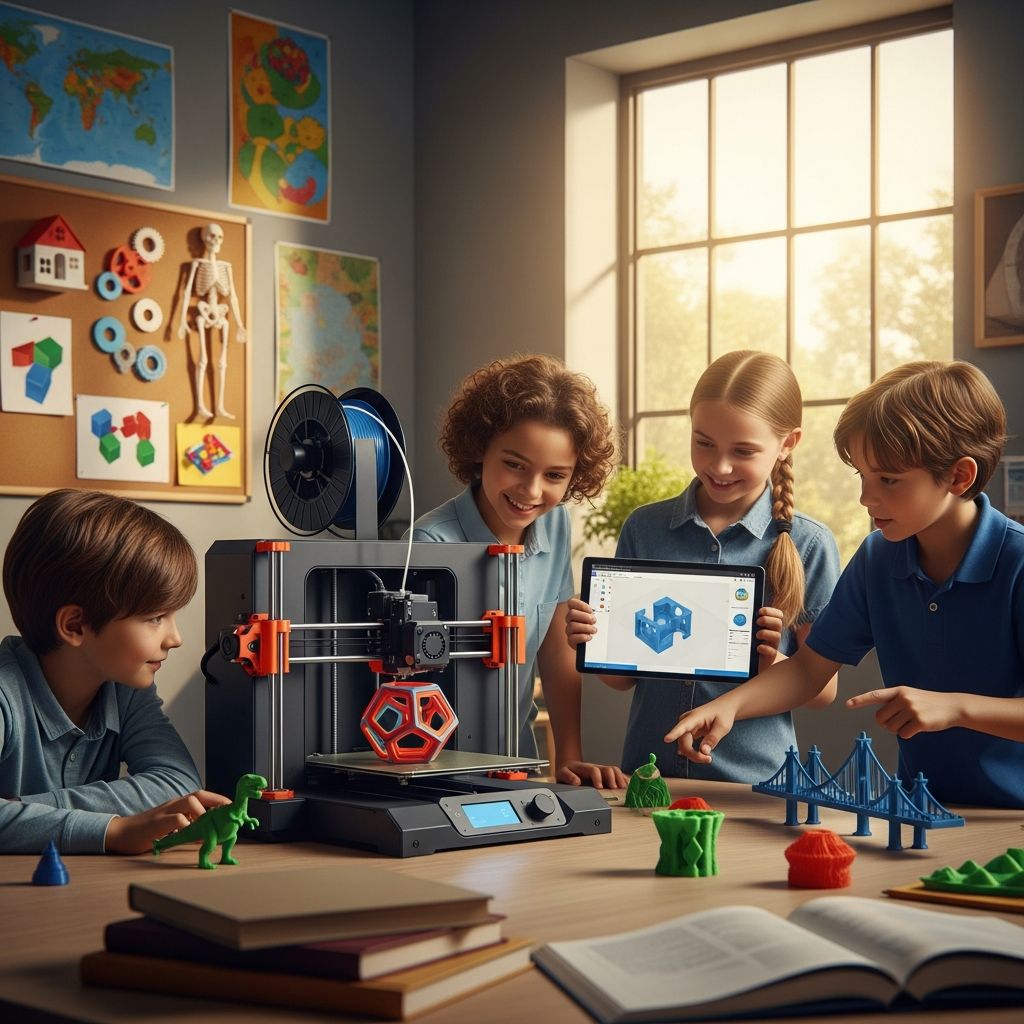
Revolutionizing Education Through Additive Manufacturing
The integration of 3D printing technology into educational settings represents a fundamental shift in how students engage with complex academic material. Rather than passively absorbing information through traditional lectures or textbook illustrations, learners now have the opportunity to physically interact with three-dimensional models that represent real-world objects and abstract scientific principles. This transformation extends across multiple academic disciplines, from mathematics and geometry to biology and chemistry, enabling educators to create immersive learning environments that cater to diverse learning styles and cognitive preferences.
The educational benefits of 3D printing extend beyond mere novelty. Research demonstrates that students who interact with physical models show significantly improved comprehension of spatial relationships, mathematical concepts, and scientific structures compared to their peers who rely exclusively on two-dimensional representations. The tactile engagement inherent in handling 3D-printed objects activates multiple sensory pathways in the brain, reinforcing neural connections and improving long-term retention of academic content.
Foundational Mathematics Through Physical Models
Elementary mathematics instruction traditionally relies on abstract number concepts that challenge young learners to visualize relationships and proportions that exist only in theory. 3D printing addresses this pedagogical challenge by translating mathematical principles into concrete, manipulable objects that students can examine from multiple angles and hold in their hands.
Geometric solids serve as an exceptional starting point for mathematical exploration. When students encounter a 3D-printed cube, rectangular prism, or pyramid, they can immediately count vertices, trace edges with their fingers, and understand facial relationships in ways that drawings or digital simulations cannot replicate. Color-differentiation techniques—printing various shapes in distinct colors or using multi-colored printing to distinguish different geometric properties—further enhance visual discrimination and classification skills.
Fraction instruction reaches new levels of clarity through transparent or semi-transparent resin printing technologies. Rather than struggling to conceptualize what one-quarter or three-eighths represents as an abstract mathematical ratio, students can physically stack quarter-blocks to demonstrate equivalency (4/4 = 1 whole) and visually compare different fractional quantities. This concrete representation bridges the cognitive gap between elementary intuition and abstract mathematical reasoning.
Mathematical tools themselves become customizable learning instruments through 3D printing. Students can design and print their own protractors with any desired size, precision markings, or visual enhancements. This personalization of measuring instruments transforms geometry lessons from passive instruction into active design experiences where students develop deeper understanding of angular measurement through the creative process of tool development.
Interactive Number Systems and Computational Practice
Counting foundations can be reinforced through 3D-printed abacuses that provide both visual and tactile feedback as students manipulate beads along rods to practice addition, subtraction, and place-value comprehension. The physical resistance and clicking sensation of beads moving along rods creates a multisensory learning experience that strengthens number sense and basic computational fluency.
Multiplication comprehension benefits similarly from customized number grids and puzzles that students can physically arrange and rearrange. Rather than memorizing multiplication facts through rote repetition, learners see visual patterns emerge as they fit together interlocking numerical blocks or arrange pre-printed multiplication table templates with removable number pieces. This visual pattern recognition activates different cognitive processing pathways than traditional memorization, potentially creating more durable and meaningful understanding of multiplicative relationships.
Life Science Concepts Made Visible and Tactile
Biology instruction frequently requires students to understand microscopic structures and complex three-dimensional relationships that cannot be adequately represented through photographs or diagrams. 3D printing transforms cellular components from abstract concepts into scaled-up models that preserve structural accuracy while making them visible and manipulable at human scales.
Cell nuclei, mitochondria, and other organelles can be printed to show relative sizes, spatial relationships, and structural features. Students examining a 3D-printed cell nucleus model can immediately grasp the comparative sizes of cellular components, understand how organelles fit within the cell’s spatial constraints, and visualize how cellular structures might function within a three-dimensional environment. This concrete representation particularly benefits students who struggle with spatial reasoning or who require tactile learning experiences to develop robust conceptual understanding.
DNA structure represents perhaps one of the most successful applications of 3D printing in biology education. The characteristic double helix configuration that students encounter in textbook diagrams becomes fully comprehensible when students can hold a 3D model in their hands, rotate it to examine the spiral orientation from different perspectives, and visualize how base pairs interlock within the structure. Color-coded base pairs—printed in different colors to represent adenine, thymine, guanine, and cytosine—further clarify the complementary pairing rules that govern genetic information storage.
Geography and Earth Systems Through Tangible Models
Traditional geography instruction relies heavily on flat maps that necessarily distort three-dimensional planetary features. 3D globe printing addresses this limitation by enabling students to feel topographical variations, mountain ranges, ocean trenches, and continental boundaries through direct tactile exploration. The raised features of a 3D-printed globe provide sensory input that flat maps cannot offer, creating embodied understanding of planetary geography that extends beyond visual recognition.
Plate tectonic theory—a concept that challenges many students because it requires visualizing continental movements across geological time—becomes more intuitive when represented through 3D puzzle models. Interlocking continental pieces that fit together to form the supercontinent Pangaea allow students to physically manipulate the components that have gradually separated over millions of years. This hands-on reconstruction of Earth’s geological history creates a kinesthetic memory that supports long-term retention and conceptual clarity.
Chemistry and Periodic Table Exploration
The periodic table presents significant cognitive challenges to chemistry students encountering it for the first time. Its complex organization, hundreds of elements, and multiple classification schemes overwhelm many learners who attempt to memorize this information as an abstract grid of symbols and numbers. 3D printing transforms this challenge into an opportunity for collaborative, creative learning.
When students design individual cubes representing specific chemical elements, they engage simultaneously with multiple dimensions of chemical knowledge: element names, atomic symbols, atomic numbers, and customized facts about element properties or historical significance. The physical construction of element cubes—potentially color-coded by chemical families—creates memorable associations between abstract information and tangible objects. When all student-designed cubes assemble into a complete 3D periodic table, the resulting structure provides visual and spatial organization that surpasses traditional flat representations in clarity and retention effectiveness.
Language Arts and Literacy Support
Beyond STEM disciplines, 3D printing supports language arts instruction through engaging literacy aids. Alphabet board games transform letter recognition from abstract symbol matching into interactive play-based learning. Students physically place letter pieces into corresponding slots, with color-coded or textured elements potentially enhancing differentiation for learners with varied needs. This multisensory approach to letter recognition strengthens neural pathways associated with phonetic awareness and symbol recognition.
Creative reading incentives like 3D-printed bookmarks—perhaps shaped as playful creatures or characters—provide tangible rewards for reading achievement while simultaneously supporting practical reading management. Bookmarks that clip or attach to pages offer functional utility alongside motivational appeal, transforming abstract literacy goals into concrete, personally meaningful objects.
Practical Applications and School Supply Innovation
Beyond academic subject instruction, 3D printing enables schools to create functional school supplies and organizational tools customized to specific classroom needs. Pencil organizers, desk storage solutions, and specialty supply holders designed and printed by students combine practical utility with creative engagement. This application of 3D printing extends beyond content mastery into developing student agency and problem-solving capabilities as learners identify genuine school challenges and design functional solutions.
Implementation Considerations for Educational Success
Successful classroom integration of 3D printing technology requires thoughtful planning beyond simply acquiring equipment. Educators benefit from established platforms and resources specifically designed for educational applications, such as classroom-specific software, pre-designed lesson templates, and curated model repositories optimized for pedagogical objectives rather than commercial applications.
Material selection significantly impacts both educational outcomes and safety considerations. Water-washable resins, user-friendly filament options, and non-toxic printing materials ensure classroom-appropriate safety profiles. Different materials offer varying aesthetic and functional properties—transparent resins for stacking fraction demonstrations, colored options for visual differentiation, and durable materials for frequently-handled learning models.
Professional development for educators proves essential for maximizing educational benefits. Teachers trained in effective 3D model design, integration into existing curricula, and troubleshooting technical challenges demonstrate greater success in translating 3D printing technology into improved student outcomes than those deploying the technology without adequate preparation.
Scaling and Sustainability in Educational 3D Printing
As more schools recognize the educational value of 3D printing, questions emerge regarding sustainable implementation across diverse educational contexts. Collaborative platforms enabling teachers to share tested models, lesson plans, and pedagogical strategies accelerate adoption while reducing individual teacher workload in model preparation and curriculum design. Online repositories of education-specific 3D models represent increasingly valuable resources that democratize access to quality instructional models across schools with varying technical expertise.
Community partnerships with local engineering firms, manufacturing businesses, and maker organizations provide schools with technical support, material resources, and authentic connections between classroom learning and professional applications. These partnerships often include site visits where students observe 3D printing applications in industrial settings, creating meaningful context for academic learning and career exploration opportunities.
Emerging Trends and Future Directions
3D printing technology continues evolving rapidly, with increasingly affordable desktop printers, faster printing speeds, and expanding material options expanding educational possibilities. Emerging applications include augmented reality integration where 3D-printed objects connect to digital content through scanning technology, creating hybrid learning experiences that combine physical object engagement with digital information access.
Student design and engineering experiences expand when 3D printing transitions from simply producing teacher-designed models to enabling student-directed design and fabrication. When learners conceptualize their own models, navigate design software, troubleshoot printing challenges, and iterate on designs based on physical prototype feedback, they develop agency, creative confidence, and problem-solving capabilities that extend far beyond any single academic discipline.
Frequently Asked Questions
Q: What age groups benefit most from 3D printing educational applications?
A: All age groups from pre-kindergarten through higher education benefit from 3D printing, though applications vary. Elementary students develop foundational spatial reasoning and concrete understanding of abstract concepts, middle school students explore more complex scientific and mathematical structures, and secondary students engage in engineering design and advanced model creation.
Q: How does 3D printing improve student comprehension compared to traditional teaching methods?
A: Physical models activate multiple sensory pathways simultaneously, creating stronger neural connections than visual-only instruction. Students can manipulate objects from different angles, feel textures and proportions, and kinesthetically explore concepts, leading to improved retention and more robust conceptual understanding.
Q: What materials are safest for classroom 3D printing?
A: Water-washable resins and non-toxic filament options designed specifically for educational use provide optimal safety profiles. These materials minimize exposure to volatile organic compounds and reduce cleanup complexity while maintaining excellent print quality and model durability.
Q: How can schools implement 3D printing with limited budgets?
A: Schools can begin with a single shared device serving multiple classrooms, prioritize the most impactful applications for their context, utilize free or open-source design software, and access pre-designed educational models through established repositories rather than creating every model from scratch.
Q: What staff training supports successful classroom 3D printing integration?
A: Teachers benefit from technical training in equipment operation, design software basics, model selection and optimization, troubleshooting common printing challenges, and pedagogical strategies for maximizing learning outcomes from 3D printing activities.
References
- 15+ 3D Printing Ideas for Students: Best STEM Projects 2026 — Siraya Tech. 2026. https://siraya.tech/blogs/news/3d-printing-ideas-for-students
- 12 Must-Have 3D Printing Ideas for Students [Back to School] — Creality. 2025. https://www.creality.com/blog/3d-printing-ideas-for-back-to-school
- 3D Printing in K-12 Classrooms — Lawrence University Makerspace. 2024. https://blogs.lawrence.edu/makerspace/3d-printing-in-education/3d-printing-in-k-12-classrooms/
- 3D printing at school: 6 projects for educators and students — Felfil. 2018. https://felfil.com/3d-printing-at-school-6-projects-for-educators-and-students/

- Integrated M.A. in Applied Linguistics, University of Hyderabad
- 5+ years in editorial, instructional, SEO, and research-based writing
Sneha is a relationships and lifestyle writer with a strong foundation in applied linguistics and certified training in relationship coaching. She brings over five years of writing experience to theskillvault, crafting thoughtful, research-driven content that empowers readers to build healthier relationships, boost emotional well-being, and embrace holistic living. Her writing and insights reflect the belief that beauty, happiness, and wellness…