
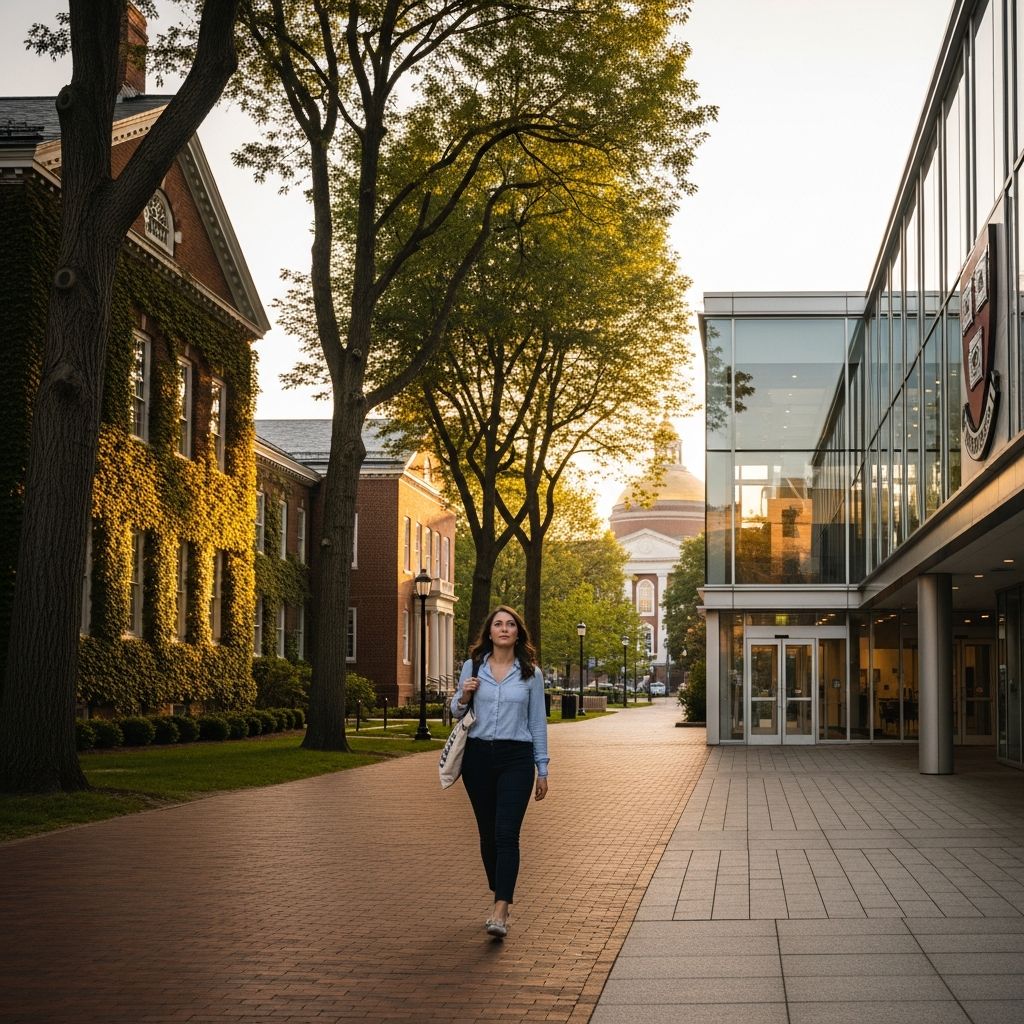
Behind every white coat is a story. For many women in medicine, that story is less about straight lines and perfect grades and more about exploration, doubt, persistence, and learning to trust their own voice. This article traces an inspired, composite journey of a woman who eventually enrolls at Harvard Medical School, highlighting the choices, missteps, mentors, and mindset shifts that make a modern medical career possible.
Use this narrative as a guide—not a checklist—to imagine your own route into medicine, whether you are a college student, career changer, or simply curious about what it really takes.
Discovering a Calling: When Interest Becomes Intention
Most doctors do not wake up at age five with a detailed plan to become a physician–scientist. Instead, the path usually begins with a blend of curiosity and exposure to human stories of illness and healing.
For our protagonist, the first spark came from three overlapping experiences:
- Family health challenges that made hospitals feel both frightening and fascinating.
- High school science classes where biology felt less like memorization and more like decoding a language of life.
- Volunteering at a local clinic, where she saw physician teams navigate complex medical and social needs.
These experiences did not deliver instant certainty, but they did raise a compelling question: Could medicine be the place where science, empathy, and real-world impact intersect?
College Years: Building a Foundation Without Losing Yourself
College is where interest in medicine meets the reality of prerequisites, grades, and institutional expectations. At a rigorous university, she quickly discovered that “premed” is less a major and more a demanding overlay on whatever academic path she chose.
Choosing a Major with Intention
Instead of defaulting to biology, she asked herself what would sustain her curiosity for four years. She chose a science concentration that combined cellular biology with public health, while keeping room for courses in literature and ethics. This balanced approach reflects guidance many schools now offer: major in a subject you love, while fulfilling the required premed coursework.
- Completed core sciences: general and organic chemistry, biology, physics, and biochemistry.
- Added social science and humanities courses to understand health in its social context.
- Protected time for writing-intensive seminars to refine communication skills.
Grades, Pressure, and Redefining Success
The premed environment was intense. Curved exams, late-night problem sets, and whispered MCAT score rumors could make each test feel like a referendum on her worth. She had semesters that went well and others that did not.
What changed the trajectory was a quiet decision: she would stop chasing a perfectly linear record and instead focus on evidence of growth. That choice mirrored how many modern medical schools evaluate applicants holistically, looking for resilience and upward trends rather than perfection alone.
Finding Her Place in the Lab: Research as a Turning Point
Her path shifted dramatically when she stepped into a research lab for the first time. What started as a part-time job to pay for textbooks became the center of her intellectual life.
Landing the First Research Role
She did not arrive on campus with publications or coding experience. Instead, she:
- Visited department pages to identify labs working at the intersection of genetics and disease.
- Sent concise, thoughtful emails to principal investigators describing her interests and schedule.
- Accepted an initial role washing glassware and preparing solutions, seeing it as an entry point, not a dead end.
Several months later, a postdoctoral mentor trusted her with her first independent experiment. That trust—and the inevitable failed experiments that followed—taught her the difference between learning from a textbook and learning from discovery.
What the Lab Really Taught Her
Working in the lab developed skills that would later matter in medical school as much as grades:
- Patience and persistence: Experiments failed more often than they succeeded, mirroring the uncertainty of clinical care.
- Collaborative work habits: She shared benches and data with graduate students, postdocs, and other undergraduates from diverse backgrounds.
- Scientific skepticism: She learned to question her own hypotheses and understand statistics, a crucial foundation for practicing evidence-based medicine.
These experiences align with the emphasis at institutions like Harvard Medical School on training physicians to interpret research and practice evidence-based care, not simply memorize facts.
Seeing Patients Up Close: Clinical and Community Experience
As much as she loved the lab, she knew research alone could not tell her whether she wanted to spend her life caring for patients. To answer that question, she pursued front-line exposure to healthcare settings.
Shadowing and Hospital Volunteering
She arranged shadowing experiences with physicians in internal medicine and pediatrics, observing how they:
- Explained complex diagnoses in simple language.
- Teamed up with nurses, social workers, and pharmacists.
- Balanced textbook knowledge with real-world constraints like insurance coverage and time limits.
She also volunteered in a hospital, supporting families in waiting rooms and assisting with non-clinical tasks on the wards. While she was not performing procedures, she was learning how the health system actually works—and where it falls short.
Community Engagement Beyond Campus
Recognizing that so much of health is shaped outside the hospital, she joined a community health program working with underserved neighborhoods. There, she:
- Helped organize health education workshops in multiple languages.
- Collaborated with local organizations on topics like nutrition, housing, and mental health.
- Saw how structural inequities and policy decisions show up as clinic visits and emergency room admissions.
This broader lens matched what modern medical curricula increasingly prioritize: understanding social determinants of health, healthcare policy, and team-based care alongside biomedical science.
Navigating the Application Gauntlet
Despite her experiences, the application process was daunting. Like many applicants, she worried that one misstep would end her dream. Instead, she learned to treat the process as a structured opportunity to tell a coherent story.
Shaping a Narrative Instead of Listing Achievements
She began by asking three questions:
- What experiences have shaped the way I understand illness and healing?
- How do my research and community work connect to the type of physician I hope to become?
- Where have I failed or struggled, and what did I learn?
Her personal statement focused less on a single dramatic moment and more on the quiet accumulation of insight—from late nights in the lab to early mornings at the clinic. She highlighted:
- Intellectual curiosity fueled by research.
- Commitment to service shown through long-term volunteer work.
- Resilience developed after academic setbacks and personal challenges.
Preparing for Interviews
When interview invitations arrived, she practiced with mentors and friends, focusing on clarity and authenticity rather than memorized scripts. She prepared to discuss:
- Specific research projects, including limitations and unexpected findings.
- Ethical dilemmas she had observed in clinical settings.
- Her understanding of the evolving role of physicians in team-based, technology-rich healthcare environments.
She also researched the structure of each school’s curriculum. At Harvard, for example, she learned about the Pathways track, which emphasizes small-group, case-based learning, early clinical exposure, and integrated science. That knowledge allowed her to ask concrete questions and demonstrate genuine interest.
Arriving at Harvard Medical School: Expectations vs. Reality
Getting the acceptance letter did not end her doubts; it simply began a new chapter. Harvard Medical School’s curriculum is designed around early patient contact, active learning, and integration of clinical medicine with basic and social sciences.
| Expectation | What She Found |
|---|---|
| Mostly lectures and note-taking | Case-based sessions, flipped classrooms, and team problem-solving where passive memorization is not enough. |
| Two preclinical years before seeing patients | Clinical exposure within the first 14 months, with skills courses running alongside scientific foundations. |
| Focus solely on basic science | Integration of policy, health systems, ethics, and social determinants throughout the curriculum. |
| Solitary competition | Intense workload, but strong reliance on study groups, peer teaching, and team-based projects. |
Learning in the Pathways Era
Under the Pathways curriculum, she moved through an arc of training that combined classroom learning with progressively deeper clinical immersion:
- Preclerkship phase: Foundations in human biology, pathophysiology, and clinical skills, often in small-group discussions rather than large lectures.
- Principal Clinical Experience: Core clerkships across medicine, surgery, pediatrics, psychiatry, and more, beginning earlier than in traditional models.
- Advanced experiences: Electives, sub-internships, and scholarly projects that allowed her to dive deeper into research and specialty interests.
This structure reflected broader national trends in medical education: moving away from rote memorization, shortening the classroom-only phase, and emphasizing active learning and early patient care.
Being a Woman in Medicine: Bias, Belonging, and Leadership
While women now make up roughly half of medical students in the United States, they remain underrepresented in many senior leadership and academic positions. Our protagonist encountered both subtle and overt signals that shaped her sense of belonging.
Recognizing Barriers Without Being Defined by Them
She noticed patterns—being mistaken for a nurse or administrator, having her questions ignored until repeated by male peers, or feeling pressure to downplay ambition. Rather than accepting these as personal failures, she:
- Sought mentors, including women and allies in leadership roles, who could share concrete strategies for navigating bias.
- Joined student groups focused on gender equity and diversity in medicine.
- Learned to document and address problematic behavior through institutional channels when necessary.
Redefining Leadership
She initially imagined leadership as a formal title. Over time, she came to see it instead as:
- Advocating for patients who are not being heard.
- Mentoring younger students from backgrounds historically excluded from medicine.
- Contributing to research and quality improvement projects that reshape how care is delivered.
This broader definition matches evolving views within academic medicine, where leadership is increasingly recognized in education, community engagement, and systems improvement—not only in traditional hierarchical roles.
Lessons for Aspiring Physicians: What She Wishes She Had Known
Looking back, she can see a few themes that mattered more than any single exam or accolade.
1. Curiosity Is a Better Guide Than Fear
Many of her best decisions—joining a lab, shadowing in a new specialty, exploring public health—came from following curiosity rather than chasing what she thought admissions committees wanted.
2. Progress Is Nonlinear (and That’s Normal)
She experienced academic setbacks, rejections from programs, and burnout. Each turning point came when she:
- Asked for feedback instead of suffering in silence.
- Adjusted her study strategies and time management.
- Allowed herself to rest and recalibrate instead of powering through endlessly.
3. Relationships Are as Important as Résumés
Mentors, peers, and collaborators opened doors she did not know existed. Strong letters of recommendation grew out of years of consistent work and honest conversations, not brief transactional meetings.
4. Medicine Is a Team Sport
From her first team-based learning sessions to interprofessional clinical experiences, she saw that no physician practices alone. Learning to listen, share responsibility, and communicate clearly proved as critical as mastering pharmacology or anatomy.
Practical Takeaways for Your Own Path
If you are thinking about a path similar to hers, consider these actionable steps:
- Clarify your motivation: Journal about why you are drawn to medicine. Revisit this during difficult semesters.
- Seek layered experiences: Aim for a mix of research, clinical exposure, and community engagement over time.
- Cultivate mentors early: Show up consistently, ask thoughtful questions, and be reliable; mentorship often follows.
- Accept imperfection: A single grade, gap year, or career change does not define your candidacy.
- Learn the landscape: Read about curricula, like Harvard’s Pathways and HST tracks, to understand how modern training is structured and where you might fit.
Frequently Asked Questions (FAQs)
Q1: Do I need to attend an elite college to reach a top medical school?
No. Medical schools accept students from a wide range of institutions. Committees look for academic excellence, meaningful experiences, and evidence of growth, not a specific school name. Strong performance and engagement wherever you are can be more important than institutional prestige.
Q2: How important is research for medical school admission?
Research is not strictly required everywhere, but it is highly valued at research-intensive schools like Harvard. Admissions offices look for applicants who can interpret evidence, appreciate uncertainty, and contribute to advancing medical knowledge. Clinical experience and community engagement remain equally important components of a balanced profile.
Q3: What if my grades are not perfect?
Few successful applicants have a flawless record. Committees often pay attention to trends over time, course rigor, and how you responded to challenges. Demonstrating improvement, seeking help, and reflecting on what you learned from setbacks can strengthen your application more than isolated high grades.
Q4: How can I find mentors if I’m the first in my family to pursue medicine?
Start with professors, teaching assistants, and advisors who seem invested in students’ success. Attend office hours, join departmental events, and ask about research or service opportunities. Many medical schools and universities now have dedicated programs for first-generation and underrepresented students interested in health careers.
Q5: Is it possible to explore other interests and still be a competitive applicant?
Yes. Diverse interests—such as humanities, arts, policy, or entrepreneurship—can enrich your perspective and make you a more compelling candidate. The key is depth and continuity: it is better to pursue a few areas seriously over time than to scatter your efforts across many short-term activities.
References
- Medical School Overhauls Curriculum With Major Redesign — The Harvard Crimson. 2015-09-02. https://www.thecrimson.com/article/2015/9/2/hms-curriculum-major-revamp/
- Harvard Medical School — Harvard University / HMS. (Curriculum section, various updates). https://hms.harvard.edu/education-admissions/md-program/curriculum
- Pathways Curriculum Map — Harvard Medical School Program in Medical Education. 2025-10. https://hms.harvard.edu/sites/default/files/2025-10/pathways_curriculum_map.pdf
- Pathways — Harvard Medical School. (Curricular track overview, various updates). https://hms.harvard.edu/education-admissions/md-program/curriculum/pathways
- MD Program — Harvard Medical School. (Program overview, various updates). https://hms.harvard.edu/education-admissions/md-program
- How to Get Into Harvard Medical School: The Definitive Guide (2024) — MedEdits/MedicalAid.org. 2024-01-10. https://medicalaid.org/blog/how-to-get-into-harvard-medical-school/

Medha Deb is an editor with a master's degree in Applied Linguistics from the University of Hyderabad. She believes that her qualification has helped her develop a deep understanding of language and its application in various contexts. Medha specializes in the areas of beauty, health, sports, and wellness and is committed to ensuring that the content on the website is…