
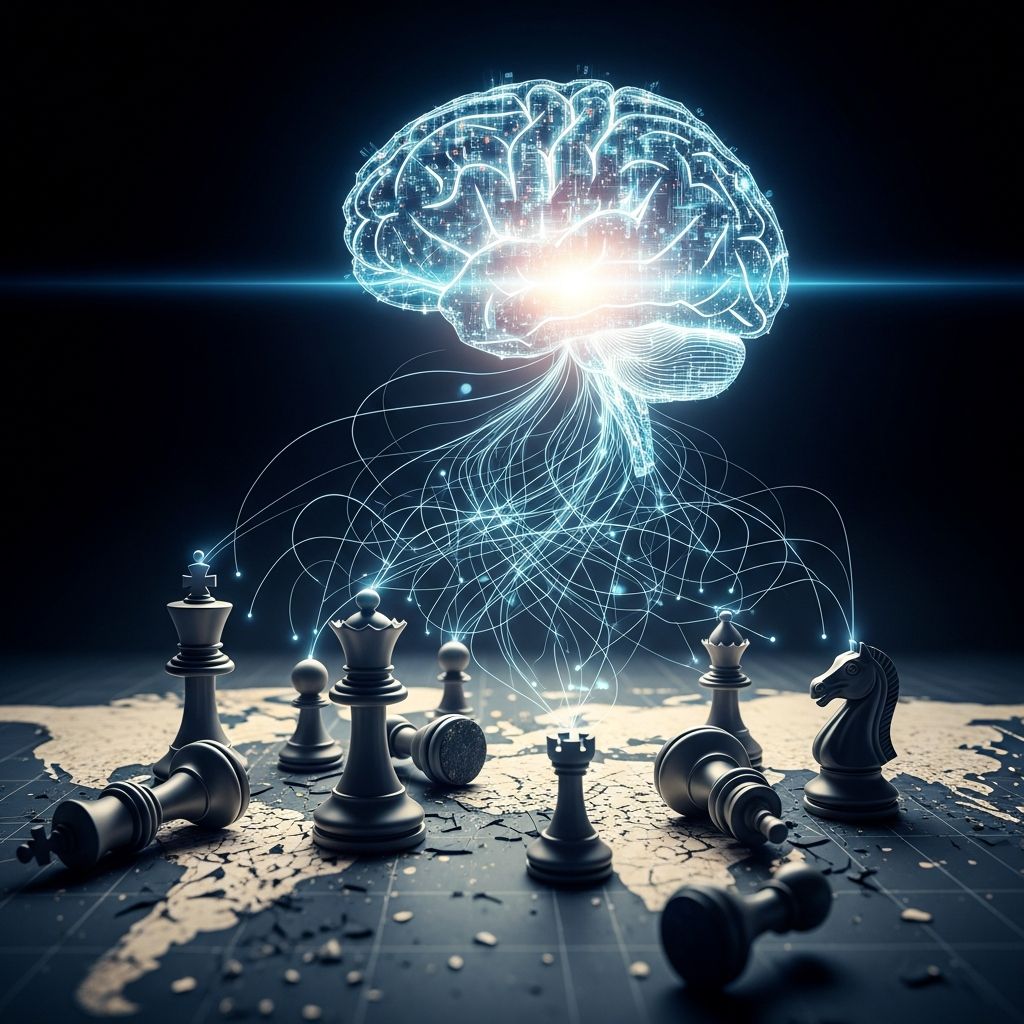
Advanced artificial intelligence will not just change how we work and communicate; it may also reshape who holds power, how they get it, and how they keep it. This article explores a disturbing but crucial question: could AI make it dramatically easier for a small group of humans to seize or entrench political power — and what can be done to prevent that?
Why AI-Enabled Power Grabs Deserve Serious Attention
When people worry about AI and politics, they often picture rogue superintelligences taking control directly. But a more immediate concern is AI as a force multiplier for ambitious people and factions who want more power than they can currently obtain through normal political or legal means.
- Authoritarian leaders could use advanced AI to monitor citizens, identify opponents, and crush dissent more efficiently than any past regime.
- Military or intelligence insiders might leverage AI to coordinate a swift coup, manipulate communications, or disable critical infrastructure.
- Corporations or non-state groups could deploy AI to influence elections, control information flows, or coerce decision-makers behind the scenes.
History shows that democratic backsliding and coups are not rare events. Political scientists have documented hundreds of coup attempts since the mid-20th century, with significant success rates in some regions. As tools for surveillance, persuasion, and cyber operations become more powerful, the “barriers to entry” for seizing power could fall.
From Traditional Coups to AI-Accelerated Seizures of Power
To understand how AI could change political power struggles, it helps to contrast traditional coups with AI-accelerated coups.
| Feature | Traditional Coups | AI-Accelerated Coups |
|---|---|---|
| Planning & coordination | Human planners, vulnerable to leaks and miscommunication | AI-assisted scenario planning, encrypted coordination, automated logistics |
| Intelligence & surveillance | Human informants, limited data processing | Real-time analysis of massive data streams; anomaly and threat detection |
| Propaganda & narrative control | Broadcast media, pamphlets, speeches | Microtargeted disinformation, synthetic media, social bot swarms |
| Use of force | Soldiers, police, physical coercion | AI-optimized deployment, drone swarms, precision targeting of key nodes |
| International reaction | Slow diplomacy, UN scrutiny | AI-generated narratives, rapid lobbying, online opinion shaping worldwide |
Many of the ingredients for this shift are already visible. Governments and security services use AI for facial recognition, predictive policing, and social media monitoring, raising concerns about civil liberties and political repression. As models improve and become easier to deploy, these capabilities could spread well beyond a few state actors.
Key Ways AI Could Supercharge Human Power Grabs
AI advances affect multiple levers of power simultaneously. The most worrying channels include:
1. Hyper-Effective Surveillance and Control
AI systems can analyze video feeds, communications data, financial transactions, and social networks at a scale no human organization could manage alone.
- Continuous monitoring of opposition groups, journalists, and activists through automated pattern recognition.
- Risk scoring systems that flag “suspect” individuals or communities for preemptive repression.
- Automated cross-referencing of databases (travel records, purchases, online posts) to map potential resistance networks.
Researchers and human rights organizations already document the deployment of AI-enhanced surveillance in several countries, often without robust oversight. In the hands of a would-be autocrat, such tools could drastically reduce the chances of an opposition successfully organizing a counter-move.
2. Precision Propaganda and Opinion Manipulation
Modern generative models can produce text, audio, images, and video convincing enough to fool ordinary viewers under many conditions. Combined with behavioral data, this enables:
- Microtargeted messaging designed to exploit specific fears, grievances, or identities.
- Scalable astroturfing via bots and sockpuppet accounts, simulating grassroots support or outrage.
- Real-time narrative adjustment as AI systems A/B test slogans, images, and conspiracy theories to see what spreads fastest.
Several governments and political actors already use less sophisticated versions of these tactics to shape elections and public debate. More advanced models could make information environments so polluted that citizens struggle to distinguish authentic politics from manufactured theater.
3. Cyber Operations and Infrastructure Disruption
AI can assist in writing malware, discovering vulnerabilities, crafting spear-phishing campaigns, and automating reconnaissance across networks.
- During a coup, actors could disable communication networks, disrupt emergency services, or paralyze financial systems.
- They might selectively take offline institutions loyal to existing leaders while preserving friendly infrastructure.
- AI could coordinate multi-vector attacks that hit physical and digital assets at the same time.
Security agencies and researchers already warn that AI lowers the skill threshold for sophisticated cyberattacks, potentially empowering smaller or less-resourced groups.
4. Strategic Planning and Scenario Simulation
Future AI systems will not just generate content; they will help plan complex operations. A coup plotter could ask an AI assistant to:
- Map out critical political and logistical choke points in a country.
- Simulate probable reactions from the military, police, foreign governments, and the public under different plans.
- Optimize the timing and sequencing of actions to minimize resistance and maximize surprise.
As large models become integrated with tools, databases, and autonomous agents, their ability to design and execute campaigns — both online and offline — will increase markedly.
Who Might Use AI to Seize or Entrench Power?
There is no single “most likely” villain. Several distinct actors could exploit AI for political domination:
- Incumbent leaders seeking to undermine term limits, sideline courts, and neutralize opposition parties.
- Military or intelligence factions attempting classic coups, but with AI support for surveillance, logistics, and media manipulation.
- Political parties or movements using AI to erode democratic norms from within, while maintaining formal elections.
- Oligarchs or criminal networks combining financial leverage, corruption, and AI tools to control state institutions indirectly.
- Foreign governments intervening in other states’ politics via AI-empowered information operations and cyber intrusions.
Each pathway creates different risks for violence, repression, and long-term global security.
Why AI-Enabled Coups Could Be Especially Hard to Reverse
Some coups fail quickly; others succeed but remain fragile. AI could change the post-coup landscape in ways that make reversal or democratization far more difficult.
- Instant consolidation: New rulers could immediately deploy AI-surveillance tools to identify and neutralize potential counter-coup organizers.
- Deep entrenchment: Generative propaganda could normalize the new regime, rewrite narratives about its legitimacy, and sow confusion about what actually happened.
- International ambiguity: If foreign populations are flooded with conflicting AI-generated accounts, coordinated pressure for restoration of democracy becomes harder to build.
- Tech lock-in: Control over domestic AI infrastructure and data centers further strengthens incumbents and weakens opposition.
Political science research already shows that successful coups can meaningfully increase the risk of repression and conflict in the years that follow. AI could amplify these patterns by giving new regimes more precise tools for control.
Safeguards and Governance: What Can Be Done?
AI-enabled human power grabs are not an inevitability. Many of the most important defenses lie in institutions, norms, and technical controls we can start building today.
1. Strengthening Democratic Institutions
Classic democracy-strengthening measures remain relevant, but they need an AI-aware update.
- Independent judiciaries and electoral commissions that can scrutinize and challenge AI-assisted abuses, such as manipulated voter rolls or unfair redistricting.
- Free and pluralistic media with the capacity and training to investigate AI-generated disinformation and state narratives.
- Civil society watchdogs that monitor digital rights, surveillance expansion, and emergency powers.
International bodies have begun to issue guidelines for responsible AI use in public administration, emphasizing transparency, accountability, and human oversight. Adapting and enforcing such principles domestically can reduce the misuse of AI in politics.
2. Regulating High-Risk AI Capabilities
Some AI systems are more dangerous than others when it comes to coups and political domination. Governments and international organizations can:
- Impose strict access controls on models specifically optimized for cyber offense, mass surveillance, or targeted influence operations.
- Require auditing and logging for the deployment of powerful AI in security, intelligence, and electoral contexts.
- Establish red lines (e.g., bans on fully automated profiling of political opponents) with real enforcement mechanisms.
The OECD AI Principles and related frameworks highlight the need for safety and robustness, including protection from malicious use. Translating such high-level norms into concrete law is a crucial next step.
3. Securing Critical Infrastructure Against AI-Boosted Attacks
Protection against AI-enabled cyber and physical attacks will require both technical and organizational changes:
- Modernizing cyber defenses with AI-based anomaly detection and continuous monitoring.
- Segmenting and hardening systems essential for elections, emergency response, and command-and-control.
- Conducting regular joint exercises that simulate AI-assisted attacks and test institutional resilience.
National cybersecurity strategies increasingly recognize AI as both a tool and a threat, emphasizing the need for resilience and rapid response capabilities.
4. Promoting International Cooperation and Norms
Because AI models and digital influence campaigns cross borders easily, unilateral policies will have limited impact.
- States can negotiate agreements restricting the use of AI for interfering in other countries’ elections or supporting coups.
- Multilateral forums can coordinate sanctions or responses against regimes that deploy AI to crush dissent.
- Shared verification and incident-reporting mechanisms can help detect violations early.
Early efforts, such as voluntary codes of conduct for advanced AI developers among major economies, are a starting point but will need to be deepened and formalized over time.
How AI Developers and Labs Fit into the Picture
AI companies sit at a crucial chokepoint: they design and train the most powerful models that could later be weaponized for coups or repression. Their decisions today will shape the future political landscape.
- Risk assessments for political misuse should be part of pre-deployment evaluations for advanced models.
- Use policies can explicitly ban support for unlawful power grabs, targeted political repression, or disinformation campaigns.
- Access controls and tiered releases (e.g., restricted APIs, licensing requirements) can limit who can use the most dangerous capabilities.
- Incident response plans should cover rapid mitigation steps if a model is found to be enabling coup-related activities.
Independent audits, safety research, and cross-lab coordination can help ensure that competitive pressures do not completely override caution.
Preparing Society: What Individuals and Institutions Can Do Now
Mitigating AI-enabled human power grabs will require broad engagement, not just technical tweaks. Some practical steps include:
- Digital literacy: Educating the public about deepfakes, bot networks, and AI-generated propaganda so they are less easily manipulated.
- Whistleblower protections: Ensuring insiders can safely raise concerns about plans to misuse AI within governments or organizations.
- Research investment: Supporting interdisciplinary work on AI, democracy, and conflict, drawing on political science, sociology, computer science, and law.
- Monitoring early warning signs: Tracking expansions of political surveillance, curbs on digital rights, and unusual concentrations of AI capability in opaque institutions.
Frequently Asked Questions (FAQs)
Q1: Isn’t the bigger risk an out-of-control AI, not human-led coups?
Both risks matter. Unaligned superintelligent AI could pose an existential threat, but long before that, humans can exploit advanced yet still fallible AI for political domination. Preparing for misuse by people is compatible with, and complementary to, preparing for misalignment risks.
Q2: Do we already see AI being used to influence politics?
Yes. Current tools are used for microtargeted online ads, automated social media accounts, and basic deepfake videos. These systems are much less capable than what is expected in the coming decade, but they demonstrate the trajectory and lower the cost of large-scale manipulation.
Q3: Can regulation really stop determined actors from abusing AI?
Regulation cannot eliminate all misuse, but it can raise the cost and reduce the scale of harmful deployments. Combined with stronger institutions, norms among AI labs, and international cooperation, well-designed rules can meaningfully lower the probability and severity of AI-enabled coups.
Q4: Are democracies or autocracies more at risk?
They face different vulnerabilities. Democracies are more exposed to AI-driven disinformation and subtle institutional erosion, while autocracies may use AI to deepen repression and prevent transitions. Cross-cutting risks include coups within authoritarian systems and democratic backsliding in mixed regimes.
Q5: What are the most promising research directions on this topic?
Valuable work includes modeling how AI capabilities change the incentives for coups, designing technical safeguards against political misuse of AI, studying the impact of AI on public opinion and polarization, and evaluating which governance reforms most effectively reduce the risk of AI-empowered authoritarianism.
References
- Coup d’état: A New Data Set — Jonathan M. Powell & Clayton L. Thyne. 2011-09-01. https://doi.org/10.1177/0022343311419254
- The Global Expansion of AI Surveillance — Steven Feldstein, Carnegie Endowment for International Peace. 2019-09-17. https://carnegieendowment.org/2019/09/17/global-expansion-of-ai-surveillance-pub-79847
- Generative AI and Deepfakes: Policy Brief — European Parliamentary Research Service. 2023-10-25. https://www.europarl.europa.eu/thinktank/en/document/EPRS_BRI(2023)754654
- Computational Propaganda Worldwide — Samuel C. Woolley & Philip N. Howard (eds.), Oxford University Press. 2018-07-19. https://global.oup.com/academic/product/computational-propaganda-9780190931407
- Artificial Intelligence and Cybersecurity: Emerging Threats and Opportunities — NATO Cooperative Cyber Defence Centre of Excellence. 2021-06-15. https://ccdcoe.org/library/publications/artificial-intelligence-and-cyber-security/
- OECD Recommendation on Artificial Intelligence — Organisation for Economic Co-operation and Development. 2019-05-22 (last updated 2023-02-08). https://legalinstruments.oecd.org/en/instruments/OECD-LEGAL-0449

- Integrated M.A. in Applied Linguistics, University of Hyderabad
- 5+ years in editorial, instructional, SEO, and research-based writing
Sneha is a relationships and lifestyle writer with a strong foundation in applied linguistics and certified training in relationship coaching. She brings over five years of writing experience to theskillvault, crafting thoughtful, research-driven content that empowers readers to build healthier relationships, boost emotional well-being, and embrace holistic living. Her writing and insights reflect the belief that beauty, happiness, and wellness…